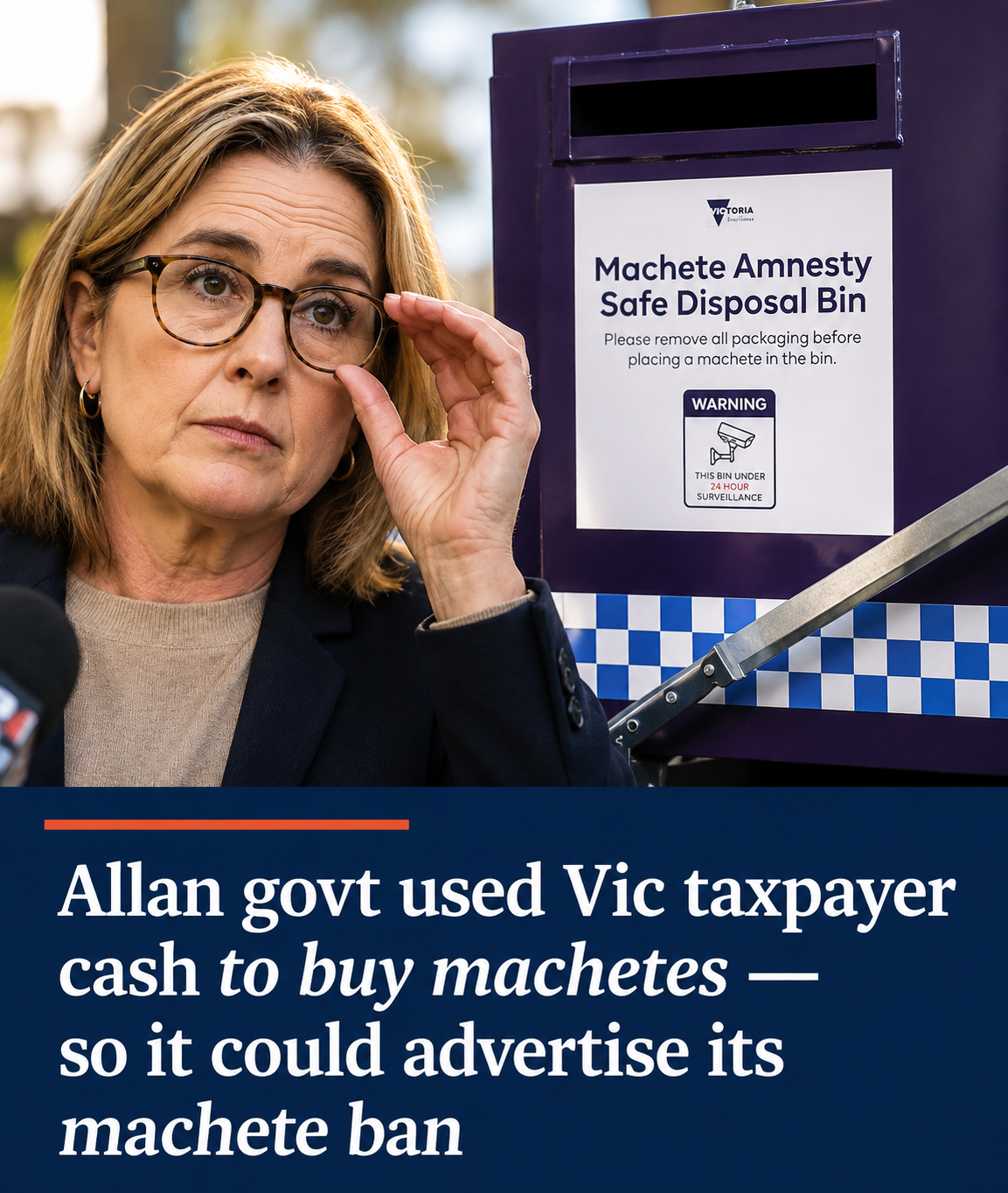
Fresh scrutiny has fallen on the Victorian Government’s machete ban after newly revealed documents showed taxpayers funded a $3.6 million advertising campaign promoting the reforms, reigniting debate over how public money is being spent in the state’s battle against violent crime.
The revelations have attracted significant attention because they arrive at a time when knife crime, youth violence and public safety remain among the most frequently discussed issues in Victorian politics.
While the government argues the campaign was necessary to inform the public about new laws and encourage the surrender of prohibited weapons, critics question whether millions of dollars should have been spent on advertising when many Victorians are demanding stronger enforcement and visible results.
The controversy centres on official documents showing the scale of spending associated with the machete ban rollout.
According to details revealed through Freedom of Information requests, approximately $3.6 million was spent promoting the reforms through television, radio, print, digital advertising and community awareness campaigns. The figure exceeded the amount reportedly spent on manufacturing disposal bins and destroying surrendered weapons.
One aspect of the expenditure has generated particular interest.
Documents indicate part of the campaign involved filming material in Sydney after a planned Melbourne location was reportedly unavailable. Additional costs were incurred for production activities, including the purchase of machetes used as props in the advertising campaign.
That detail has become a lightning rod for criticism.
For many observers, the idea of government funds being used to purchase machetes for an anti-machete advertising campaign appears contradictory, even if the items were obtained solely for filming purposes.
Supporters of the campaign argue the criticism misses the broader objective.
They point out that large public safety campaigns routinely require visual demonstrations, professional production and widespread distribution if governments want to ensure the public understands new laws and regulations.
The Allan Government has defended the expenditure, arguing that the campaign reached millions of Victorians and helped explain both the new restrictions and the weapon surrender process. Officials have also highlighted the number of weapons handed in during the amnesty period as evidence that public awareness efforts achieved tangible results.
Yet the political challenge remains.
Public confidence is often shaped not only by outcomes but by perceptions of value for money.
When governments spend millions on advertising, voters naturally ask whether those funds could have been directed elsewhere.
That question has become particularly sensitive in Victoria, where concerns about government debt, public spending and cost-of-living pressures continue to dominate political debate.
The machete ban itself emerged after a series of highly publicised incidents involving edged weapons, including violent confrontations in public places that generated widespread concern among residents. The government responded by introducing some of Australia’s toughest restrictions on machete ownership and establishing an amnesty program to remove weapons from circulation.
The policy received strong public support from many Victorians who wanted tougher action against knife crime.
However, questions about implementation have persisted since the beginning.
Critics have challenged whether disposal bins, advertising campaigns and awareness programs address the underlying causes of violent offending. Others argue that removing thousands of weapons from circulation is a worthwhile outcome regardless of how the program is delivered.
The broader issue extends beyond machetes.
Governments frequently face a difficult balancing act when introducing major reforms. New laws require public awareness. Public awareness campaigns require funding. But every dollar spent on communication is a dollar that cannot be spent elsewhere.
That tension becomes especially visible when the reforms relate to crime and public safety.
Voters generally want both effective enforcement and responsible spending. Achieving both simultaneously is often easier said than done.
The latest revelations have therefore reignited a familiar debate inside Victorian politics.
Is success measured by the number of weapons surrendered? By reductions in crime? By public confidence? Or by how efficiently taxpayer money is spent?
The answer may depend largely on political perspective.
What is certain is that the machete ban remains one of the most closely scrutinised policies of the Allan Government. With state politics becoming increasingly competitive and public spending under greater examination, every dollar attached to the program is likely to continue attracting attention.
As Victorians assess the results of the reforms, the discussion is no longer focused solely on machetes themselves. It has evolved into a broader conversation about government priorities, public safety and whether major policy announcements are delivering the outcomes taxpayers expect.






