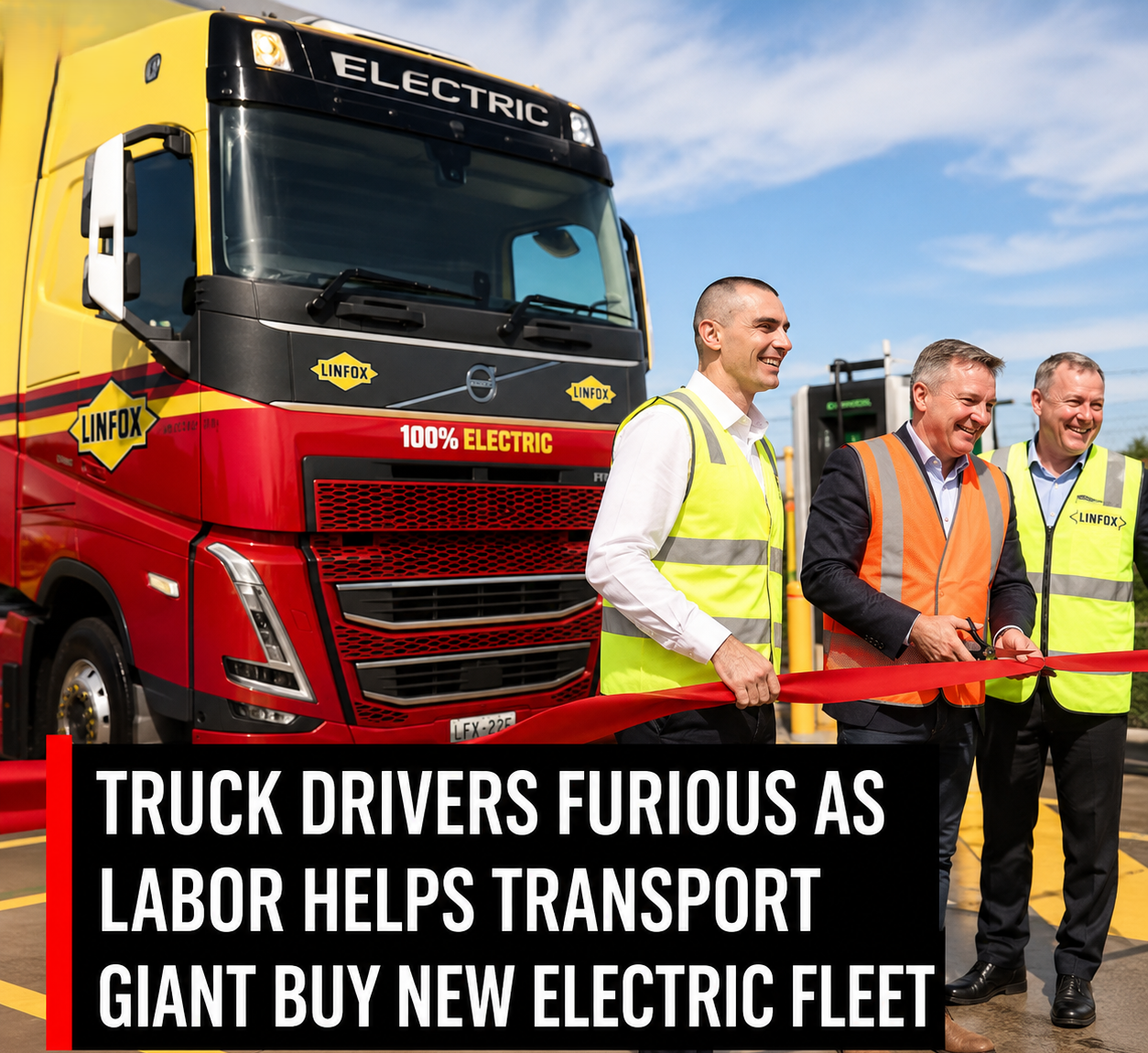
A government-backed push to expand Australia’s electric truck fleet has ignited debate across the transport industry after one of the country’s largest logistics companies received almost $20 million in funding to help roll out new battery-powered vehicles.
The funding package, worth approximately $19.6 million, is linked to plans by transport giant Linfox to expand its electric truck operations as part of a broader transition toward lower-emission freight transport. The company has been trialling electric trucks for several years and is building supporting charging infrastructure alongside the fleet rollout.
Supporters argue the investment represents an important step toward modernising Australia’s freight industry and reducing emissions from one of the economy’s most fuel-intensive sectors.
Critics, however, have questioned whether taxpayers should be helping fund electric vehicles for a major private company at a time when many Australians remain focused on cost-of-living pressures.
The controversy has generated strong reactions across social media and trucking communities, where some drivers have raised concerns about range limitations, charging times and the practicality of electric trucks for long-haul freight routes.
Those concerns are not unique to Australia.
Around the world, governments and transport companies are experimenting with different approaches to reducing freight emissions while maintaining efficiency and reliability.
Heavy transport presents a particular challenge because trucks often travel long distances, operate under tight schedules and carry substantial loads.
For that reason, the transition away from traditional diesel vehicles is generally more complex than the shift occurring in the passenger vehicle market.
Industry advocates argue that early investment is necessary if Australia wants to remain competitive as transport technology evolves.
They point out that major freight operators often serve as testing grounds for new technologies before wider adoption becomes commercially viable.
Linfox has already been involved in electric truck trials and has publicly committed to lowering emissions through a combination of vehicle electrification, rail freight expansion and investment in supporting infrastructure.
According to company statements, electric trucks are already being used in selected freight operations, including supermarket distribution networks in major cities.
Yet questions remain about how quickly the technology can scale.
One of the biggest challenges is charging infrastructure.
Unlike conventional fuel stations, large-scale charging networks for heavy vehicles remain relatively limited.
Research into electric freight systems has consistently identified charging availability, charging times and operational planning as critical barriers that need to be addressed as fleets expand.
Those practical realities help explain why opinions on the grant remain sharply divided.
Supporters see the funding as a long-term investment in cleaner transport and future technology.
Critics see it as corporate assistance being provided during a period when households and small businesses are facing significant financial pressure.
The debate also highlights a broader political challenge facing governments around the world.
Climate targets often require substantial investment before benefits become fully visible.
At the same time, voters frequently judge policies based on their immediate impact on living costs, jobs and public spending.
Balancing those competing priorities has become one of the defining issues in modern politics.
For Australia’s transport industry, the conversation is likely to continue long after the current controversy fades.
Freight operators know that pressure to reduce emissions is unlikely to disappear.
They also know that reliability, affordability and operational efficiency remain essential to keeping goods moving across a vast country.
The question now is whether electric trucks can eventually satisfy all three requirements at the scale Australia’s economy demands.
As governments, transport companies and taxpayers continue to debate the answer, the latest funding decision has become another flashpoint in the larger discussion about Australia’s energy transition and economic future.






