Pauline Hanson has spent three decades surviving political scandals, media pile-ons and predictions of her political extinction.
But conservative commentator Andrew Bolt says her decision to record a podcast with British far-right activist and convicted criminal Tommy Robinson may represent something more dangerous for the One Nation leader: a self-inflicted mistake at precisely the moment she can least afford one.
What was Hanson thinking?
That is the question at the centre of Bolt’s extraordinary attack on a politician whose voters he has often argued are misunderstood and unfairly demonised by Australia’s political and media establishment.
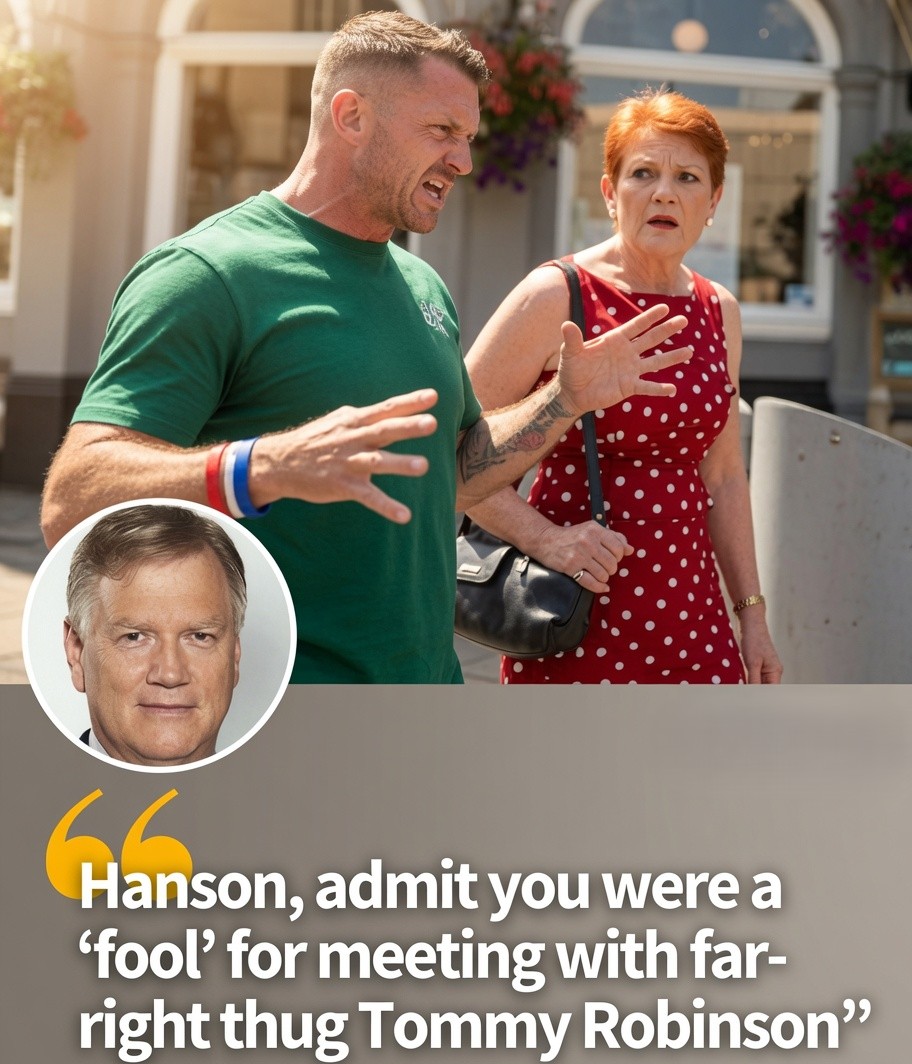
This time, however, Bolt is not blaming the establishment.
He is blaming Hanson.
During a visit to Britain, the One Nation leader met Robinson, toured his hometown of Luton with him and sat down to record a podcast interview.
Robinson, whose real name is Stephen Yaxley-Lennon, enthusiastically promoted the encounter.
He described Hanson as one of the “bravest” women in politics and suggested she could become Australia’s next leader.
For Hanson, who has built a political career on challenging immigration policy, multiculturalism and what she describes as the threat of radical Islam, a conversation with Robinson may have seemed like a meeting with someone fighting similar cultural battles in Britain.
Bolt’s argument is that this explanation is nowhere near good enough.
Robinson is not simply a controversial commentator with unpopular opinions.
He is one of Britain’s most divisive far-right activists and has a lengthy history of criminal convictions and court proceedings.
His record includes convictions connected to violence, fraud and public order matters. He has also repeatedly faced contempt of court proceedings.
In October 2024, Robinson was jailed for 18 months after admitting contempt of court by breaching a High Court injunction that prohibited him from repeating false allegations about a Syrian schoolboy.
He was released early in 2025 after the High Court reduced his sentence.
Robinson was later cleared in November 2025 of a separate terror-related offence involving his refusal to provide police with access to his phone during a border stop. The court found the stop had been unlawful.
The distinction matters.
Not every allegation against Robinson has resulted in a conviction and his supporters regularly argue that he has been unfairly targeted because of his political views.
But Bolt’s criticism of Hanson does not depend on pretending every accusation against Robinson is true.
It rests on Robinson’s established public and criminal history.
For Bolt, that history should have been enough to make Hanson stay away.
The political contrast with Nigel Farage is particularly damaging.
Hanson was also expected to meet Farage, the leader of Britain’s Reform UK and one of the world’s most successful contemporary right-wing populist politicians.
Farage has spent years trying to distance his movement from Robinson.
That has not always pleased activists on the British right.
But Farage’s political calculation has been clear: if a populist movement wants to win mainstream votes and become a serious electoral force, it must decide who belongs inside its political coalition and who does not.
Bolt believes Hanson has failed that test.
His criticism arrives at a critical stage in One Nation’s development.
For much of Hanson’s political career, controversy itself was a form of political oxygen.
When major parties ignored her, a provocative statement could force them to respond.
When television networks attacked her, the confrontation reinforced her argument that Australia’s political and media elites despised ordinary voters who shared her concerns.
When critics called One Nation extreme, Hanson could point to issues such as immigration, cost-of-living pressure and social cohesion and argue that the mainstream parties were refusing to discuss problems visible to the public.
That political model helped Hanson survive.
But survival is no longer One Nation’s only objective.
The party is attempting to grow.
It is trying to recruit candidates, build permanent political infrastructure and convert voter frustration with Labor and the Coalition into lasting electoral support.
That changes the cost of controversy.
A protest party can live from scandal to scandal.
A party that wants to become a durable political force must persuade voters it can exercise judgment.
It must also attract candidates who have careers, families and reputations they are unwilling to gamble on an organisation that could be dragged into an international extremist controversy without warning.
This is the danger Bolt sees in Hanson’s meeting with Robinson.
The immediate political problem is not simply that Labor, the Greens or progressive commentators will condemn her.
They were likely to condemn Hanson anyway.
The greater problem is what the association says to potential One Nation voters and candidates who are conservative on immigration, worried about radical Islam or angry with the major parties but do not want to be associated with Britain’s far right.
Those voters exist.
In fact, One Nation’s political growth may depend on them.
Bolt’s argument is effectively that Hanson is behaving as though she still needs to shock Australia into noticing her.
She does not.
Australians already know Pauline Hanson.
They know what she thinks about immigration.
They know she opposes multicultural policies she believes divide Australians by race and religion.
They know she has spent decades warning about Islamist extremism.
Whether voters agree with her or despise her, Hanson does not suffer from a lack of political recognition.
Meeting Robinson therefore creates a basic question of political reward and risk.
What did Hanson gain?
A podcast appearance?
Praise from Robinson?
Attention from an international audience already sympathetic to many of her views?
Against those benefits sits an obvious political cost.
Hanson has handed opponents photographs, video and headlines connecting the One Nation leader to one of Britain’s most notorious far-right figures.
She did so voluntarily.
The timing makes the decision even more extraordinary.
Robinson had already become the centre of a major Australian media controversy only weeks earlier.
Former Today host Karl Stefanovic faced intense criticism after interviewing Robinson for his podcast.
The episode was removed shortly after publication, triggering a bitter debate over censorship, editorial judgment and the responsibility of prominent media figures when interviewing extremists.
Stefanovic subsequently left the Nine Network amid the fallout surrounding the controversy.
Hanson then republished the Robinson interview through One Nation’s channels, accusing the network of censorship and defending Stefanovic’s right to conduct the conversation.
There was already a legitimate political debate available to her.
Hanson could have argued that journalists should be permitted to interview controversial figures.
She could have criticised Nine.
She could have defended open debate without personally embracing Robinson.
Instead, she travelled to Britain and met him.
Then she recorded a podcast with him.
Robinson took her around Luton and publicly showered her with praise.
For Bolt, this crossed the line between defending someone’s right to speak and choosing to associate politically with that person.
The difference is important.
A journalist interviewing a controversial activist is not necessarily endorsing the activist.
A politician meeting the same activist, touring his hometown with him and participating in friendly media content creates a different public impression.
Politicians understand the symbolic power of association.
Every photograph is considered.
Every meeting can be interpreted.
Every person granted access to a party leader can become part of the leader’s political identity.
That is why major political parties employ advisers whose job is partly to ask a brutally simple question before an event: how will this look?
In Hanson’s case, the answer was predictable.
The images would be described as the One Nation leader “cosying up” to Robinson.
His criminal history would be republished.
His past involvement in far-right organisations would be examined.
His most inflammatory statements would return to Australian headlines.
And Hanson would be asked why she chose to meet him.
None of this required hindsight.
It was the inevitable political consequence of the meeting.
Bolt’s frustration appears to come from his belief that Hanson should now be politically experienced enough to understand that.
She is not a first-term protest candidate.
She first entered federal Parliament in the 1990s.
She has been expelled from a major party, founded her own political movement, lost office, been imprisoned after convictions that were later quashed, returned to national politics and rebuilt One Nation.
Few Australian politicians have experienced more controversy.
Few understand the power of media imagery better.
That makes the Robinson meeting harder to dismiss as political naivety.
Bolt has challenged Hanson to explain whether she knew the full extent of Robinson’s record before meeting him.
If she did not, the question becomes one of political competence.
How could the leader of an Australian political party record a podcast with such a controversial international figure without proper background checks?
If she did know, the problem becomes more serious.
Why did she decide his history was not enough to prevent the meeting?
Bolt’s proposed solution is blunt.
Hanson should admit she was a fool.
Political leaders rarely enjoy making such admissions.
Hanson, in particular, has built much of her appeal on refusing to apologise when opponents demand it.
Backing down can be interpreted by her supporters as surrendering to the same media and political establishment she has spent her career fighting.
But Bolt’s criticism comes from a different direction.
He is not demanding Hanson abandon her concerns about immigration or Islamist extremism.
He is arguing that those concerns become easier for opponents to dismiss when she associates with figures such as Robinson.
This is a strategic problem that has confronted populist parties across Western democracies.
Movements built on public anger often attract people with radically different ideas about where political boundaries should sit.
Some voters want lower immigration.
Some want stronger integration policies.
Some are concerned about religious extremism.
Others hold genuinely racist or extremist views.
A political leader attempting to turn that broad anger into electoral power must draw lines.
If the lines are unclear, opponents will draw them instead.
They will select the most extreme person associated with the movement and argue that this person represents everyone inside it.
Farage appears to understand this political reality.
Whatever critics think of Reform UK, he has repeatedly rejected attempts to bring Robinson into his movement.
Farage has said Robinson is not suitable for his party.
That decision has allowed him to argue that Reform’s policies on immigration and national identity should be judged on their own terms rather than through Robinson’s record.
Hanson has now made that separation much harder for herself.
And she has done so as One Nation faces perhaps its greatest opportunity in years.
The party has been gaining attention amid deep voter dissatisfaction with Australia’s political establishment.
Cost-of-living pressure remains a defining concern for households.
Immigration and housing have become central political arguments.
Trust in the major parties has been strained.
One Nation is trying to expand its organisation and position itself as more than a vehicle for Hanson personally.
In Victoria, the party is preparing to capitalise on voter anger ahead of the state election.
That requires candidates.
Not merely angry candidates.
Credible candidates.
People who can stand in front of a local community, discuss hospitals, roads, schools, energy and the cost of living, and convince voters they are capable of participating seriously in government.
Bolt’s warning is that the Robinson controversy could repel exactly those people.
A successful professional considering One Nation may agree with Hanson on immigration.
They may believe Labor has moved too far left.
They may be frustrated with the Coalition.
But will they put their name on a ballot paper if they fear waking up to photographs of their party leader touring Luton with Tommy Robinson?
If mainstream conservatives leave, the party risks attracting more extremists.
Then the extremists become evidence that One Nation is extreme.
The cycle reinforces itself.
That is the political trap Bolt believes Hanson is approaching.
The controversy also raises a broader question about the difference between free speech and political endorsement.
Robinson has a right to speak within the law.
Australians have a right to listen to him.
Journalists have a right to interview him.
Politicians can defend those principles without pretending that every speaker is a suitable political ally.
Free speech does not require friendship.
Opposing censorship does not require a podcast tour.
And believing that radical Islam should be discussed does not require embracing every activist who claims to fight it.
That is the distinction Hanson must now explain.
Her supporters may dismiss the criticism as another attempt to smear One Nation through guilt by association.
They may argue that Hanson should be able to speak to anyone.
They may also point to Robinson’s 2025 acquittal on the terror-related charge as evidence that authorities have at times overreached in dealing with him.
Those arguments do not erase his established record.
Nor do they answer Bolt’s central political question.
Why him?
Why now?
And what did One Nation gain that was worth the obvious damage?
Hanson has survived bigger controversies than this.
It would be foolish to predict that one podcast will end her political career.
Her supporters have repeatedly demonstrated that attacks from the media can strengthen their loyalty rather than weaken it.
But Bolt’s warning is not primarily about Hanson’s existing supporters.
It is about the voters One Nation does not yet have.
It is about the candidates the party still needs to recruit.
It is about the difference between leading a permanent protest and building a serious political force.
Pauline Hanson has spent 30 years demanding that Australians take her political concerns seriously.
Andrew Bolt’s message is that seriousness requires judgment.
And by sitting down with Tommy Robinson, Hanson may have handed her enemies the argument they have always wanted to make.
The question now is whether she doubles down — or admits that, this time, she got it wrong.






