A senior British military official’s rebuttal of Malcolm Turnbull has exposed a central question behind Australia’s submarine plans: how much confidence should Australians place in delivery assurances when the ships, workers and industrial capacity are still being assembled?
Major General Mark Totten, the British defence official overseeing nuclear-powered submarine capability, rejected the former prime minister’s suggestion that UK shipbuilding was in disarray. Speaking to The Australian Financial Review, Totten disputed Turnbull’s assessment and argued that Britain’s submarine industry was expanding. The significance of his intervention was not simply the blunt disagreement. It was that a senior official responsible for the program was addressing one of its most recognisable Australian critics on the issue most likely to determine whether a massive defence investment delivers operational vessels.
Turnbull’s objections are substantial and longstanding. In a National Press Club address, the former prime minister questioned the risk assumed by Australia under the AUKUS submarine arrangement. He argued that the proposed transfers of American Virginia-class submarines depended on decisions Australia could not control, including US naval requirements and production capacity. He also expressed deep scepticism about the timetable for the future UK-designed SSN-AUKUS boats, describing the British project as troubled and warning that Australia’s existing Collins-class fleet could age out before replacements arrived.
The British defence official’s response did not mean that those underlying risks had disappeared. Nor did Turnbull’s warnings prove the agreed program would fail. Both sides are making judgments about industrial performance, strategic necessity and future decisions. The distinction matters because forecasts about ships not yet delivered are different from verified facts about ships already in service. The most useful way to read their disagreement is as a dispute over the burden of proof.
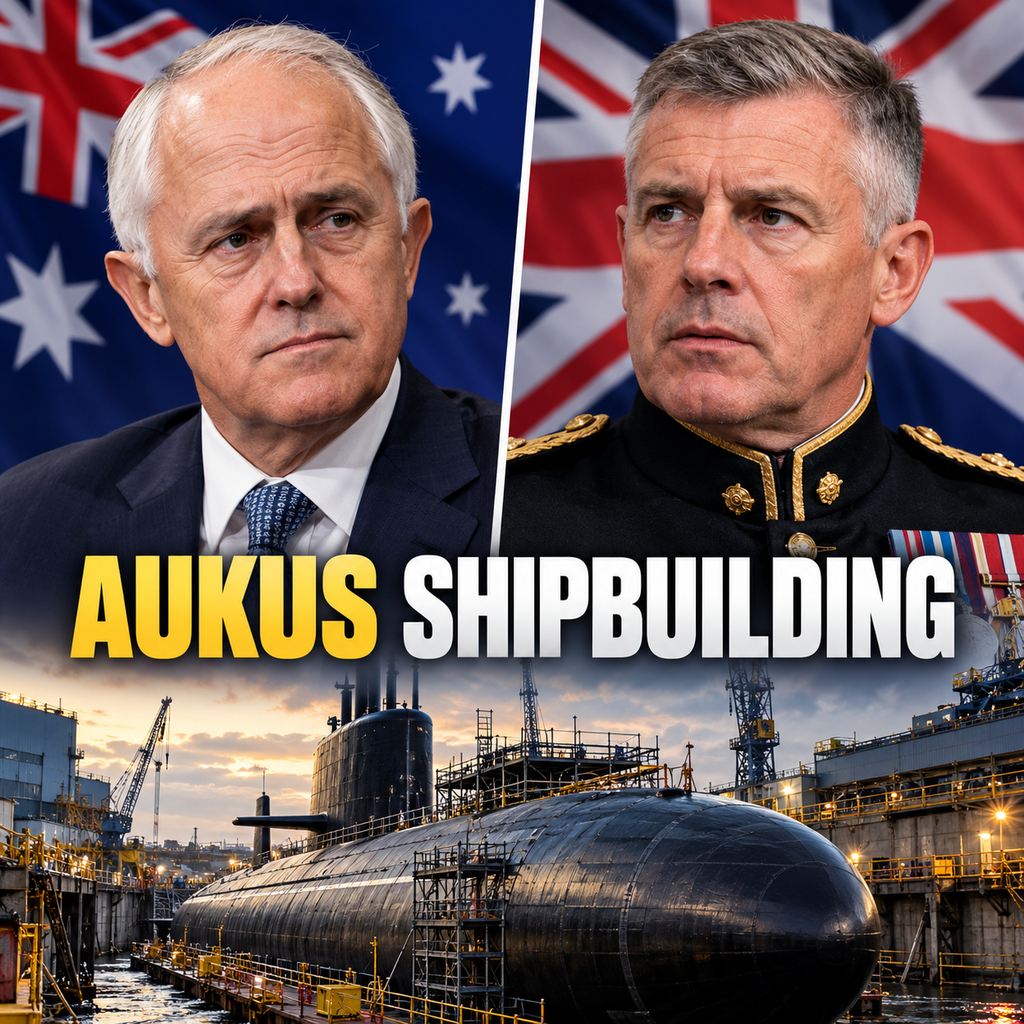
The program envisages two intertwined pathways. Australia expects to acquire US-built Virginia-class submarines before Australian-built SSN-AUKUS boats are available. In parallel, Canberra, London and Washington are developing the workforce, infrastructure, maintenance capability and nuclear stewardship systems needed for a new Australian fleet. A submarine partnership is therefore not a single purchase order. It is a series of connected undertakings, and weakness in one country’s industrial base can have consequences elsewhere.
Turnbull has repeatedly challenged whether those dependencies have been explained clearly enough to the public. His speech set out the requirement that an American president certify, before transfers, that supplying boats to Australia would not degrade US undersea capabilities and that the industrial base could meet both countries’ needs. That condition was not a hypothetical invented by the former prime minister. It represents a genuine strategic dependency: Australia cannot compel Washington to part with a submarine regardless of American fleet pressures.
Yet the UK contribution raises separate questions. The industrial resources used to design and build a new class of nuclear-powered submarine are not interchangeable with commercial shipyard capacity. Nuclear propulsion, highly specialised steel fabrication, reactor construction, complex electronics and security-cleared labour all require long-term investment. When Totten argued that Britain’s capacity was increasing, that addressed the direction of industrial investment. It did not by itself settle the pace, productivity or risk of delivering a demanding new design.
The distinction cuts in both directions. A project can encounter costly setbacks while still producing a usable military capability. Equally, a commitment to hire workers and build facilities is not proof that eventual launch and acceptance dates will be met. Independent scrutiny must ask which milestones are complete, which remain targets and which have slipped. That is more informative than treating either a warning or a reassurance as the final verdict.
The Australian financial stake makes this debate more than a contest of personalities. Turnbull described the flow of Australian money towards the defence industrial bases of two allies as placing pressure on other military priorities. His argument was that a very large submarine commitment should not crowd out investments needed for a sovereign capacity to defend Australia in the near term. Defenders of AUKUS, in contrast, consider nuclear-powered submarines a capability that Australia could not realistically create on its own and argue that investment in partners is necessary to secure it.
That trade-off deserves close attention. Money directed to submarine infrastructure and overseas production cannot automatically be treated as wasted simply because it does not immediately produce an Australian boat. Training crews, building maintenance facilities and expanding a supply chain are prerequisites for operating the vessels. But they are also not substitutes for the vessels themselves. If the delivery chain breaks, Australians could be left with expensive preparation for a capability that arrives later than intended.
The military consequences are equally concrete. The Collins-class fleet forms a crucial part of Australia’s undersea force. Any transition to a new generation involves years of training and engineering work even if ship construction runs smoothly. Crews have to qualify, maintenance systems must be established, and supporting ports and security arrangements must be ready. Risk is not limited to a headline delivery year; it includes the possibility that operational readiness lags behind physical handover.
Turnbull’s position is that governments should develop and openly test alternatives rather than simply assume the program succeeds. He has pointed to the possibility of different submarine designs or other defence capabilities as issues worth examining. Those alternatives are not straightforward fixes. Switching direction could entail new political agreements, design changes, costs and delays of its own. Nor is a conventional submarine a direct like-for-like replacement for a nuclear-powered attack boat. A credible comparison would have to account for range, endurance, sustainment, training and the strategic missions envisaged for Australia’s navy.
Totten’s rebuttal is important precisely because it pushes back against the suggestion that the UK’s shipbuilding problems are terminal. Britain is investing in the industrial capacity and expertise needed to meet its submarine commitments. That is an identifiable response to criticism, not merely a statement of enthusiasm. But the reported assurance that the program is on track should remain attributed to him, not rewritten as an independently verified result. Delivering a complex defence project depends on evidence over many stages rather than a single official’s confidence.
Some public commentary also treats the British and American parts of AUKUS as if they face identical obstacles. They do not. The timing of Virginia-class sales involves US construction and certification decisions; the SSN-AUKUS project involves a new submarine design and British-Australian industrial development. If one element succeeds, it will not automatically cure problems in the other. Conversely, a challenge in one yard does not establish that every submarine under the wider arrangement is undeliverable.
There is an accountability question for the Australian parliament. Lawmakers must decide what evidence is required to reassure voters that the program represents a defensible use of public money. Officials can publish realistic milestones, explain schedule risks, identify contractual and sovereign dependencies, and clarify what contingency planning exists. Where security restrictions prevent full disclosure, an explanation of the limits of public information can still be more honest than suggesting there is no uncertainty.
The clash also reflects a larger disagreement about what sovereign defence means. For Turnbull, dependence on another government’s future political decision is a vulnerability to be acknowledged. For those directing AUKUS, security comes through deeper practical integration with partners whose industrial resources exceed Australia’s own. Both approaches are attempting to solve a real Australian problem: how to sustain credible deterrence over a maritime area too large for the country’s current fleet to cover alone.
The oversight challenge is especially demanding because some claims cannot be fully tested in public. Submarine construction schedules may contain classified assumptions about systems, availability and deployments. That limitation is real, but not absolute. Governments can still release broad milestones for workforce numbers, yard upgrades, project expenditure, training and industrial performance. Parliamentary committees can scrutinise sensitive details through established processes, while independent financial audits can examine spending without disclosing operational secrets. An all-or-nothing choice between complete public disclosure and blind trust is not the only option. Transparency can be designed around the genuine security boundaries.
Another issue is the accountability of forecasts. When a government quotes a delivery target, it should explain what conditions make that target achievable. Are sufficient skilled workers available? Are design approvals and industrial facilities ready? Have contingency reserves been included? How are contractors’ risks monitored? Answers do not require certainty about the future; they require clarity about assumptions. Once an assumption changes, a schedule should be revised openly rather than preserved as political reassurance. That makes both optimistic claims and sceptical predictions more useful to decision-makers.
The submarine partnership is also a major test of industrial policy in South Australia and Western Australia. Defence investment can support skilled employment, manufacturing and technical education, but the amount of work completed in Australia depends on actual contracts and capacity. Claims that every dollar spent overseas represents a lost domestic job would be too simple, just as promises of economic transformation should not be taken as guaranteed. Training personnel abroad may be essential to building a domestic workforce. The important question is what capability and work remain in Australia when the transfer of knowledge is complete.
Finally, the program cannot be judged solely by ship construction. Nuclear-powered submarines place long-term demands on regulatory oversight, reactor safety, maintenance and waste management. Australia’s preparations therefore involve commitments extending far beyond the acceptance of a first vessel. The public interest is served when politicians explain how those responsibilities will be funded and governed, including their effect on other defence capabilities. Turnbull’s criticisms invite scrutiny of those trade-offs; Totten’s rebuttal invites scrutiny of Britain’s ability to deliver its part. Both arguments improve only when linked to verifiable milestones rather than confidence or alarm alone.
Neither a critic’s dramatic language nor an official’s confidence should close that conversation. Australians need to know not only whether the partners still support AUKUS but also how they will measure delivery, what happens if important milestones slip and who bears the financial and operational consequences. Totten has forcefully rejected Turnbull’s diagnosis of British shipbuilding. The tougher test for all three governments will be whether construction, training and acceptance records ultimately support that confidence.






