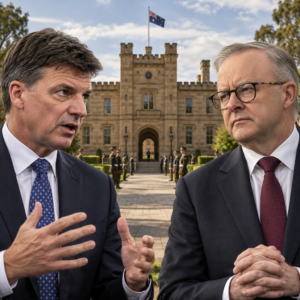
Opposition Leader Angus Taylor and shadow treasurer Tim Wilson have released costings for $31.3 billion in proposed savings over four years, setting up a conflict with Labor over inflation, the budget and the future of housing and clean-energy programs. Treasurer Jim Chalmers disputes the Coalition’s claim that government spending is driving household mortgage pressure.
The package was unveiled on Monday with estimates prepared by the independent Parliamentary Budget Office for specified measures. Taylor presented it as an initial payment towards the opposition’s tax agenda and a demonstration of fiscal restraint. The document covers only part of the Coalition’s proposed policy changes. It should not be described as a complete election platform or evidence that every promise has been independently funded.
Wilson argued that government spending was contributing to inflation and higher mortgage rates. Chalmers responded that the government was budgeting responsibly and pointed to plans for further savings. The dispute occurs before another Reserve Bank interest-rate decision. That timing matters politically, but no single budget announcement can prove what the central bank will decide or whether a particular borrower’s repayments will rise.
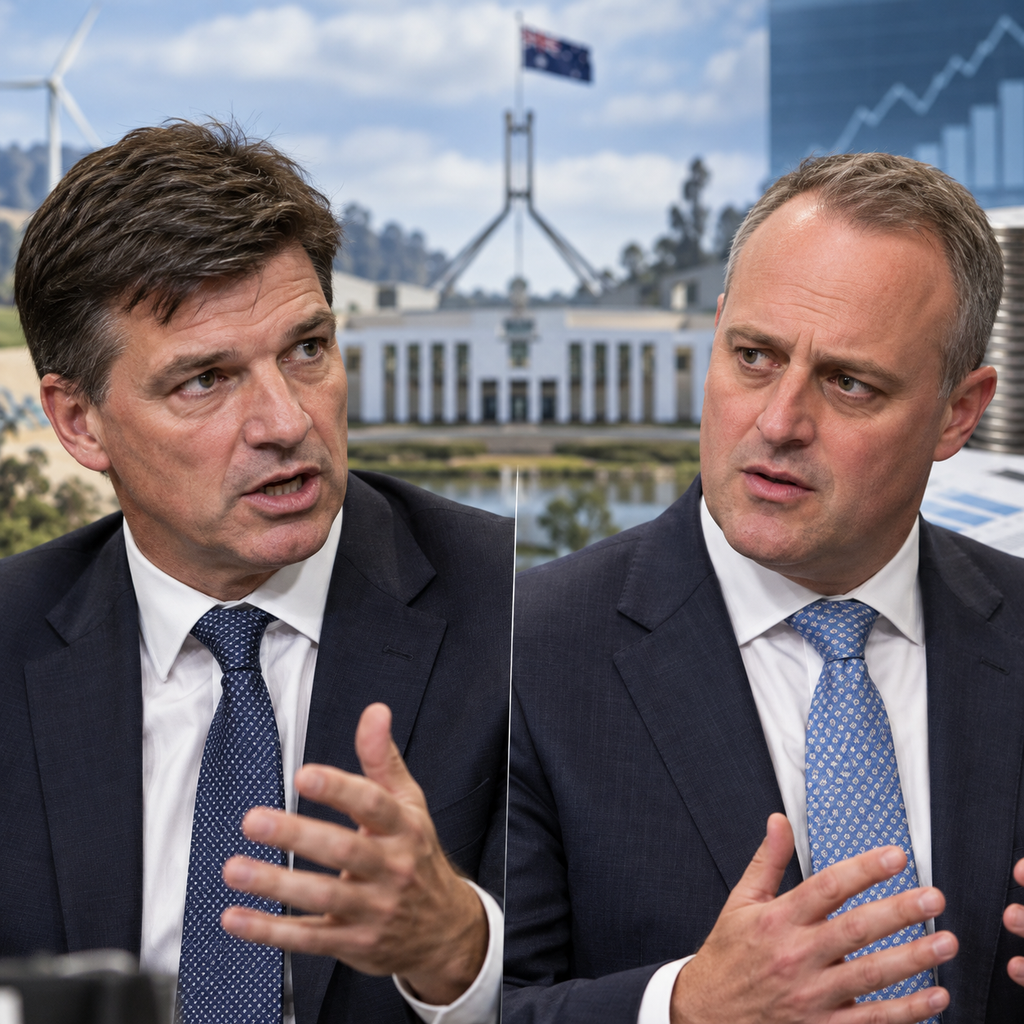
More than half of the announced savings comes from reversing climate and industry measures. According to ABC reporting, roughly $9.4 billion would come from scrapping a group of policies including the new vehicle efficiency standard, electric vehicle discount, home battery subsidies, the net zero advisory body, some functions of ARENA and business Scope 3 emissions reporting. A further $7.3 billion would come from ending specified supports for green aluminium, hydrogen, critical minerals and other industrial initiatives.
Those two climate and industry groupings are politically important because they bundle policies with different purposes. An EV tax concession, a household battery subsidy and an industry grant each reach different users and influence different investment decisions. The published costings aggregate the totals rather than provide a complete household-by-household distribution. Savings to the Commonwealth do not automatically tell consumers what they would pay as a result.
Housing is another major source of proposed savings. The opposition estimates about $4.7 billion from cancelling or changing Labor measures including Help to Buy, the Housing Australia Future Fund, build-to-rent tax incentives and payments to states linked to housing supply. Critics of the cuts may argue that they reduce support for new construction and first-home buyers; Coalition advocates can argue that existing programs are ineffective or represent spending priorities the budget cannot sustain.
Those competing claims need to be tested against the actual function of each program. Help to Buy assists eligible buyers through a shared-equity arrangement. The housing fund supports social and affordable housing investment. Build-to-rent incentives aim to alter the economics of large rental developments. Removing all of them has different implications from tightening one eligibility criterion, and a four-year budget saving does not capture every possible long-term supply effect.
The Coalition also proposed reducing eligibility for welfare payments and the National Disability Insurance Scheme for permanent residents and other non-citizens, producing an estimated $2 billion in savings. That is a particularly consequential change because permanent residents may have established homes, jobs and family responsibilities in Australia. The proposal is not current law, and its precise effects would depend on definitions, exemptions, transition rules and the way eligibility changes are implemented.
The ABC reported a further projected $7.9 billion in savings associated with reducing tobacco excise and legalising vapes. That estimate partly depends on assumptions about a shift from illicit to legal tobacco sales. Such modelling is not a guarantee that consumer behaviour or tax receipts will follow projections. Public-health consequences would also require separate evaluation, rather than being assumed from the fiscal number alone.
The Coalition says its $31.3 billion package exceeds the estimated $9.7 billion cost of its announced tax changes. That comparison is arithmetically meaningful for the proposals included, but the reporting says several other opposition commitments are not fully costed in the same document. These include parts of its approach to capital gains, negative gearing, superannuation, migration and defence. Voters should be told exactly what a claimed budget balance includes and what is still outside the calculation.
The role of the PBO also needs precision. The office supplies independent estimates based on stated policy specifications and modelling assumptions. It does not endorse the political wisdom of a measure or guarantee that all behavioural responses will match estimates. A PBO cost can support a statement about a policy’s projected effect on the budget. It cannot, by itself, prove that the policy is fair, economically optimal or certain to lower inflation.
Inflation is influenced by several forces beyond discretionary Commonwealth spending. Supply disruptions, commodity prices, wages, private demand, housing constraints and global monetary conditions can all matter. Excess public demand may contribute, but the scale and timing require economic analysis. Wilson’s attack on Labor is a political interpretation; Chalmers’s defence is another. Neither should be mistaken for a Reserve Bank determination about the direct cause of the next rates move.
The practical consequences for a household can run in opposite directions. An income-tax change may increase take-home pay for one taxpayer. Removing a battery or housing subsidy could raise a planned purchase cost for that same person. A permanent resident might face a more substantial reduction in access to support. Some Australians may benefit from lower taxes while others experience lower program availability, so the net impact cannot be inferred from the headline saving.
Supporters of spending cuts may argue that future generations should not be burdened with debt for programs that do not deliver value. Critics may argue that failing to invest in housing supply and technology raises longer-term costs. Those are legitimate policy positions. The strongest reporting will ask each side to show evidence of program performance and to explain which groups bear the adjustment, rather than treating ‘cuts’ or ‘investment’ as automatically positive.
The release is politically unusual because opposition costings often appear nearer an election. Putting numbers out earlier allows the Coalition to define its economic argument and challenges Labor to defend particular expenditure items. It also invites scrutiny of omissions and assumptions long before voters must choose. A partial document may be more informative than no costings at all, without being complete enough to settle the entire debate.
The timing of a saving also matters. A four-year cost estimate may capture near-term reductions in spending while missing benefits or liabilities that occur beyond the forward estimates. Energy projects can have substantial upfront costs and effects that persist for years; housing programs may take time to deliver completed dwellings. None of this demonstrates that a particular subsidy is good value, but it does mean that a budget comparison should specify its time horizon.
The same concern applies to distribution. Income-tax changes can be presented as broad relief, but their benefit depends on a person’s taxable income and the structure of the brackets. Savings from changing welfare eligibility fall on a different group. A person who gains through one measure may lose through another, while someone with no income-tax liability could see little benefit from a tax adjustment. Voters need examples grounded in actual legislative specifications before concluding who is better off.
Permanent residence is also different from temporary visitor status. Many permanent residents live and work in Australia on a long-term basis, pay taxes and raise families. A proposed restriction on access to support could affect individuals in vulnerable circumstances, depending on exemptions and transitional provisions. Describing everyone affected simply as ‘foreigners’ would obscure the legal and social distinctions relevant to the policy.
For clean-energy measures, the question is what market behaviour public support is intended to change. Battery incentives seek to make home storage more affordable; industrial funding aims to encourage investments that may otherwise face high initial costs. Critics can legitimately question additionality, value for money and market distortion. Supporters can point to potential deployment, employment and transition benefits. The PBO’s savings estimate alone does not adjudicate these competing evaluations.
Future updates will need to clarify the full cost of promises still excluded, the detailed treatment of existing beneficiaries, and the projected effect on services and revenue. The government will be pressed to explain its own spending outlook and planned December savings. Neither side has produced a definitive answer merely by attacking the other at a press conference.
There is an additional question about whether savings are recurring or concentrated in particular years. A program abolished before it begins may create an apparent saving in the forward estimates without changing existing services immediately. Ending an established benefit may affect current participants much sooner. Forecasts can also change as eligibility, population, inflation and market conditions evolve. These distinctions help explain why independent costing is valuable but insufficient on its own. Voters need to know the specification behind each estimate and when the effects would be felt by households and businesses.
For now the verified development is the publication of a $31.3 billion partial savings package and a direct dispute over whether Labor’s spending is worsening inflation. It is a live argument about priorities, not an enacted budget cut. Readers evaluating the offer should compare the underlying policy choices, the independent estimates and the unresolved commitments before accepting any claim that the total alone solves household cost pressures.