Home Affairs Minister Tony Burke has vowed the Albanese government will “not lift a finger” to help 13 suspected Australian ISIS detainees return home if they are released from prison in Iraq, declaring he will use every legal power available to keep them away for as long as possible.
The blunt warning comes as Iraqi and United States authorities examine foreign detainees accused of links to Islamic State, raising the prospect that some prisoners assessed as non-combatants could eventually be released.
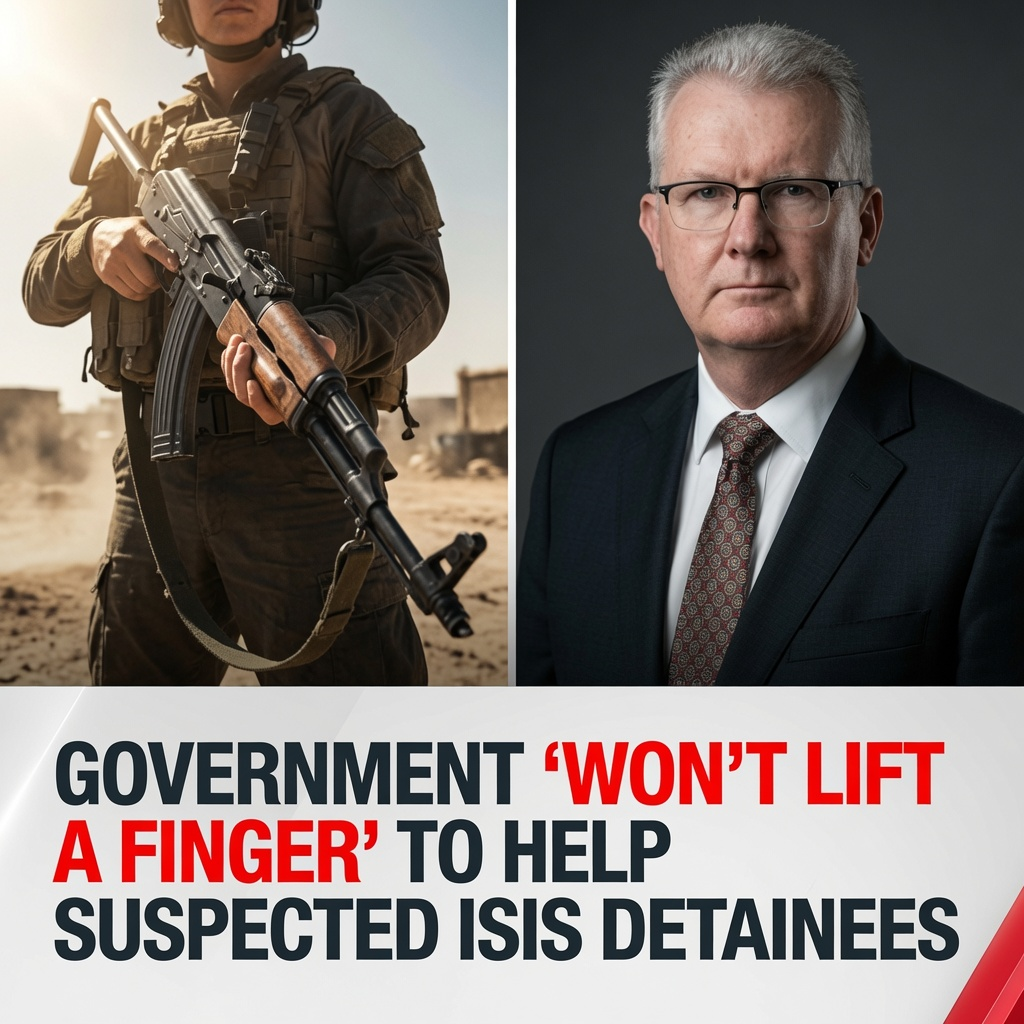
Thirteen men who identify as Australian are understood to be held in Baghdad’s prison system over suspected links to ISIS.
Burke made clear on Monday that Canberra would not treat them like other Australians imprisoned overseas for whom the government might pursue diplomatic or consular efforts to secure a release or return.
“There are times when people are locked up around the world, and the Australian government takes steps to try to get them returned home, not with this crew, absolutely not,” Burke told Sunrise.
“I won’t lift a finger to help them. And wherever we’ve got a legal power to be able to keep them away for longer, we’ll take it.”
The Home Affairs Minister said his position was unequivocal when it came to Australians who had voluntarily travelled overseas to join Islamic State.
“My view is anybody at all who decided to get on a plane to be part of ISIS; my view is anything we can do to restrict your return, if I get that legal option, I take it,” Burke said.
But the political message collides with a difficult legal reality.
If the detainees are Australian citizens and Iraqi authorities eventually release them, the federal government cannot automatically impose a permanent ban preventing them from returning to Australia.
Canberra can use national security powers in circumstances permitted by law, investigate alleged offences and prosecute individuals where sufficient admissible evidence exists.
Security agencies can also manage people assessed as threats using surveillance and other lawful measures.
What the government cannot simply do is permanently exile an Australian citizen on the basis of suspicion alone.
Burke warns of charges or intense surveillance
Burke said any suspected ISIS-linked Australian who returned would face one of two broad scenarios.
If authorities had sufficient evidence to charge the person, police would act.
If investigators could not establish a criminal case but national security agencies remained concerned about the individual, surveillance would become critical.
“And if you do find your way to Australia, then if we can charge you, you get locked up,” Burke said.
“And if we are not in a position with the evidence to be able to charge you, then the surveillance that happens on you needs to occur to keep Australians safe.”
“At the moment, every single one of these people is locked up, and I’ve got no problem with that being the status quo.”
The distinction between suspicion and prosecution has long complicated Australia’s response to foreign fighters.
Islamic State seized large areas of Iraq and Syria, declared a so-called caliphate and committed mass killings, enslavement and terrorist atrocities.
Australians who voluntarily joined the organisation can potentially face serious terrorism offences.
But prosecutors still need evidence capable of proving an individual offence in an Australian court.
That can be exceptionally difficult when the alleged conduct occurred years earlier in an overseas war zone.
Witnesses may have been killed or displaced. Records may have been destroyed. Digital material must be authenticated and intelligence obtained from foreign partners may be sensitive.
An intelligence agency may have strong reasons to assess someone as a national security threat without prosecutors possessing the evidence required to prove a criminal charge beyond reasonable doubt.
That gap helps explain Burke’s emphasis on surveillance.
He specifically named the Australian Security Intelligence Organisation and Australian Federal Police when describing the response to people of national security concern.
“Our agencies, ASIO, the Australian Federal Police, they’re watching individuals; they’re on them,” Burke said.
“The surveillance and the restrictions that people would want is what we deal with.”
Thirteen detainees caught in an Iraqi review
The immediate concern in Canberra has been triggered by a broader process involving detainees held in Iraq.
Iraqi and US officials are reportedly reviewing prisoners suspected of ISIS involvement to determine whether they were combatants or non-combatants.
Thirteen prisoners identifying as Australian are understood to be among those held in Baghdad.
The review has created the possibility that some detainees could be released if authorities conclude they were not fighters.
That does not mean all 13 Australians are about to walk free.
It also does not establish that every man in the group voluntarily joined ISIS or committed the same alleged conduct.
The individual circumstances appear to differ significantly.
One of the Australians identified in reporting is Yusuf Zahab, who was taken to Syria as a child.
Zahab’s circumstances have been distinguished from those of adults alleged to have voluntarily travelled to Islamic State territory.
He disappeared while detained in north-east Syria and was once feared dead before later footage indicated he was alive. Human Rights Watch has previously described his detention as wrongful.
The Department of Foreign Affairs and Trade has reportedly been in contact with his family.
Zahab’s case illustrates why the description “13 ISIS fighters” risks overstating what has been established about every detainee.
Burke’s strongest language was specifically directed towards anyone who “decided to get on a plane to be part of ISIS”.
Whether each detainee falls within that category depends on evidence about the person’s age, circumstances of travel and conduct in Syria or Iraq.
For the Australian government, however, the practical problem begins if an Australian citizen is released.
While a detainee remains inside an Iraqi prison, that person is physically contained.
Once released, an Australian citizen may seek travel documents and attempt to return home.
Temporary exclusion orders cannot impose permanent exile
Burke acknowledged the limits of the powers available to him.
Australia’s Temporary Exclusion Order framework can be used to temporarily restrict the return of certain Australians assessed as posing terrorism-related risks.
A Temporary Exclusion Order can prevent a person from returning to Australia without a return permit for a limited period.
The return permit system can allow authorities to control the timing and circumstances of an individual’s arrival.
That gives security agencies an opportunity to prepare for a return and impose lawful conditions where the statutory requirements are met.
But a Temporary Exclusion Order is exactly that: temporary.
It is not a power to permanently strip an Australian citizen of the ability to return to their country.
Burke said the threshold for imposing an exclusion order was difficult to satisfy.
“It’s a really tough threshold to meet legally,” he said.
“Certainly, I’ve only had one time when the department said that the threshold was met and I was able to put an exclusion order in. I did that straight away.”
Asked whether alleged participation in atrocities such as beheadings should satisfy the threshold, Burke replied: “Oh, well, you would hope so.”
The exchange exposed the tension between what many Australians may expect the government to do and what citizenship and national security laws actually permit.
A foreign national can be refused an Australian visa in circumstances allowed under migration law.
An Australian citizen is in a fundamentally different legal position.
Burke also said citizens were generally entitled to seek an Australian passport through an embassy overseas, while the government’s power to temporarily suspend travel documentation was tightly constrained.
“The only time that you can temporarily suspend one is if somebody is about to engage in an act of violence at that point in time,” he said.
“It’s very tight for citizens.”
The government has already confronted those limits in its handling of Australians linked to ISIS who remained in Syria.
In June, Burke confirmed that an Australian woman previously subject to a Temporary Exclusion Order had been issued a return permit after the government received legal advice about its obligations.
Burke said she would face a “very high level of surveillance” if she returned.
Forty-five Australian men had already returned, Burke says
Burke said 45 Australian men who travelled overseas to fight with ISIS had already returned before the current Labor government took office.
He cited those cases as evidence that Australia’s national security agencies have experience managing people who have returned from overseas extremist conflicts.
Not every person of security concern can necessarily be charged immediately.
Australia has terrorism laws covering conduct including membership of a terrorist organisation, providing support to terrorist groups and engaging in hostile activities overseas.
But the existence of a criminal offence does not remove the need to prove that a particular defendant committed it.
Evidence gathered from former ISIS territory can present serious challenges.
A foreign intelligence service may hold information that cannot safely be disclosed in open court.
A source may require protection.
Surveillance may demonstrate present-day security concerns without proving exactly what someone did in Syria a decade earlier.
Australian authorities have therefore used a combination of criminal prosecution, intelligence monitoring and national security powers when dealing with ISIS-linked returnees.
Burke’s message to the 13 men held in Iraq is that the strongest lawful option will be used against anyone assessed as a threat.
His preference, however, is that the Australian government does nothing to facilitate their return.
Recent ISIS-linked returnees have already been charged
The warning follows renewed controversy over Australians linked to Islamic State returning from Syria.
Earlier in 2026, several Australian women with alleged ISIS connections returned from the region.
Australian authorities subsequently laid serious charges in multiple cases.
In May, two Victorian women were charged by the Victoria Joint Counter Terrorism Team with crimes against humanity offences allegedly committed in Syria.
Police alleged the women exercised powers of ownership over a Yazidi woman in circumstances amounting to slavery.
The charges are allegations and remain before the courts.
In a separate case, another woman was charged with terrorism offences after returning to Australia.
Those prosecutions demonstrate that Australian citizenship does not provide immunity from investigation or arrest for alleged conduct committed in ISIS territory.
They also support Burke’s argument that authorities will act when investigators obtain sufficient evidence.
But the cases reveal the central difficulty confronting the government.
Citizens may have a legal pathway home even when the public and security agencies hold grave concerns about their alleged past conduct.
The government’s task is then to transform intelligence and overseas evidence into a criminal case capable of surviving the Australian court process.
Iraq wants foreign governments to take responsibility for their citizens
The 13 Australian detainees are part of a much larger international problem created by the collapse of Islamic State’s territorial rule.
Thousands of foreign nationals travelled to ISIS-controlled territory from countries around the world.
After the caliphate collapsed, authorities in Syria and Iraq were left responsible for suspected foreign fighters and ISIS-linked families.
Iraq has repeatedly pushed foreign governments to take responsibility for their own nationals.
For Baghdad, indefinitely holding foreign citizens creates security, financial and legal pressures.
For Canberra, the prospect of suspected ISIS members returning to Australia creates an entirely different set of risks.
The two governments do not necessarily have the same interests.
Australia may prefer that a suspected fighter remain detained overseas.
Iraq may conclude it no longer has a lawful or practical basis to continue holding that individual.
Once a foreign government releases an Australian citizen, Canberra has limited ability to control what happens outside Australian territory.
That is why Burke is drawing a sharp distinction between facilitating a repatriation and managing a return that Australia may ultimately be legally required to accept.
The government says it will not organise the first.
It must prepare for the second.
Proving what happened inside ISIS territory remains the hardest task
Public debate often treats suspected foreign fighters as a single group.
The criminal justice system cannot.
Each prosecution requires evidence relating to an individual accused.
Investigators may need to establish when a person travelled, why they entered ISIS-controlled territory, which organisation they joined and what role they performed.
Living in territory controlled by Islamic State is not automatically proof that a person personally committed a specific terrorist offence.
Some defendants may claim they travelled under coercion.
Others may argue they performed civilian roles.
People taken overseas as children present fundamentally different factual and legal questions from adults alleged to have voluntarily joined a terrorist organisation.
Security agencies must also assess current risk rather than focusing only on conduct alleged to have occurred years earlier.
A person may remain committed to violent extremist ideology.
Another individual may have disengaged.
The assessment must be based on intelligence about that person.
This is why Burke’s public language can be uncompromising while the operational response still requires individual case assessments by ASIO, the AFP and other agencies.
“I won’t lift a finger”
For now, the 13 suspected Australian ISIS-linked detainees remain imprisoned in Iraq.
There is no confirmed timetable for the release of the group and the Iraqi review does not guarantee any particular detainee will be freed.
But the possibility has again forced Australia to confront one of the most difficult national security questions left by the Islamic State conflict.
What happens when an Australian citizen suspected of joining or supporting a terrorist organisation is released overseas and wants to come home?
Burke’s political answer could hardly be clearer.
The Albanese government will not lobby for the return of people it believes voluntarily joined ISIS.
It will not actively help them leave Iraqi detention.
Where the law allows a return to be delayed or restricted, Burke says he will use that power.
If an individual arrives in Australia and sufficient evidence exists, the government expects criminal charges to follow.
If prosecution is not immediately possible but security agencies assess the person as a threat, Burke says surveillance and lawful restrictions must be used to protect Australians.
The unresolved problem is that national security powers have legal limits and Australian citizenship cannot simply be ignored by executive order.
Burke acknowledged those limits while making his position unmistakable.
“Wherever we’ve got a legal power to be able to keep them away for longer, we’ll take it,” he said.
And when it comes to the Australian government helping the 13 detainees return from Iraq, his message was shorter still.
“I won’t lift a finger to help them.”






