Home Affairs Minister Tony Burke has delivered a forceful condemnation of One Nation leader Pauline Hanson after controversial comments she made during a podcast appearance with British far-right activist Tommy Robinson reignited debate over Australia’s immigration history, multiculturalism and social cohesion.
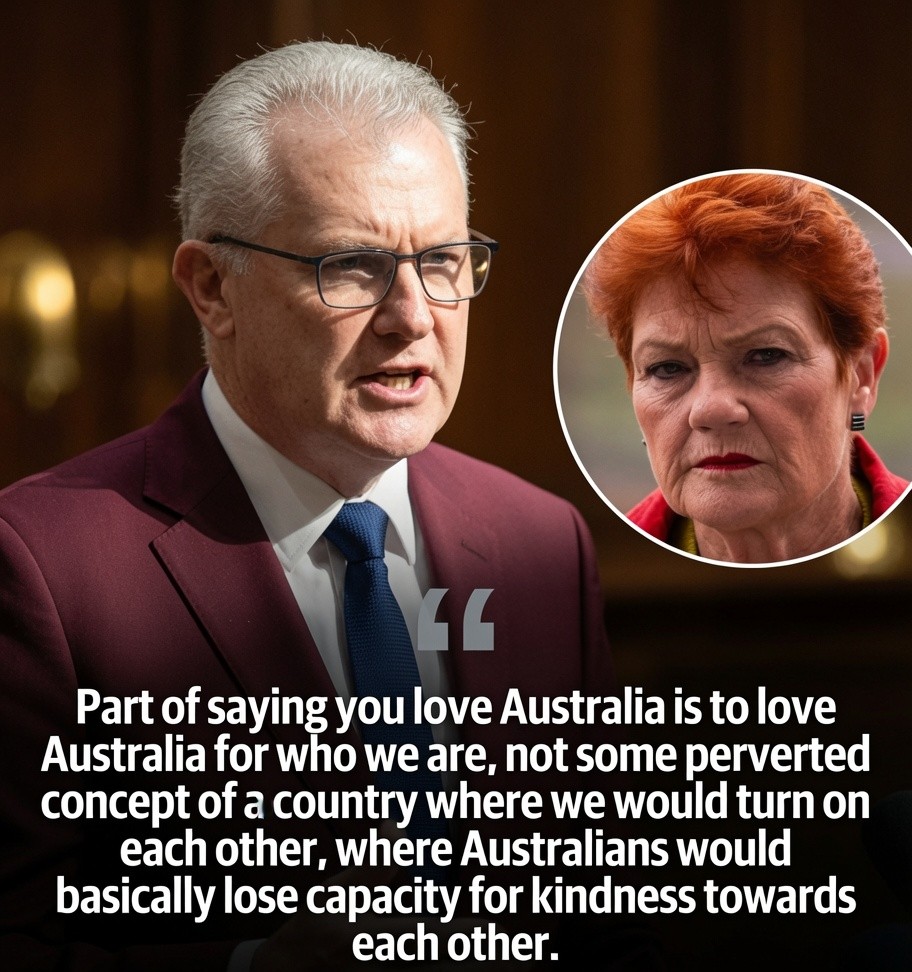
Burke made the remarks while unveiling the Albanese Government’s formal response to Australia’s national report into Islamophobia, arguing that references to the former White Australia policy had no place in modern Australian political discourse.
Speaking at a media conference, the minister described Hanson’s comments as “perverted” and said he never expected to see an elected Australian parliamentarian appearing to defend or romanticise one of the country’s most discriminatory historical policies.
The controversy stems from an interview Hanson recorded in Britain with Tommy Robinson, a far-right political activist whose views have attracted widespread criticism and who has a history of criminal convictions in the United Kingdom.
During the discussion, Robinson asked Hanson when Australia had begun receiving larger numbers of migrants from countries including Pakistan, Sudan and Somalia. Hanson responded by referring to the abolition of the White Australia policy in 1973 and suggested that many of Australia’s current migration challenges began after that change.
The White Australia policy was introduced following Federation in 1901 through a series of immigration laws designed to restrict non-European migration to Australia. Successive governments progressively dismantled the policy during the 1960s before it was formally abandoned under the Whitlam Government in 1973, paving the way for Australia’s modern multicultural immigration system.
Today, the policy is widely regarded as a discriminatory chapter in Australia’s history, and no major political party supports its return.
Burke argued that revisiting the policy in a favourable context undermined decades of progress towards a more inclusive society.
He said Australians had long accepted that the country had moved beyond racially selective immigration and warned that political rhetoric linking migration problems to the end of White Australia risked damaging social cohesion.
The minister’s comments were echoed by Prime Minister Anthony Albanese, who accused Hanson of continuing a pattern of rhetoric that he said divided Australians rather than bringing communities together.
The government’s criticism came as it released its response to the national Islamophobia report prepared by Special Envoy Aftab Malik.
The Albanese Government accepted or accepted in principle the majority of the report’s recommendations, announcing new initiatives aimed at strengthening community safety, improving reporting mechanisms for anti-Muslim incidents and supporting programs intended to build social cohesion.
Among the measures announced were additional funding for community engagement, enhanced data collection and closer cooperation between governments, police and community organisations.
Hanson has strongly rejected suggestions that she was advocating a return to the White Australia policy.
Speaking after returning to Australia, she said her remarks had been taken out of context.
According to Hanson, she was answering Robinson’s historical question about when Australia’s immigration system changed rather than expressing support for reinstating the former policy.
“It was not me advocating the White Australia policy,” Hanson said.
“I have never advocated for the White Australia policy.”
She added that her concerns relate to immigration levels, integration and Australian values rather than race or skin colour. >
Nevertheless, the podcast appearance has attracted criticism because of Robinson’s involvement.
The British activist has long been regarded as one of Europe’s most controversial anti-Islam campaigners, and Hanson’s decision to appear alongside him during her overseas trip prompted criticism from Labor, the Greens and several independent MPs.
Supporters of Hanson, however, argue that appearing on a controversial podcast should not itself be interpreted as endorsing every opinion expressed by the host.
The dispute has become part of a broader political debate over immigration policy.
One Nation has continued advocating significantly lower migration levels, stricter border controls and stronger integration requirements, arguing that rapid population growth has contributed to Australia’s housing shortages, infrastructure pressures and rising cost of living.
Labor rejects that characterisation, maintaining migration remains important to Australia’s economy while acknowledging that overall migration levels have begun declining from post-pandemic peaks.
The controversy also illustrates how questions about immigration increasingly intersect with debates over multiculturalism, religious tolerance and national identity.
While critics accuse Hanson of reviving divisive narratives associated with Australia’s past, Hanson insists she is raising concerns shared by many Australians about immigration management and social integration.
Political observers note that these issues have become more prominent as cost-of-living pressures, housing affordability and border policy continue to dominate public discussion ahead of the next federal election.
The latest exchange has also highlighted the highly polarised nature of Australia’s political debate.
Opinion writers and commentators have reached sharply different conclusions about Hanson’s podcast remarks. Some argue they amounted to an implicit endorsement of a discriminatory historical policy, while others contend her comments have been selectively interpreted and that she merely described the timing of historical policy changes rather than calling for their return.
Despite those competing interpretations, the political response has been swift.
Government ministers have continued to argue that Australia’s multicultural society is one of the country’s greatest strengths and that public figures have a responsibility to avoid rhetoric capable of increasing division.
One Nation, meanwhile, maintains its focus remains on immigration policy rather than race and says criticism from Labor reflects political disagreement rather than the substance of Hanson’s comments.
With migration expected to remain one of the defining issues in Australian politics, the dispute over Hanson’s podcast appearance is unlikely to end quickly.
It has already become another flashpoint in the broader national conversation about immigration, multiculturalism and Australia’s historical identity—issues that continue to shape political debate across the country as parties position themselves for future electoral contests.






