Federal Social Services Minister Tanya Plibersek has sharply criticised One Nation leader Pauline Hanson over comments describing domestic violence as “a two-way street”, arguing the remarks risk trivialising one of Australia’s most serious social issues and overlooking the dangers victims face when attempting to leave abusive relationships.
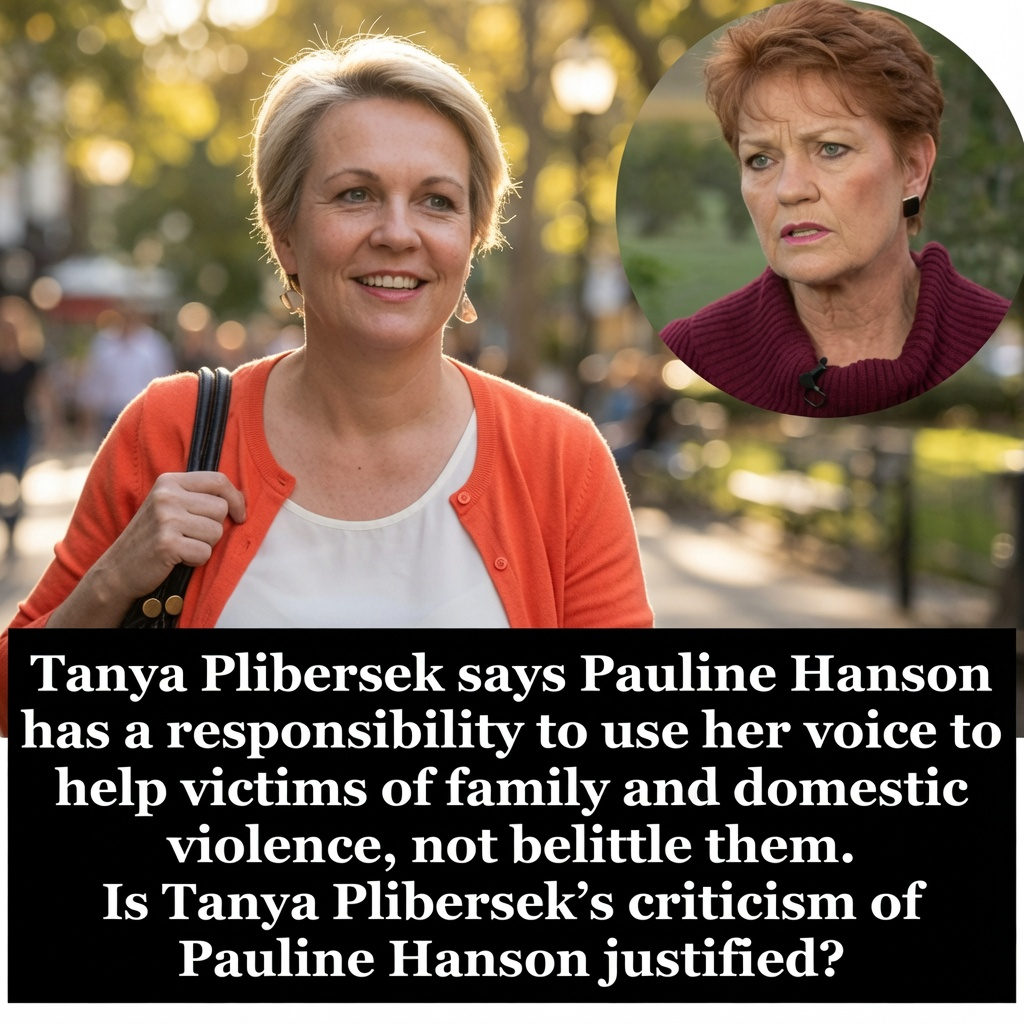
The dispute erupted after Hanson, during a radio interview, said family violence was “wrong, but it’s also a two-way street” and suggested women experiencing abuse should leave violent relationships rather than remain in them. Her comments quickly drew criticism from across the political spectrum, domestic violence advocates and victim support organisations.
Responding publicly, Plibersek rejected Hanson’s characterisation of domestic violence and argued that the advice simply to “leave” ignores the reality confronting many victims.
“Violence is never the answer. Everybody experiences stress, but it’s never OK to hit your partner because you’re having a hard time,” Plibersek said.
She added that telling women to leave abusive relationships “completely misses the point”, stressing that research consistently shows the period immediately before and after separation is often the most dangerous time for victims of family and domestic violence.
Plibersek also argued that elected representatives have a responsibility to use their public platforms carefully when discussing domestic violence.
“Pauline Hanson has a responsibility to use her voice to help victims of family and domestic violence, not belittle them,” the minister said.
The criticism reflects longstanding advice from domestic violence experts, who have repeatedly warned that leaving an abusive relationship is frequently the period of greatest risk. Perpetrators may escalate violence when they believe they are losing control, making safety planning and specialist support critical components of any attempt to leave.
Australian governments and specialist support services have for years encouraged victims to seek professional assistance rather than leave without a safety plan, particularly where children are involved or where previous violence has occurred.
Hanson’s original remarks came during an interview on Brisbane radio, where she acknowledged domestic violence was wrong but argued that women could also become violent and that family violence should not automatically be viewed as involving male perpetrators alone.
“It is wrong, but it’s also a two-way street,” Hanson said, adding that women could “lose their cool as well” while discussing the pressures facing Australian families.
The One Nation leader has also spoken publicly in the past about experiencing domestic violence herself and has maintained that her comments were intended to acknowledge that both men and women can be victims of abuse.
Following the backlash, Hanson defended her remarks on social media, arguing that they had been selectively quoted and taken out of context. She said she was not excusing perpetrators and maintained that domestic violence should never be tolerated regardless of the victim’s gender.
Despite that clarification, criticism continued to grow.
Former Liberal staffer Brittany Higgins accused Hanson of promoting victim-blaming rhetoric, arguing the comments risked normalising attitudes that shift responsibility away from perpetrators. Higgins described the remarks as dangerous given the continuing national concern over violence against women.
Domestic violence organisations also condemned the comments.
Experts working in the sector argued that encouraging victims simply to leave abusive relationships fails to recognise the complex financial, emotional and safety barriers many people face. They noted that coercive control, fear of retaliation, concerns for children and limited access to secure housing frequently prevent victims from leaving immediately.
Australian data consistently shows that family and domestic violence remains one of the country’s most significant social challenges.
Women are disproportionately affected by serious domestic violence, although men can also be victims. Governments at both federal and state levels have invested billions of dollars in prevention programs, emergency accommodation, legal assistance and behavioural intervention programs for perpetrators.
The debate also comes amid renewed national discussion about violence against women following several high-profile deaths this year, prompting renewed calls for stronger prevention measures and greater investment in frontline support services.
Within Parliament, Labor ministers have argued that political leaders should exercise particular care when discussing domestic violence because public statements can influence community attitudes and whether victims feel supported in seeking help.
The Coalition has likewise criticised Hanson’s wording, with Opposition representatives saying discussions about family violence should remain focused on protecting victims and holding perpetrators accountable rather than generating political division.
The controversy has also renewed debate about how politicians discuss the gendered nature of domestic violence.
While experts acknowledge that family violence can affect people of any gender, they also note that women experience the overwhelming majority of serious intimate partner violence and are significantly more likely to be killed by a current or former partner.
Support organisations argue that recognising this statistical reality does not diminish the experiences of male victims but helps governments design policies that respond to the patterns of violence documented through criminal justice and public health data.
For Hanson, the episode represents another politically contentious moment as One Nation continues campaigning on issues it says the major parties avoid discussing.
For Labor, Plibersek’s response reinforces the government’s argument that domestic violence should be approached as a public safety issue requiring careful language, evidence-based policy and sustained support for victims.
As debate continues, the exchange has highlighted the broader challenge facing Australian political leaders: balancing robust public discussion with the responsibility to communicate in ways that reflect both the complexity of domestic violence and the lived experiences of those affected by it.






