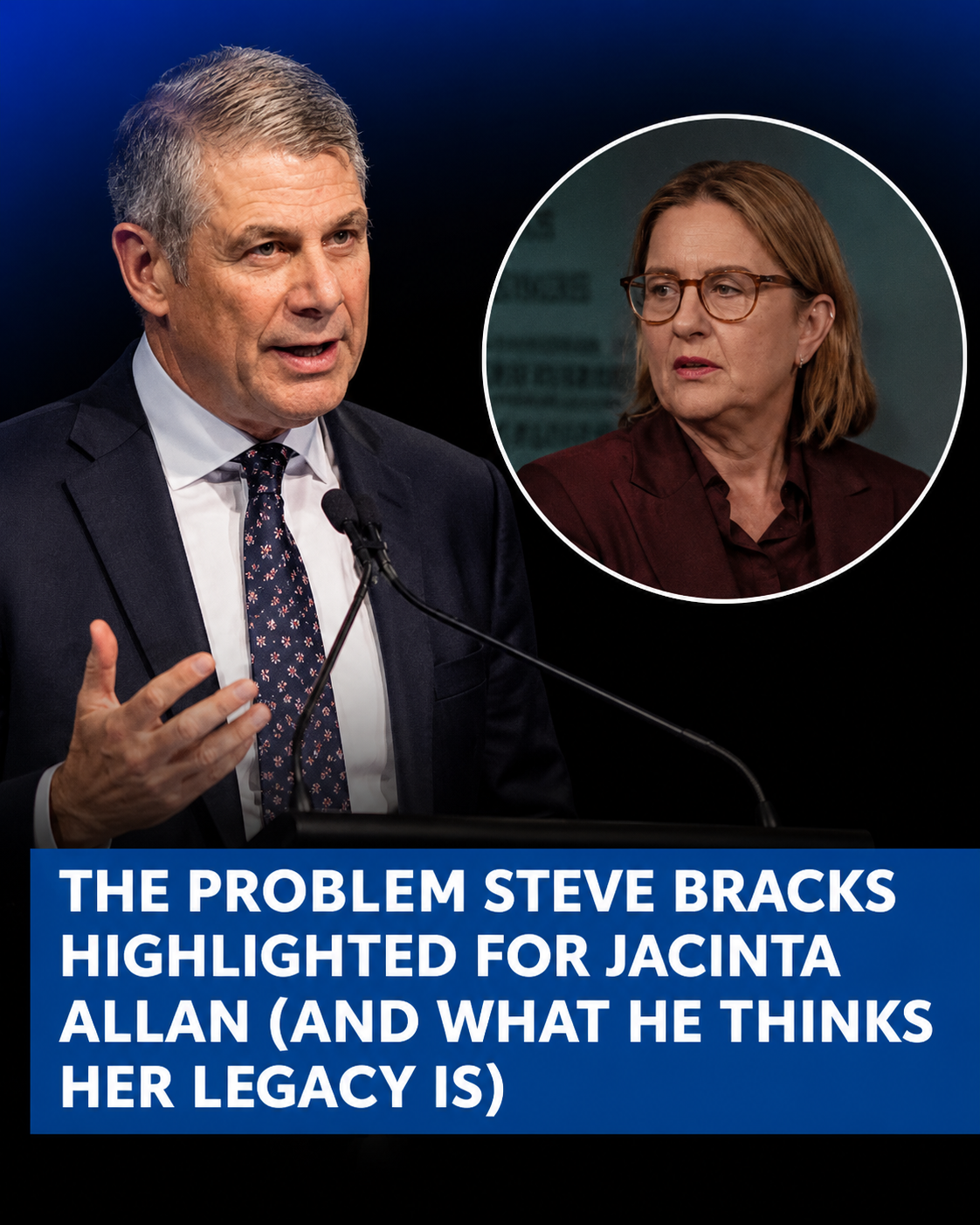
Former Victorian premier Steve Bracks believes Jacinta Allan ultimately became the face of a government that voters increasingly associated with the past, arguing that the challenge confronting her was not simply about individual policy decisions but about convincing Victorians that Labor still represented renewal after more than a decade in office.
Bracks made the comments following one of the most dramatic political upheavals in recent Victorian history, with Deputy Premier Ben Carroll replacing Allan as Labor leader and becoming Victoria’s 50th premier just months before the state election.
The leadership transition ended weeks of mounting speculation over Allan’s political future as opinion polling continued to deteriorate and growing numbers of Labor MPs concluded the party required a new leader if it hoped to remain competitive at the November election.
Speaking after the leadership change, Bracks said governments that remain in office for extended periods inevitably confront a powerful desire among voters for political renewal.
According to the former premier, Allan’s greatest obstacle was that she found herself carrying responsibility not only for her own premiership but also for the broader legacy of successive Labor governments stretching back to the Daniel Andrews era.
He suggested that once voters begin seeking change, even capable leaders can struggle to reverse public sentiment within a short period.
“Governments that have been there a long time always face that challenge,” Bracks said, arguing that leadership alone cannot completely reset public perceptions built over many years.
Allan became premier in September 2023 after Daniel Andrews unexpectedly resigned following almost nine years in office.
Although she inherited one of Australia’s most electorally successful Labor governments, she also inherited significant political challenges, including rising state debt, ongoing cost-of-living pressures, housing affordability concerns, debate over major infrastructure spending and increasing scrutiny of government integrity.
Throughout her premiership, opposition parties consistently argued that Allan represented continuity rather than change, portraying her administration as an extension of the Andrews government rather than a fresh political chapter.
Those arguments became increasingly influential as Labor’s polling weakened during the first half of 2026.
Reports suggested a growing number of Labor MPs feared the party faced a substantial electoral defeat unless it changed direction before Victorians went to the polls.
Deputy Premier Ben Carroll eventually emerged as the consensus alternative after support for Allan within caucus collapsed, prompting her resignation before a formal leadership ballot could take place.
Bracks nevertheless rejected suggestions that Allan’s political career should be judged solely by the circumstances surrounding her departure.
He argued that her legacy extends well beyond the final weeks of internal party turmoil and should include her long parliamentary career, her work representing regional Victoria and her involvement in delivering major infrastructure and transport projects.
Allan entered the Victorian Parliament in 1999, representing the regional electorate of Bendigo East, and became one of Labor’s longest-serving ministers before eventually succeeding Andrews as premier.
During her years in government she held portfolios including regional development, public transport and infrastructure, overseeing projects that reshaped parts of Victoria’s transport network and regional economy.
Supporters argue those achievements should remain an important part of any assessment of her time in public office, regardless of Labor’s political difficulties in 2026.
Bracks echoed that view, describing Allan as someone who had dedicated much of her working life to public service and who played a significant role in the delivery of major government initiatives over more than two decades.
However, he acknowledged that elections are often decided as much by public mood as by policy detail.
Political history shows that long-serving governments frequently encounter growing voter fatigue, even when economic conditions remain relatively stable or governments continue delivering significant projects.
Victoria has experienced similar political cycles before. Labor governed continuously under John Cain and Joan Kirner until its heavy defeat in 1992, while the Liberal government led by Jeff Kennett later suffered a surprise loss after two terms despite implementing substantial economic reforms.
Bracks himself returned Labor to office in 1999 and remained premier until 2007, leading one of the state’s longest periods of political stability before handing leadership to John Brumby.
His observations therefore carry particular significance given his experience managing both the opportunities and challenges associated with long periods in government.
The transition to Ben Carroll represents Labor’s attempt to convince voters that meaningful renewal remains possible despite nearly twelve years in office.
Immediately after assuming office, Carroll promised “a new direction” focused on integrity, community safety and economic management.
He also announced plans for a royal commission into alleged corruption within Victoria’s construction sector, signalling an early effort to distinguish his leadership from that of his predecessor.
Political analysts broadly agree that Carroll now faces the difficult task of persuading voters that he represents genuine change rather than simply another face leading the same administration.
While he has pledged to govern differently, the Coalition continues to argue that he served as deputy premier throughout many of the policy decisions now attracting criticism.
Opposition Leader Jess Wilson has already sought to tie Carroll to the Andrews-Allan years, arguing that changing leaders does not erase Labor’s broader record in government.
The leadership change also comes amid an increasingly fragmented political environment.
The Liberal-National Coalition is attempting to capitalise on voter dissatisfaction, while One Nation, the Greens and several independents are seeking to expand their influence across both metropolitan and regional electorates.
Recent polling has suggested Victoria’s November election could be the state’s most competitive in more than a decade, with Labor’s parliamentary majority under significant pressure.
Bracks stopped short of predicting the election outcome but indicated that Labor still has an opportunity to reconnect with voters if it demonstrates that the leadership transition represents more than a symbolic change.
Whether that proves sufficient remains uncertain.
Governments approaching the end of long periods in office often face sceptical electorates demanding fresh ideas, stronger accountability and clearer economic direction. Carroll’s challenge will be convincing Victorians that Labor can still provide those qualities after more than a decade in power.
For Jacinta Allan, meanwhile, the debate over her political legacy is likely to continue well beyond her resignation.
Supporters will point to her decades of public service, commitment to regional Victoria and role in delivering major infrastructure projects. Critics will focus on rising state debt, declining public confidence, controversy surrounding aspects of the Big Build program and Labor’s deteriorating electoral position during her premiership.
Bracks suggested those competing interpretations are inevitable for any long-serving political leader.
Rather than defining Allan solely by the circumstances of her departure, he argued her career should be viewed within the broader context of more than 25 years in Victorian public life, during which she helped shape many of the state’s largest transport, regional development and infrastructure initiatives.
Ultimately, however, he acknowledged that politics is often driven by timing as much as achievement.
As Victoria prepares for its November election, Labor hopes Ben Carroll’s appointment will satisfy voters looking for a fresh start. Whether that strategy succeeds may also influence how history remembers Jacinta Allan’s premiership—and whether her legacy is defined primarily by the reforms she helped deliver or by the political moment that brought her leadership to an end.






