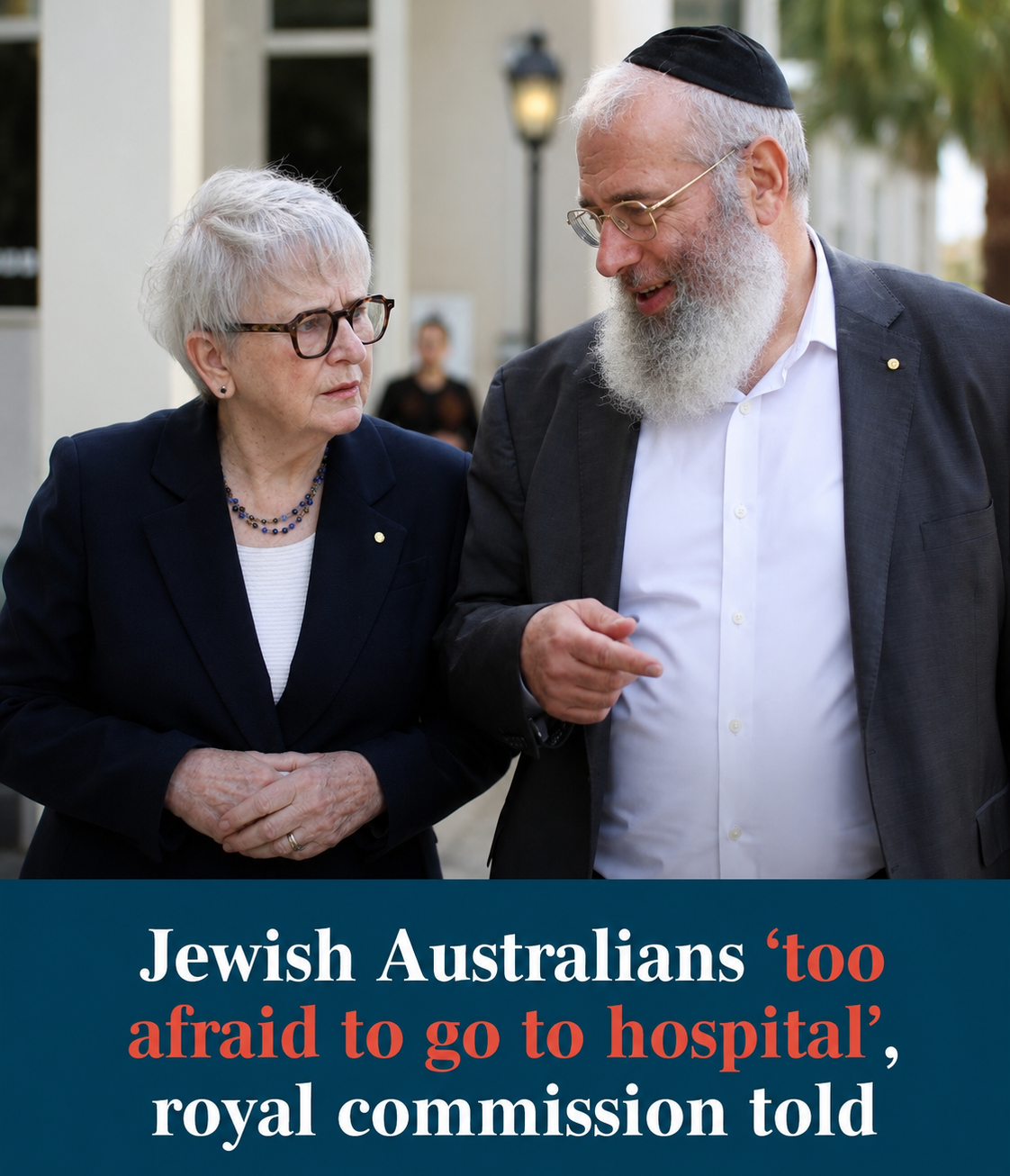
Jewish Australians have become so concerned about antisemitism in parts of the healthcare system that some are reluctant to disclose their religion when admitted to hospital, while others reportedly fear speaking openly with medical staff, Australia’s Royal Commission on Antisemitism and Social Cohesion has heard.
The evidence emerged during the sixth hearing block of the commission, which is examining how antisemitism is experienced in healthcare, schools, workplaces and the arts, and whether existing policies and training adequately protect affected communities. The hearings form part of the broader inquiry established following the 2025 Bondi terrorist attack to examine antisemitism, social cohesion and responses to ideologically motivated extremism across Australia.
Rabbi Mendel Kastel, chief executive of Jewish House and a prominent community leader, told the commission that fear within Australia’s Jewish community had reached a point where some patients had requested that references to Judaism be removed from hospital admission records.
According to Kastel, community members have also expressed anxiety about identifying themselves as Jewish while receiving medical treatment, reflecting a loss of confidence that hospitals will always provide an environment free from discrimination or intimidation.
The concerns have intensified since the widely publicised Bankstown Hospital controversy, in which two nurses allegedly made threatening comments about Israeli patients during an online conversation. The pair have pleaded not guilty to criminal charges, and the allegations are yet to be determined by the courts. Nevertheless, the incident has become a defining reference point in discussions about antisemitism within Australia’s healthcare system.
Kastel told the commission that while the overwhelming majority of healthcare professionals continue to provide compassionate and professional care, highly publicised incidents have had a disproportionate impact on community confidence.
He said some Jewish Australians now worry about how they might be treated during vulnerable moments such as emergency admissions or major medical procedures, even though there is no evidence that such fears reflect the conduct of most healthcare workers.
Among the recommendations raised during the hearings was the suggestion that hospitals reinforce political neutrality in clinical settings. Kastel argued that visible political symbols worn by healthcare staff can undermine patient confidence and should be carefully considered where they may create perceptions of bias or compromise trust between patients and medical professionals.
Beyond hospitals, Kastel warned that Australia also faces a broader problem of what he described as “casual” antisemitism—everyday expressions of prejudice, stereotypes and hostility that may not always breach criminal laws but nevertheless contribute to fear and social division.
He argued that addressing only the most extreme incidents would be insufficient if lower-level discriminatory behaviour continued to become normalised within workplaces, educational institutions and public life.
Counsel assisting the commission, Zelie Heger SC, said the current hearing block deliberately focuses on education and prevention rather than solely on law enforcement responses.
Previous hearings examined policing, security arrangements and institutional responses to antisemitic incidents. This week’s proceedings instead seek to understand whether stronger education, governance and professional training can reduce prejudice before it escalates into more serious conduct.
Heger told the commission that long-term cultural change would ultimately be essential if Australia hoped to reduce antisemitism and lessen the need for the extensive security measures currently protecting many Jewish schools, synagogues and community facilities. She noted that education remains one of the most effective tools for countering ignorance and prejudice.
The hearings have also examined how the Commonwealth is attempting to prevent extremists from entering Australia.
Senior Home Affairs official Clare Sharp told the commission that amendments introduced under the Combatting Antisemitism, Hate and Extremism Criminal and Migration Laws Act 2026 have strengthened the government’s ability to refuse or cancel visas for individuals considered likely to incite hatred or social division.
Under the revised legislation, officials no longer need to conclude that an individual would incite discord before acting. Instead, visa action may be considered where authorities assess that a person might pose such a risk, allowing earlier intervention in appropriate cases.
Sharp said the lower legal threshold enables immigration authorities to make more timely, risk-based decisions while continuing to assess each case individually. She emphasised that Australia cannot realistically screen every visa applicant for extremist views, but the legislative changes provide greater flexibility where credible concerns arise.
The commission heard that the strengthened powers have already been used in several high-profile cases.
Officials confirmed that American commentator Candace Owens was refused entry to Australia under the revised framework, while rapper Kanye West’s visa was cancelled in 2025 following repeated antisemitic statements that authorities concluded posed an unacceptable public risk.
The visa evidence formed part of the commission’s broader examination of how government agencies respond to extremist ideologies before they result in violence or serious community harm.
Commissioners are considering whether current legal powers strike an appropriate balance between protecting public safety, preserving freedom of expression and maintaining Australia’s longstanding commitment to multiculturalism.
The Royal Commission itself was established in January 2026 following the Bondi terrorist attack in December 2025. Former High Court Justice Virginia Bell was appointed commissioner, with the inquiry tasked with examining antisemitism, social cohesion, institutional responses and possible reforms to strengthen public safety. An interim report has already been delivered, while the commission’s final recommendations are due later this year.
Throughout the hearings, witnesses have consistently distinguished between legitimate political debate about Israel and antisemitic conduct directed at Jewish Australians.
Community representatives have argued that criticism of governments or international conflicts should never become a justification for discrimination, intimidation or hostility towards individuals based solely on their Jewish identity.
At the same time, legal experts appearing before the inquiry have stressed that any reforms recommended by the commission must remain consistent with Australia’s democratic principles, including freedom of speech, procedural fairness and the rule of law.
The commission has also received evidence describing antisemitic incidents affecting Jewish schoolchildren, university students, healthcare workers and community organisations, illustrating what witnesses say is a pattern of increasing concern across multiple sectors rather than isolated individual events.
Healthcare professionals who have appeared before the inquiry have acknowledged the seriousness of those concerns while emphasising that Australia’s medical system continues to operate under professional obligations requiring equal treatment for every patient regardless of religion, ethnicity or background.
Medical experts have argued that maintaining public confidence is essential because fear of discrimination may discourage vulnerable people from seeking treatment when they need it most.
For the federal government, the evidence presented to the commission highlights the dual challenge of addressing both immediate security risks and the longer-term social attitudes that allow prejudice to develop.
Witnesses repeatedly told the inquiry that policing alone cannot eliminate antisemitism. Instead, they argued that education, institutional leadership, professional training and consistent enforcement of existing standards will all be required if trust between communities is to be rebuilt.
As hearings continue, the Royal Commission is expected to examine additional evidence from educators, government agencies, cultural institutions and community organisations before preparing its final report.
Those recommendations are expected to influence future policy on immigration, education, workplace standards, healthcare governance and community safety as Australia continues responding to rising concerns about antisemitism while seeking to strengthen social cohesion across an increasingly diverse society.






