Biosecurity teams are working across Sydney’s inner west after red imported fire ants were detected and treated at the Enfield Intermodal Logistics Centre, a major freight and warehousing facility. State and Commonwealth authorities have confirmed the invasive pest was found through surveillance at the site, prompting specialist searches, treatment and a broader response involving nearby businesses and residents. Officials say there is currently no evidence that fire ants have spread beyond the facility, but they are not ruling out the possibility. The immediate priority is to find any undetected activity quickly, protect surrounding neighbourhoods and avoid unintentionally moving material that could carry the insects.
The confirmation of red imported fire ants at a freight centre matters because the species is regarded as a serious threat to people, agriculture and the environment. It is highly invasive, can spread through the movement of suitable materials and is capable of aggressive, repeated stinging when a nest is disturbed. The NSW Government has activated an incident management response and is working with Commonwealth officers and specialists from the National Fire Ant Eradication Program. Officials are asking local businesses and households to stay observant without taking matters into their own hands. Suspected nests should be left untouched and reported promptly for expert assessment.
The discovery began with Commonwealth biosecurity surveillance at a facility in the Strathfield area. Department of Agriculture, Fisheries and Forestry officers found ant specimens in a monitoring trap and subsequently confirmed the species as Solenopsis invicta, the scientific name for red imported fire ants. Officials treated the identified infestation and began tracing possible pathways by which the ants may have reached the site. The facility handles goods under biosecurity controls, which helps explain why surveillance takes place there. The presence of the species does not, by itself, prove that a particular freight operator, shipment or worker was responsible for its arrival.
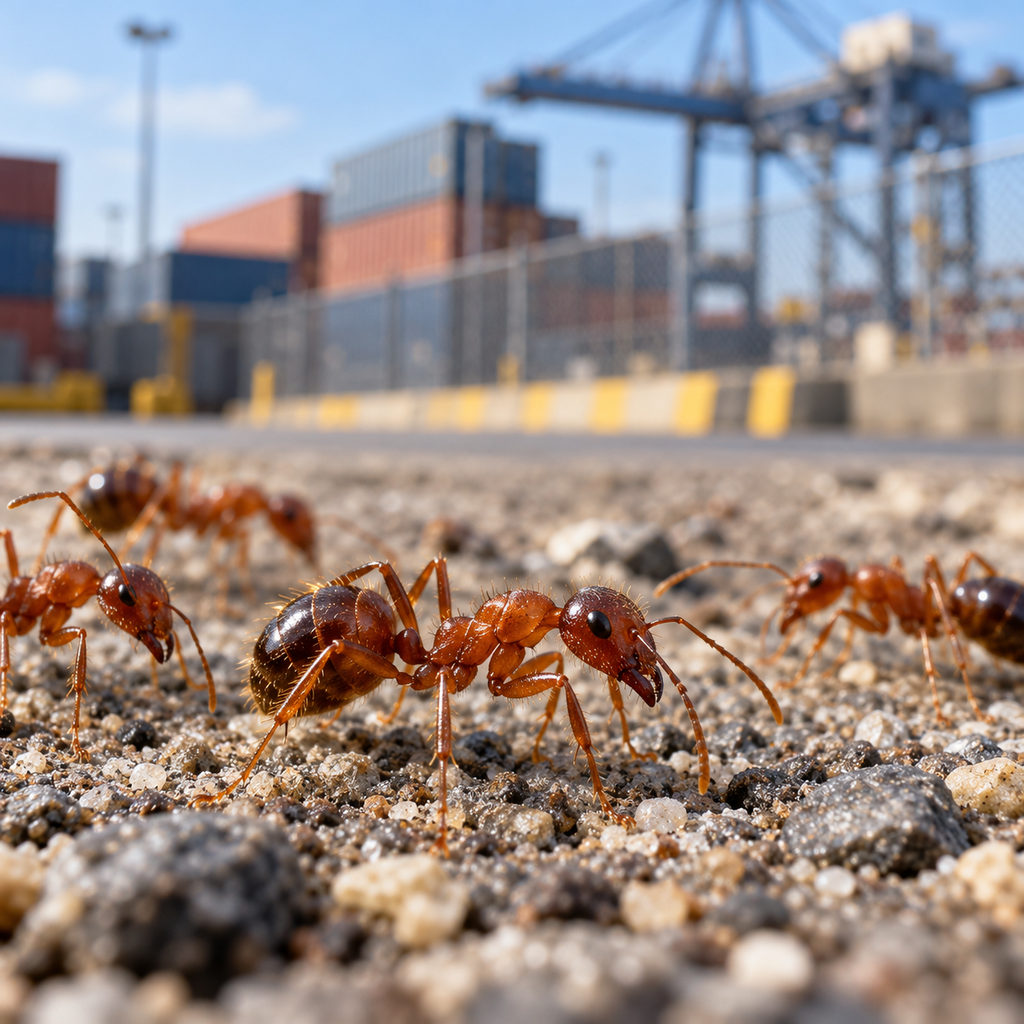
The site is described as Enfield Intermodal Logistics Centre in the NSW Government’s public material and as an approved facility in Strathfield in the Commonwealth account. Both agencies are discussing the same local response. Their statements do, however, differ on the precise number of nests found at the facility. Because the official figures are not consistent, reporting a single numerical count as settled would be misleading. What both sources support is that red imported fire ants were detected, treatment began and surveillance remains necessary. The difference should be resolved through the authorities rather than guessed away in a news report.
Commonwealth officers say the initial detection emerged from a routine, risk-based surveillance program. That point is important: fire ants can be difficult to notice before a colony becomes established, particularly at a large operational site where freight, vehicles and equipment are constantly moving. Detecting the pest through a monitoring trap gives biosecurity teams an opportunity to act before signs are obvious to the wider public. It does not guarantee that all ants have been found. The response therefore combines immediate treatment at the known location with searches of nearby land and consideration of how the pest might move from one place to another.
The NSW response is designed around several layers of attention. Authorities say the most immediate work will cover properties and possible risk sites within about 500 metres of the intermodal centre. Surveillance and treatment, where required, are then planned within a wider area extending to around two kilometres. Those areas are an operational response based on scientific understanding of how fire ant queens may move and establish new colonies. They should not be read as a map of confirmed infestation. The government has not announced that all land inside those distances contains fire ants, nor does it claim that land beyond them is definitively safe.
Specialist detection dog teams have already undertaken surveillance at the facility and its immediate surrounds. NSW authorities say no further nests have been found at the intermodal centre through that work. The Commonwealth likewise reports no evidence of spread beyond the site at this stage. Both statements describe what monitoring has shown so far, not a permanent guarantee about what future searches may reveal. It is possible to take reassurance from the absence of additional detections while still respecting the reason officials are expanding their effort. Ongoing surveillance is a precaution, and its results may change as more areas are checked.
Freight operations make the local business response particularly important. NSW officials are prioritising contact with enterprises involved in materials that may carry invasive ants, including soil, turf, construction supplies, nursery products and heavy equipment. The government plans to help these businesses understand identification, monitoring and movement responsibilities while seeking to minimise unnecessary disruption to normal operations. That balance is significant: authorities want to reduce pathways for pest movement without implying that every load or every business at the centre is contaminated. Specific restrictions are to be communicated through the appropriate biosecurity controls rather than assumed from the mere announcement of a detection.
NSW has indicated that a formal Biosecurity Control Order will follow the community engagement phase. Such an order is intended to help officials manage risk within a defined area, especially for businesses handling materials associated with possible movement of the species. The precise legal obligations must come from the order and official guidance once in effect. It would be premature for a report to describe every planned measure as already legally binding. Businesses requiring clarification should consult the current NSW biosecurity advice rather than make decisions from an older headline, particularly as surveillance boundaries and practical arrangements can be adjusted during a developing response.
The state has also announced a community information drop-in centre at Chullora Marketplace on Waterloo Road in Greenacre. Officials say the centre will help residents and business operators learn what the ants look like, understand reporting procedures and prepare for any relevant controls. Information materials have been prepared in multiple languages to reach people around the intermodal facility. This direct community engagement is part of the containment strategy. An early report from a resident or worker may give teams a chance to investigate an isolated detection before material is moved elsewhere, while a mistaken sighting can be assessed by experts without unnecessary alarm.
Red imported fire ants are usually dark reddish-brown with a darker abdomen, but the appearance of a single insect is not enough for a member of the public to make a reliable identification. NSW identification advice notes that workers may vary in size, commonly around two to six millimetres within a colony. Nests do not always resemble a familiar ant hill. They may appear as relatively flat patches or soil mounds without an obvious central entrance. That is another reason officials recommend photographs taken at a safe distance and a formal report instead of asking residents to dig into, dismantle or chemically treat a suspected nest.
The advice from NSW is deliberately simple: leave suspected ants or mounds undisturbed, safely photograph them if possible, and contact the biosecurity helpline on 1800 680 244 or use the official online reporting form. The government warns people not to try to capture ants or destroy a nest themselves. Disturbing an infestation can result in painful stings and may complicate the response by dispersing insects. Public reporting is a way of supporting the trained teams, not a substitute for professional treatment. Residents should also avoid moving suspect soil or plant material on the assumption that an unidentified colony is harmless.
The public health concern is real, although the detection should not be described as an immediate medical emergency across Sydney. NSW health and biosecurity information says fire ants can swarm in large numbers when disturbed and deliver repeated painful stings. People may experience burning, itching, redness or local blisters, while some may develop severe allergic reactions, including anaphylaxis. Anyone experiencing symptoms of a severe allergic reaction should seek urgent medical assistance through established emergency channels. Those risks explain the firm advice not to investigate a suspicious nest by hand. They do not establish that anyone in the Enfield area has already been stung in this incident.
Genetic testing has provided another useful piece of information. Officials say the ants detected at the Sydney facility are not linked to the existing south-east Queensland infestation, the major active fire ant infestation in Australia. NSW believes the local incursion may have an overseas origin associated with the movement of freight. That finding helps guide tracing and surveillance, but it is not the same as identifying one confirmed shipment or origin point. Pinpointing a pathway requires evidence that has not been publicly provided. The genetic result supports treating the Sydney case as a distinct detection rather than presuming it represents a known Queensland population moving south.
Authorities point to previous successful eradications in NSW as evidence that a rapid response can work. That is grounds for cautious confidence, not a promise that this incursion is already over. Officials must still look for further signs of the pest, confirm the effect of treatment and ensure businesses and residents understand how to report possible discoveries. Even if no additional ants are found, the process of demonstrating containment can extend beyond the initial treatment. The public should expect updates to reflect new surveillance evidence, including whether the operational area or movement controls need to change.
For the broader Australian audience, the issue illustrates why biosecurity can become a local concern at a site most people associate with ordinary freight and logistics. Goods and equipment pass through facilities that connect communities and industries. Surveillance is designed to find risks that may otherwise go unnoticed, while response orders and community guidance are intended to prevent a small detection becoming a wider problem. The important distinction is between a confirmed detection at one site, a possible pathway of spread and an established infestation elsewhere. Conflating those categories risks either understating the situation or turning precautionary work into a false alarm.
The NSW Government and Commonwealth are continuing to coordinate the response, with expert teams inspecting, treating and tracing as necessary. For nearby residents, the practical instruction is to remain alert but not interfere with suspicious ant activity. For businesses, it is to obtain current advice on materials and movements that could carry the pest. The official information provides no basis to declare the threat eliminated or to claim it has spread through surrounding suburbs. Until surveillance gives a clearer picture, the most accurate account is of an invasive species detected and treated at a freight facility, and a cautious effort to prevent a wider outbreak.






