A light-hearted but pointed political jab from South Australian Premier Peter Malinauskas has added another chapter to one of Australia’s most unexpected viral political moments, after he told Labor Party delegates that “if you can’t govern your dog, you can’t govern the country.”
The remark drew laughter during the opening of Labor’s 50th National Conference in Adelaide, where Malinauskas used the now-famous Barnaby Joyce interview interruption as a metaphor while warning delegates about what he described as growing political instability and the challenge posed by One Nation’s rising popularity. 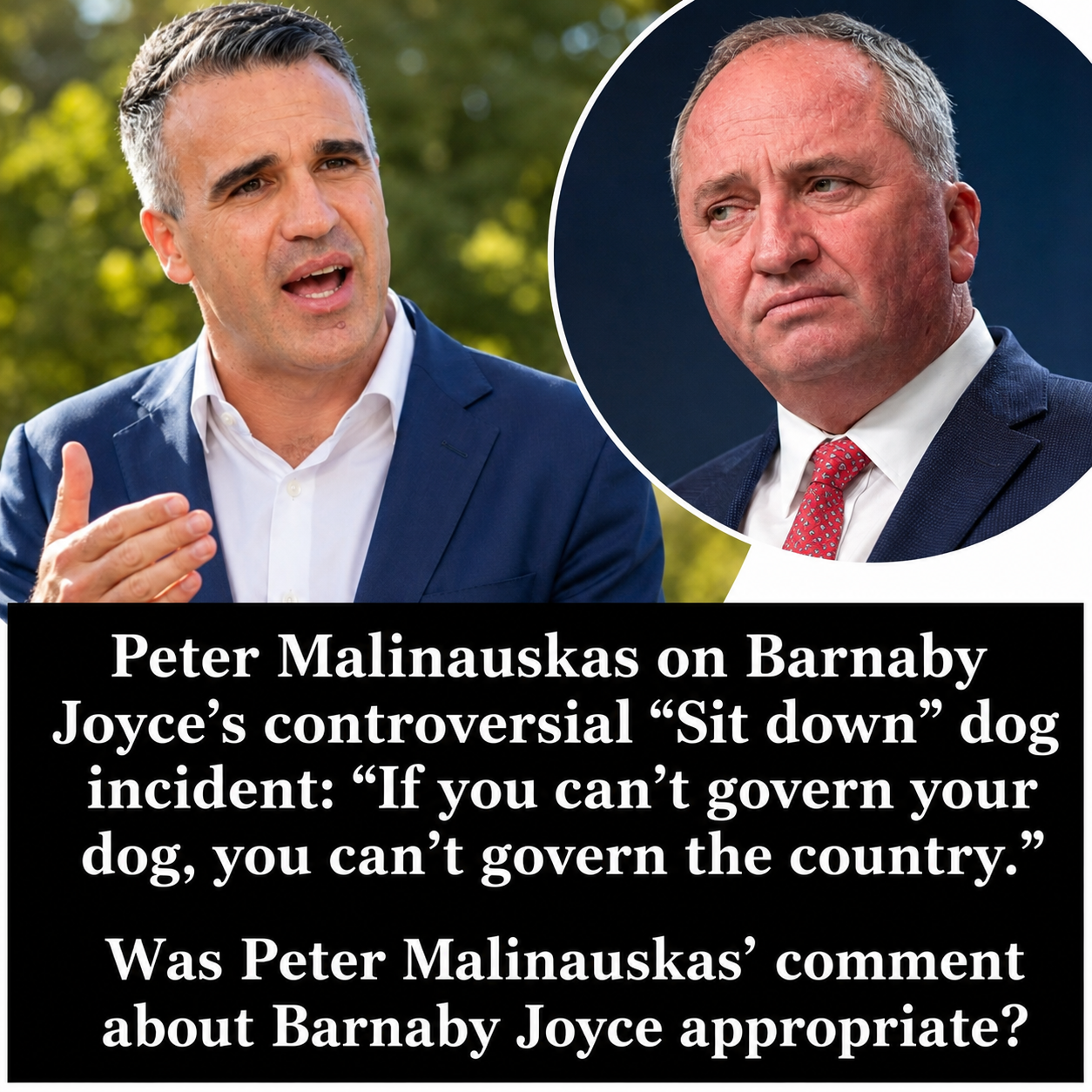
The comment came only days after Barnaby Joyce unexpectedly interrupted an ABC 7.30 interview to shout “Sit down!” before immediately explaining to presenter Sarah Ferguson that he had been speaking to his dog rather than reacting to the interview itself.
Within hours, the short exchange had spread across social media, generating thousands of comments, parody videos and memes while quickly becoming one of Australia’s most widely shared political clips of the week.
A joke that landed at Labor’s biggest gathering
Opening Labor’s national conference at the Adelaide Convention Centre, Malinauskas used the incident to criticise conservative opponents while emphasising what he described as the importance of discipline in government.
He told delegates:
“If you can’t govern your dog, you can’t govern the country.”
The audience responded with laughter, making the line one of the most memorable moments from the conference’s opening session.
Although delivered humorously, the remark also reflected Labor’s broader strategy of challenging the growing popularity of One Nation, which has emerged as one of the most significant political threats to both major parties during 2026.
How the viral moment unfolded
The original incident occurred during an ABC 7.30 interview in which Joyce was responding to questions from Sarah Ferguson.
The discussion covered several politically sensitive topics, including Pauline Hanson’s interview with British activist Tommy Robinson, debate surrounding historical immigration policy and recent disclosures about funding connected to Hanson’s European trip.
While Ferguson was asking a question, Joyce suddenly turned away from the camera and firmly shouted:
“Sit down!”
He immediately apologised before explaining:
“Sorry, it’s the dog.”
The interruption lasted only moments but quickly overshadowed much of the political discussion that followed.
Meet Stella
Joyce later explained that the dog involved was Stella, a young Staffordshire Bull Terrier–Border Collie cross.
According to Joyce, Stella had wandered underneath the deck where the television interview was taking place and continued moving around while Ferguson was asking questions.
Speaking afterwards, Joyce said he initially tried to ignore the distraction but eventually realised he could no longer properly hear the interview.
“It came under the deck while Sarah Ferguson was giving me a grilling,” he explained.
“I tried to keep going, hoping it would stop, but I was missing Sarah’s questions.”
He then added with characteristic humour:
“The dog still loved me afterwards. I’m not so sure Sarah did.”
Rejecting criticism
While many Australians treated the incident as harmless comedy, others criticised the way Joyce had spoken to the dog.
Some social media users suggested the exchange appeared unnecessarily aggressive, prompting Joyce to publicly reject any suggestion that Stella had been mistreated.
He argued the reaction reflected a cultural divide between metropolitan Australia and regional communities.
“People in the regions have a laugh about it,” Joyce said.
“People in the inner city act like it’s a war crime.”
Joyce maintained Stella suffered no harm and that the incident simply reflected everyday life for many Australians working around animals.
Social media embraces the moment
Regardless of political affiliation, Australians quickly transformed the clip into internet entertainment.
Memes featuring Stella appeared across Facebook, X, Instagram and TikTok within hours.
Some users edited the footage into comedy sketches, while others imagined conversations between Joyce and the dog or created satirical political campaign material based on the interruption.
Political commentators noted that moments of unintended humour often spread further online than carefully prepared political messaging, and Joyce’s interview proved no exception.
Within days, many Australians who had not watched the original interview were nevertheless familiar with the “Sit down!” moment through social media.
Labor’s broader political message
Malinauskas’ joke was not simply an isolated one-liner.
It formed part of Labor’s broader effort to contrast its own message of stability with what party leaders characterised as growing political fragmentation on the conservative side of politics.
During the conference, both Malinauskas and Prime Minister Anthony Albanese repeatedly criticised One Nation’s recent rise in opinion polling while arguing Labor remained focused on practical issues such as cost-of-living pressures, housing and workplace reform.
Albanese similarly warned delegates against what he described as imported culture wars and divisive politics, although he did not directly mention Barnaby Joyce during his keynote address.
One Nation’s growing influence
The exchange also highlights the increasingly significant role One Nation now occupies in Australian politics.
Recent polling has shown the party attracting substantially higher support than in previous election cycles, forcing both Labor and the Coalition to respond more directly to its policy agenda and political messaging.
Joyce, now representing One Nation after leaving the National Party, has become one of the party’s highest-profile parliamentary figures and frequently appears in media interviews discussing immigration, regional Australia and economic policy.
Politics in the age of viral moments
The Stella episode also illustrates how modern political communication increasingly extends beyond speeches, parliamentary debates and policy announcements.
Short, unscripted moments frequently dominate public discussion, sometimes overshadowing the substantive issues politicians intended to address.
Whether viewed as harmless humour, an unfortunate distraction or a clever political opportunity, the interview interruption generated significantly more online engagement than many major policy announcements made during the same week.
For Malinauskas, the viral clip offered an easy opportunity to deliver a memorable line at Labor’s national conference.
For Joyce, it became another example of how an ordinary moment from regional life unexpectedly evolved into national political conversation.
And for Australians following politics online, Stella may well have become one of the country’s most famous dogs—at least for one extraordinary week when a brief interruption during a television interview evolved into memes, political speeches and fresh debate about leadership, public image and the unpredictable nature of modern campaigning.






