One Nation founder Pauline Hanson says she is considering taking one of Australia’s most closely watched racial discrimination cases to the High Court after suffering another legal defeat over comments directed at Greens deputy leader Mehreen Faruqi.
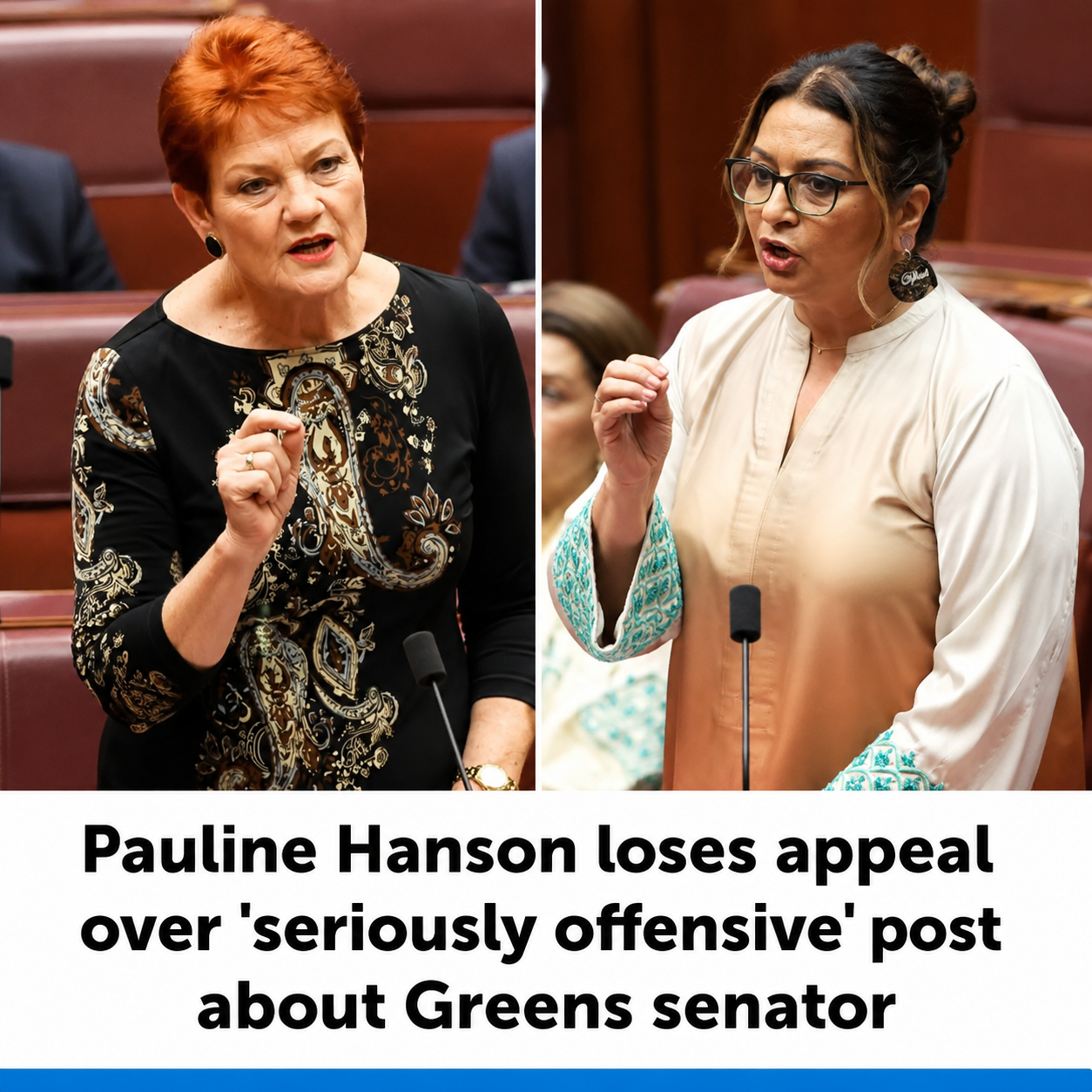
The Full Court of the Federal Court has unanimously dismissed Senator Hanson’s appeal against a 2024 judgment that found she unlawfully racially vilified Senator Faruqi through a social media post published on X, formerly known as Twitter, in September 2022.
The latest decision means the original ruling by Justice Angus Stewart remains in force, confirming that Senator Hanson’s remarks breached Section 18C of Australia’s Racial Discrimination Act 1975. It also represents another significant legal setback for one of Australia’s most prominent and controversial political figures.
The dispute began shortly after the death of Queen Elizabeth II, when Senator Faruqi posted on social media that while she acknowledged those mourning the monarch, she could not grieve “the leader of a racist empire built on stolen lives, land and wealth of colonised peoples.” The comments generated widespread political debate and strong reactions across Australia.
Senator Hanson responded with a post telling Senator Faruqi to “pack your bags and piss off back to Pakistan”, despite Senator Faruqi being an Australian citizen and a serving federal senator.
That exchange quickly escalated beyond political disagreement. Senator Faruqi subsequently launched legal proceedings, arguing the remarks amounted to unlawful racial discrimination under federal law because they targeted her race, national origin and identity rather than engaging with her political opinions.
After extensive hearings, Justice Angus Stewart delivered judgment in November 2024, concluding that Senator Hanson’s statement was far more than robust political commentary.
The judge described the remarks as “seriously offensive” and characterised them as a “strong form of racism”, finding they relied upon a familiar racist trope suggesting Australians from migrant backgrounds do not truly belong in the country and should return elsewhere whenever they express unpopular views.
Justice Stewart also rejected arguments that the comments were protected by the implied constitutional freedom of political communication, ruling that Australia’s anti-discrimination laws could legitimately restrict speech where it amounted to unlawful racial vilification.
Senator Hanson appealed that decision, arguing the original judgment had interpreted both the law and the social media exchange too broadly.
During the appeal, her legal team submitted that while the language used may have been offensive or unpleasant, it did not intimidate people because of their race in the manner required by the legislation. Counsel also argued that political figures should enjoy wide latitude when participating in heated public debate, particularly on matters of national identity, immigration and multiculturalism.
The Full Federal Court rejected those submissions.
In a unanimous decision delivered by Justice Melissa Perry on behalf of the three-member bench, the court concluded the original findings contained no legal error and that Justice Stewart had correctly interpreted both the evidence and the operation of Section 18C.
The judges also reaffirmed that Australia’s constitutional protection for political communication is not unlimited and does not prevent Parliament from enforcing laws designed to protect people from racial discrimination and hate speech.
Following the judgment, Senator Hanson expressed disappointment that her appeal had failed.
She argued the outcome represented another example of restrictions being placed on public debate and suggested Australians were increasingly reluctant to speak openly because of concerns about legal consequences.
Although acknowledging the court’s decision, she indicated she was actively considering lodging an application for special leave to appeal to the High Court of Australia.
“Public discussion has been silenced,” Senator Hanson said after the decision, maintaining her long-held position that the case is fundamentally about freedom of speech rather than racial discrimination.
Any further appeal would not occur automatically.
Unlike appeals to lower courts, proceedings before the High Court require applicants to obtain special leave. The High Court generally grants permission only where a case raises issues of national legal importance, conflicting legal authority or significant constitutional questions.
Legal experts note that only a relatively small proportion of special leave applications succeed each year, meaning Senator Hanson faces another substantial legal hurdle before the case could proceed further.
Senator Faruqi welcomed the outcome, describing the decision as an important affirmation that Australia’s anti-discrimination laws apply equally to all Australians, including elected politicians.
Outside court she said the unanimous judgment demonstrated that “justice has prevailed” and argued it sent a clear message that racism and Islamophobia should not be excused simply because they occur within political debate.
She also emphasised that the ruling represented a broader victory for multicultural communities who have experienced similar forms of racial abuse.
The Australian Human Rights Commission likewise welcomed the appeal decision, with Race Discrimination Commissioner Giridharan Sivaraman describing it as an important reaffirmation of legal protections against racism and racial hatred. The Commissioner said the judgment reinforced that public discourse can remain robust without resorting to discriminatory attacks based on race or ethnicity.
The litigation has become one of Australia’s most significant recent test cases involving Section 18C of the Racial Discrimination Act.
The provision makes it unlawful to engage publicly in conduct reasonably likely to offend, insult, humiliate or intimidate another person because of their race, colour or national or ethnic origin.
Although Section 18C has been the subject of political controversy for many years, Australian courts have consistently held that the legislation seeks to balance freedom of political communication with protection from serious racial abuse.
Importantly, Australia does not possess an explicit constitutional guarantee of unrestricted free speech similar to the First Amendment in the United States.
Instead, Australian law recognises an implied freedom of political communication that protects democratic debate while still allowing Parliament to impose proportionate legal restrictions pursuing legitimate public objectives.
The Full Federal Court concluded that Australia’s racial discrimination legislation comfortably satisfies those constitutional requirements in this case.
The Hanson-Faruqi proceedings have also highlighted how political disputes conducted through social media can rapidly evolve into landmark constitutional litigation.
What began as a single exchange on X following the death of Queen Elizabeth II has produced multiple Federal Court hearings, constitutional arguments concerning political communication and now the possibility of Australia’s highest court being asked to examine the case.
Regardless of whether the High Court ultimately agrees to hear the matter, the Full Federal Court’s unanimous judgment has already established one of the clearest modern statements about the limits of political speech under Australia’s racial discrimination laws.
The decision confirms that elected representatives are not exempt from those laws and that comments invoking racial or ethnic stereotypes may attract legal consequences even when made during highly charged political debate.
Attention will now focus on Senator Hanson’s next move.
If she files an application for special leave, the High Court will first determine whether the legal issues raised extend beyond the individual dispute and warrant further consideration. Until that process is complete, the Federal Court’s findings remain the authoritative legal position in one of Australia’s most consequential racial discrimination cases involving a serving parliamentarian.






