One Nation leader Pauline Hanson says she will continue fighting what she describes as the erosion of free speech in Australia after the Full Federal Court unanimously dismissed her appeal against a landmark racial discrimination ruling involving Greens Senator Mehreen Faruqi.
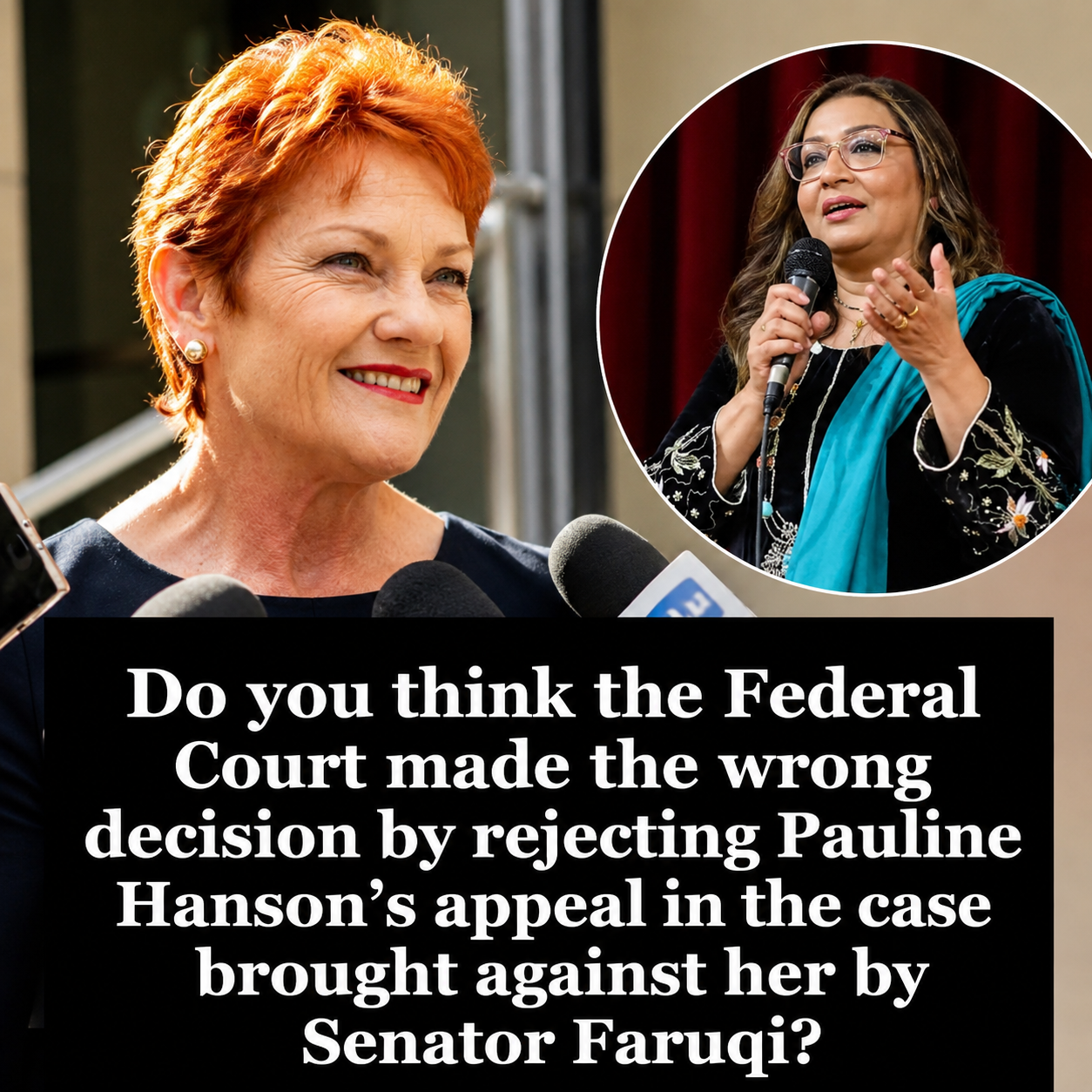
The decision leaves in place a 2024 Federal Court judgment that found Senator Hanson breached Section 18C of the Racial Discrimination Act 1975 after telling Senator Faruqi to “pack your bags and piss off back to Pakistan” in a post published on X, formerly Twitter, following the death of Queen Elizabeth II in September 2022.
Following the unanimous decision, Senator Hanson released a lengthy statement expressing disappointment with the outcome while signalling that the legal battle is far from over.
She confirmed her legal team would carefully analyse the Full Federal Court’s judgment before deciding whether to seek special leave to appeal to the High Court of Australia.
Although such an appeal is not automatic, Senator Hanson indicated she believes the case raises broader constitutional questions extending well beyond the dispute between herself and Senator Faruqi.
“My legal team and I will now closely review the decision in the coming days, with a view to commencing an appeal in the High Court of Australia,” she said after the judgment.
Throughout her statement, Senator Hanson framed the litigation not simply as a personal legal dispute but as part of a much wider debate about freedom of expression in Australia.
She argued that public discussion has become increasingly constrained by laws, regulations and social expectations that discourage Australians from expressing opinions for fear of causing offence or becoming the subject of legal action.
According to Senator Hanson, this growing reluctance to speak openly represents a significant departure from what she regards as Australia’s traditional culture of frank and robust public debate.
She maintained that ordinary Australians should not feel intimidated into remaining silent simply because their views may be unpopular or upsetting to others.
In her view, the willingness to tolerate disagreement has long been one of Australia’s defining democratic values.
Senator Hanson argued that expressing controversial opinions should not automatically expose citizens to accusations of racism or unlawful conduct where those views concern matters of public importance.
She said Australians need both the courage and the freedom to discuss issues affecting the nation’s future without fearing that disagreement alone may attract legal consequences.
The legal proceedings originated from an exchange on social media on the day Queen Elizabeth II died.
Senator Mehreen Faruqi posted that while she acknowledged many Australians would mourn the late monarch, she could not grieve “the leader of a racist empire built on stolen lives, land and wealth of colonised peoples.”
The comments generated immediate political controversy and prompted Senator Hanson to respond publicly by telling Senator Faruqi to “pack your bags and piss off back to Pakistan.”
Senator Faruqi subsequently commenced proceedings in the Federal Court, arguing the remarks constituted unlawful racial discrimination because they targeted her race and national origin rather than engaging with her political views.
In November 2024, Justice Angus Stewart ruled in Senator Faruqi’s favour.
His judgment concluded the social media post was “seriously offensive” and represented a “strong form of racism”. He found the statement relied upon a familiar racist message suggesting Australians from migrant backgrounds do not truly belong in the country and should return elsewhere if they express unpopular opinions.
The court also found the comments were capable of offending, insulting, humiliating and intimidating not only Senator Faruqi but other Australians sharing similar racial or ethnic backgrounds.
Senator Hanson challenged that decision before the Full Federal Court.
Her legal team argued the original judgment gave insufficient weight to Australia’s implied constitutional freedom of political communication and submitted the comments should be viewed within the context of heated political debate rather than racial discrimination.
The appeal also argued that while the language used may have been offensive, it did not satisfy the legal threshold required by the Racial Discrimination Act.
The Full Court unanimously rejected those submissions.
Justice Melissa Perry, delivering the judgment on behalf of the three-member bench, concluded that Justice Stewart had correctly applied the legislation and that Australia’s anti-discrimination laws remained constitutionally valid in the circumstances of the case.
Following the dismissal of the appeal, Senator Hanson reiterated that she remained deeply offended by what she regarded as disrespect shown towards Queen Elizabeth II on the day of the monarch’s death.
She said her response on social media reflected genuine anger at comments she believed dishonoured Australia’s Head of State and the institutions underpinning the nation’s constitutional system.
For Senator Hanson, respect for Australia’s democratic institutions, constitutional arrangements and shared civic values remains fundamental to national identity.
She argued that citizens should be able to defend those values openly, even where their opinions attract criticism or provoke disagreement.
According to Senator Hanson, restricting that ability risks gradually weakening important national traditions of democratic participation and open discussion.
She also thanked supporters who have stood behind her throughout the lengthy legal proceedings, saying their encouragement had strengthened her determination to continue contesting the matter.
Senator Hanson pledged to keep advocating for what she described as every Australian’s right to express personal opinions freely without fear of legal sanction simply because another person may feel offended or distressed.
On the other side of the litigation, Senator Faruqi welcomed the unanimous judgment, describing it as an important affirmation that racism and Islamophobia have consequences under Australian law.
Outside court, she said the decision represented not only a personal victory but a broader win for multicultural Australians who have experienced similar forms of racial abuse.
She argued that telling Australians from migrant backgrounds to “go back” to another country has long functioned as a racist trope designed to question their place within Australian society.
“Justice has prevailed,” Senator Faruqi said after the appeal was dismissed, adding that hate speech should never be confused with legitimate freedom of expression.
The case has become one of Australia’s most significant legal authorities concerning the interaction between freedom of political communication and the Racial Discrimination Act.
Section 18C makes it unlawful to engage publicly in conduct reasonably likely to offend, insult, humiliate or intimidate another person because of their race, colour or national or ethnic origin.
While the provision has remained politically controversial for many years, successive Federal Court decisions have consistently recognised Parliament’s ability to impose reasonable legal limits on discriminatory conduct, even where that conduct occurs during political debate.
The Full Federal Court reaffirmed that Australia’s implied constitutional freedom of political communication does not provide an unrestricted licence for racially discriminatory speech.
Instead, the judges concluded the legislation strikes a constitutionally valid balance between protecting democratic discussion and safeguarding Australians from serious racial abuse.
Attention will now turn to Senator Hanson’s next legal move.
If she proceeds with an application for special leave, the High Court will first determine whether the appeal raises issues of sufficient national importance to justify another hearing. Only a small percentage of special leave applications are granted each year.
Until then, the unanimous judgment of the Full Federal Court remains the authoritative legal position, reinforcing that elected representatives are subject to the same anti-discrimination laws as every other Australian and that racially discriminatory public statements may attract legal consequences regardless of the political context in which they are made.






