One Nation leader Pauline Hanson has come under intense criticism after describing domestic violence as “a two-way street” during a Brisbane radio interview, comments that have reignited debate over how Australian political leaders discuss one of the country’s most pressing social issues.
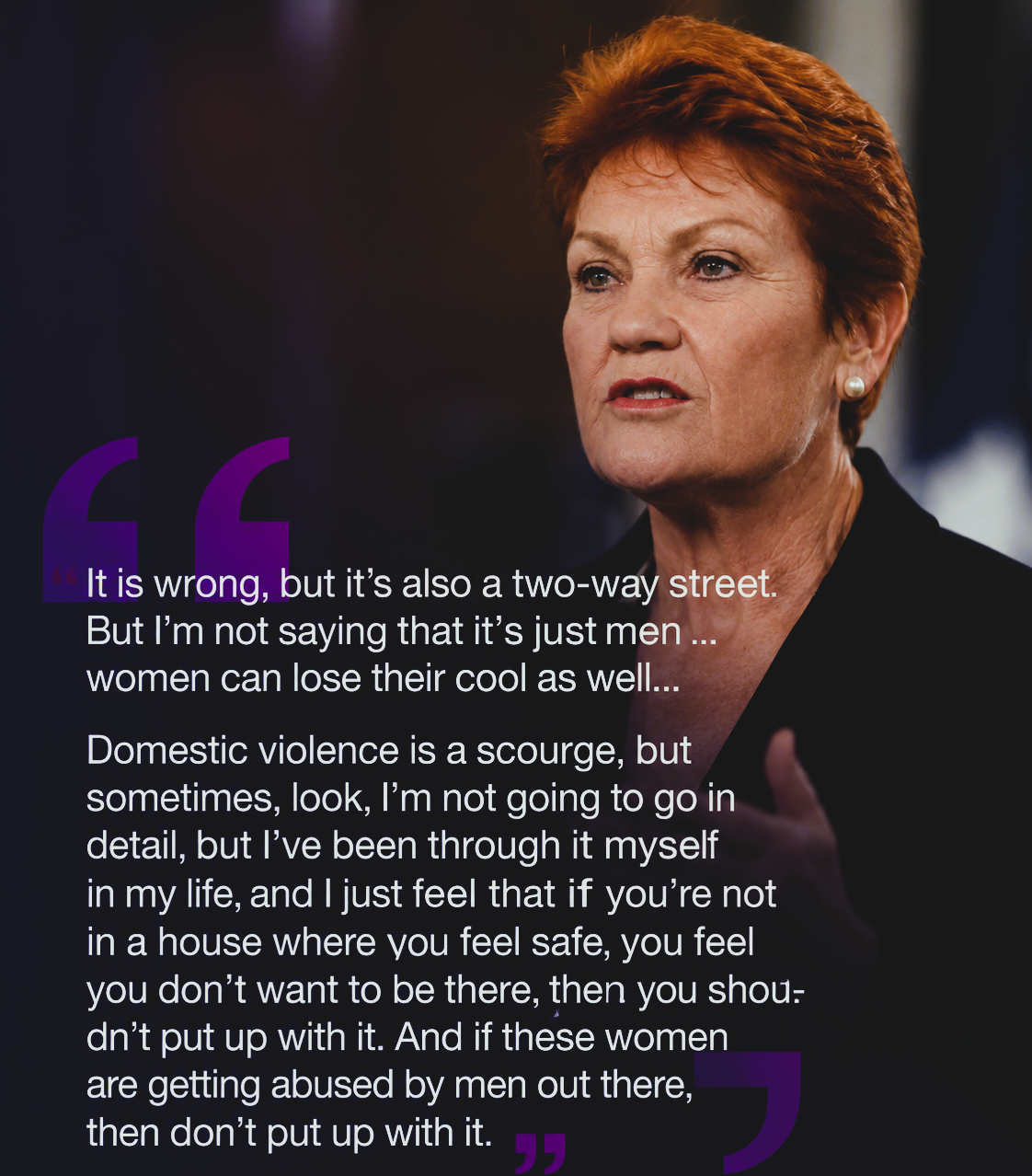
The Queensland senator made the remarks during an interview with 4BC when she was asked what message she would send to men who abuse their partners. Hanson responded that domestic violence was “wrong”, but added that it was also “a two-way street”, saying that both men and women could lose their tempers under pressure. She also urged women who felt unsafe in abusive relationships not to remain in those situations.
“It is wrong, but it’s also a two-way street,” Hanson said during the interview. “I’m not saying that it’s just men, women can lose their cool as well.” She went on to describe domestic violence as “a scourge” while speaking about the pressures many Australians face and encouraging victims not to tolerate abuse.
However, the comments quickly drew condemnation from domestic violence advocates, victim support organisations and politicians across the political spectrum, many of whom argued that Hanson’s framing risked shifting responsibility away from perpetrators and onto victims.
Critics said the phrase “two-way street” failed to recognise the power imbalance that frequently exists in abusive relationships and ignored extensive evidence showing that leaving an abusive partner is often the period of greatest danger for victims.
Women’s advocacy organisations warned that suggesting domestic violence is a mutual conflict rather than a pattern of coercive and controlling behaviour could discourage victims from seeking help or reinforce harmful misconceptions about abuse.
Tarang Chawla, a prominent domestic violence campaigner whose sister was murdered by her abusive partner, criticised Hanson’s comments, arguing that responsibility for domestic violence rests with the perpetrator rather than the victim. Other advocates stressed that while women can also commit acts of violence, the overwhelming majority of serious domestic violence incidents involving injury and homicide in Australia involve male perpetrators and female victims.
Former political staffer Brittany Higgins was among those who publicly criticised the senator, accusing her of promoting narratives that blame victims instead of focusing on those responsible for abuse. Higgins said Australia should be working to challenge, rather than reinforce, misconceptions about domestic violence at a time when violence against women remains a national concern.
Labor ministers also joined the criticism. Education Minister Jason Clare said domestic violence was not simply an argument between two people but a serious criminal offence, while other government figures argued political leaders should be careful not to minimise the realities faced by victims attempting to escape violent relationships.
Opposition figures likewise distanced themselves from Hanson’s remarks. Coalition representatives described the comments as unhelpful and stressed that discussions about domestic violence should recognise the complex and often life-threatening circumstances confronting victims.
Domestic violence experts emphasised that leaving an abusive relationship is frequently the most dangerous stage for victims. Research consistently shows that the risk of serious assault or homicide can increase when an abusive partner believes they are losing control over the relationship.
Elise Feltham, chief executive of Better Futures Education and Consultancy and a former Queensland police officer, described Hanson’s comments as “dangerous” and “irresponsible”. She argued that telling victims to “just leave” oversimplifies an issue involving fear, financial dependence, coercive control, children, housing insecurity and ongoing threats of violence.
Experts note that many victims remain in abusive relationships not because they accept the violence, but because leaving may expose them to greater risks. Safe accommodation, financial support, legal protection and specialist services are often critical factors in helping victims escape abusive situations safely.
Following the backlash, Hanson defended herself on social media, insisting her comments had been taken out of context. She published the full interview and argued that critics had ignored the parts where she clearly condemned domestic violence and encouraged victims not to tolerate abuse.
The One Nation leader maintained that she had never suggested violence was acceptable and said her own personal experiences had informed her views. Hanson argued that she was highlighting the pressures affecting many families while acknowledging that domestic violence remains unacceptable regardless of who commits it.
Even so, advocacy groups rejected the explanation, arguing that the wording itself carried significant weight because public figures influence how Australians understand domestic violence.
Australia has invested heavily in recent years to improve public awareness of coercive control, family violence and the barriers preventing victims from leaving abusive relationships. Governments across the country have introduced new laws, funding programs and awareness campaigns following a series of high-profile domestic violence deaths.
Calls have also intensified for broader national reforms after several women were allegedly killed in domestic violence-related incidents earlier this month, renewing pressure on governments to strengthen prevention measures and victim support services.
According to official Australian statistics, women continue to make up the overwhelming majority of victims in intimate partner homicide cases, although authorities recognise that men can also experience domestic and family violence. Support organisations therefore emphasise that services should remain available to all victims while recognising the gendered nature of the most severe offending.
The controversy surrounding Hanson’s comments has also revived debate over the responsibilities of elected representatives when discussing sensitive issues. Political leaders routinely shape public discourse, and advocacy groups argue that inaccurate or overly simplistic descriptions of domestic violence can undermine years of education aimed at encouraging victims to seek help.
For Hanson, the episode represents another high-profile controversy at a time when One Nation has remained a prominent force in Australian political debate. Throughout her political career, the Queensland senator has frequently attracted criticism for provocative comments on issues including immigration, multiculturalism, race relations and social policy.
Whether the latest controversy has any lasting political impact remains to be seen. However, the reaction has again highlighted how discussions surrounding domestic violence remain deeply sensitive in Australia, where policymakers, advocacy organisations and law enforcement agencies continue to stress that preventing abuse requires both holding perpetrators accountable and ensuring victims can access support without fear.
As debate continues, the central disagreement remains clear. Critics argue Hanson’s choice of words risks reinforcing harmful myths about domestic violence, while Hanson insists her comments have been misunderstood and that she was condemning abuse while encouraging victims to remove themselves from unsafe situations. The controversy is likely to remain part of Australia’s broader conversation about political rhetoric, victim protection and the country’s ongoing efforts to reduce domestic and family violence.






