One Nation leader Pauline Hanson has confirmed that mining billionaire Gina Rinehart paid for several flights during her recent European trip, including travel between London, Rome and Sicily, as well as her ticket to a luxury Dolce & Gabbana fashion event, while insisting Australian taxpayers did not contribute to the journey.
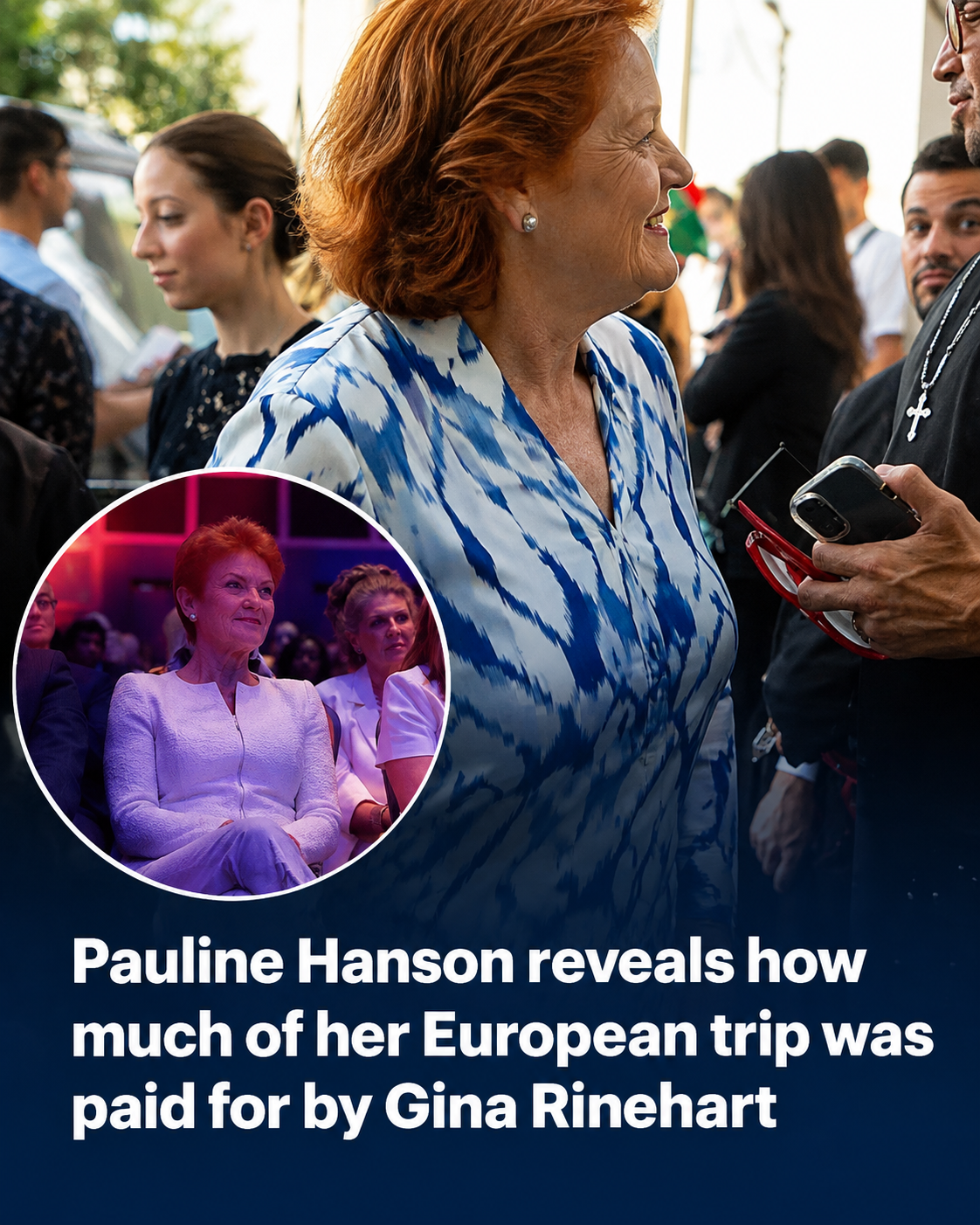
The details emerged after Senator Hanson updated her parliamentary Register of Interests, revealing that Mrs Rinehart funded her flights from London to Sicily via Rome and the return journey during a trip undertaken between 11 and 16 July. Hanson also disclosed that Rinehart covered the cost of her ticket to the exclusive Dolce & Gabbana fashion show held in Sicily.
However, Hanson said she personally paid for all accommodation, meals and day-to-day expenses throughout the visit.
“It didn’t cost the taxpayer one cent for my trip overseas. Not one cent,” Hanson said while responding to questions about the disclosures. She stressed that no public money had been used to fund the overseas travel and that the gifts had been properly declared in accordance with parliamentary disclosure requirements.
The updated declaration follows public scrutiny after photographs emerged showing Hanson and Rinehart together at the Grand Hotel San Pietro in Taormina, Sicily, before attending the Dolce & Gabbana event.
The images prompted widespread speculation about who had financed the high-profile European itinerary, particularly given Hanson’s position as a federal senator and leader of One Nation.
Under parliamentary rules, senators and members of parliament are required to disclose gifts, sponsored travel and other interests above specified thresholds through the Register of Interests. The register is designed to promote transparency by allowing the public to identify financial relationships that could give rise to actual or perceived conflicts of interest.
Hanson’s updated filing identified Rinehart as the provider of the flights and fashion show ticket while separately recording that she bore her own accommodation and living expenses.
The disclosure has once again drawn attention to the longstanding relationship between Hanson and Australia’s richest person.
Gina Rinehart, executive chair of Hancock Prospecting, has supported a number of One Nation activities in recent years through declared gifts and sponsored travel. Earlier this year, Hanson disclosed receiving a Cirrus G7 aircraft and campaign funding from Rinehart to assist One Nation’s election activities, a move that generated significant political debate over the influence of wealthy donors in Australian politics.
Hanson has consistently defended the relationship, arguing that Rinehart’s support is fully disclosed and complies with parliamentary rules.
She has also rejected suggestions that the businesswoman influences One Nation policy, maintaining that the party develops its positions independently and that donations or gifts do not determine its political agenda.
The European trip itself attracted considerable attention beyond the financial disclosures.
While overseas, Hanson attended the Dolce & Gabbana event alongside Rinehart, addressed the Conservative Political Action Conference (CPAC) in London and appeared on a podcast hosted by British far-right activist Tommy Robinson.
Her interview with Robinson, during which she made renewed criticisms of immigration and Islam, generated condemnation from Labor ministers, crossbench MPs and community organisations after excerpts were broadcast in Australia.
Questions were also raised about whether the overseas travel was appropriate while Parliament remained in recess.
Hanson responded that the visit took place during the parliamentary winter break and did not interfere with her parliamentary responsibilities. She argued that members of all major political parties routinely travel overseas during recess periods and that her itinerary should not be treated differently simply because of the public profile of those she met.
The renewed focus on Rinehart’s support has prompted broader discussion about transparency and political donations.
Australia’s parliamentary disclosure system requires parliamentarians to declare sponsored travel and significant gifts, but it does not prohibit such arrangements provided they are disclosed in accordance with the rules. Political finance experts have long argued that transparency enables voters to assess whether financial relationships may create perceptions of influence, while supporters of the current system contend that disclosure provides sufficient public accountability.
Critics of the Hanson-Rinehart relationship argue that repeated financial support from one of Australia’s wealthiest business figures risks creating the appearance of privileged access to political leaders, even where no rules have been breached.
Government ministers have also used the disclosures to criticise what they describe as increasingly close ties between sections of the political right and wealthy business interests.
Treasurer Jim Chalmers questioned the broader political implications of the relationship, suggesting Australians were entitled to understand who was financially supporting prominent political figures and why. He argued debates about housing affordability, taxation and economic policy should take place transparently and without undue influence from vested interests.
One Nation has rejected those criticisms.
The party argues it receives support from a wide range of Australians and maintains that every declared gift has been handled in accordance with parliamentary requirements.
Hanson has repeatedly pointed out that political parties across the spectrum receive financial support from businesses, unions and individual donors, contending that One Nation is being subjected to greater scrutiny because of her public profile and outspoken political positions.
The issue also highlights the distinction between parliamentary disclosure obligations and campaign donation laws.
While gifts provided directly to individual parliamentarians must be declared through the Register of Interests, political donations to parties and election campaigns are governed by separate electoral legislation administered by the Australian Electoral Commission.
Transparency advocates have argued that the two systems together are intended to provide voters with a clearer picture of financial relationships involving elected representatives.
For Hanson, the latest disclosures arrive during a period of heightened public attention.
In recent weeks she has announced a series of major policy proposals on immigration, energy and government spending while also remaining at the centre of legal and political controversies, including the Federal Court’s decision to dismiss her appeal in a racial discrimination case.
The European trip has therefore become part of a broader examination of both Hanson’s political agenda and her increasingly visible association with Rinehart.
Despite the renewed scrutiny, Hanson remains adamant that the central fact is straightforward.
She says Gina Rinehart funded specific flights and a fashion show ticket, she personally paid the remaining travel costs, the arrangements were disclosed through Parliament’s Register of Interests, and Australian taxpayers did not finance any part of the overseas visit.
Whether the disclosures generate further political consequences is likely to depend less on the legality of the arrangements—which Hanson insists fully comply with parliamentary rules—than on the continuing debate over transparency, political influence and the role of wealthy benefactors in Australia’s democratic system.