Pauline Hanson has unveiled what she says would be the defining priorities of a One Nation government, promising sweeping changes to immigration, Indigenous acknowledgements, climate policy and government spending if the party were ever elected to office.
Appearing during a special live edition of Paul Murray Live: Pauline Hanson, Please Explain on News24, the One Nation leader answered unscripted questions from voters and was asked directly what she would do during her first 100 days as Prime Minister.
Rather than offering broad political slogans, Hanson identified a series of immediate policy actions that she said would begin on day one of a One Nation government, arguing they were designed to reduce cost-of-living pressures, improve economic productivity and restore what she describes as “common sense” to government decision-making. 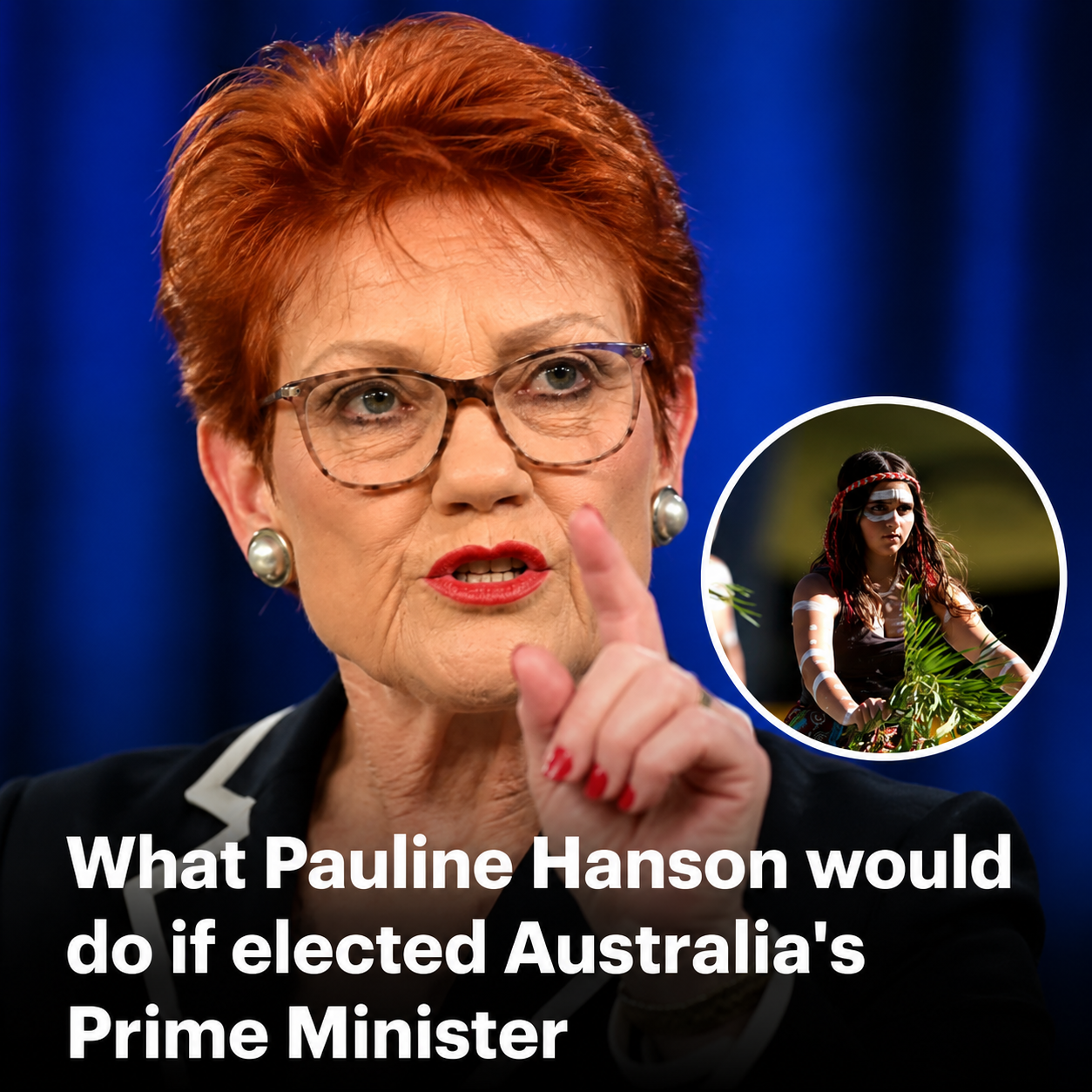
Welcome to Country ceremonies targeted
Among Hanson’s most controversial proposals was a commitment to remove Welcome to Country ceremonies and acknowledgements from federal government departments and public schools.
She said One Nation senators already demonstrate their opposition by turning their backs during Welcome to Country ceremonies in the Senate and argued the practice should no longer be incorporated into official government activities.
“I do not believe in having Welcome to Country,” Hanson said.
She clarified that private businesses would remain free to conduct ceremonies if they wished, but argued government agencies should no longer include Welcome to Country statements on official publications, websites or departmental material.
“You can’t stop people if businesses want to do it, all right. But in government departments, I wouldn’t have a Welcome to Country on the bottom of their literature or their sheets of paper they put out or government websites,” she said.
“I wouldn’t be having it in educational system schools. I’d shut it all down.”
The proposal reflects One Nation’s long-standing criticism that Welcome to Country ceremonies have become excessive within public institutions.
Supporters of the ceremonies argue they acknowledge the Traditional Owners of the land and promote recognition of Aboriginal and Torres Strait Islander cultures. Critics, including Hanson, contend they have become overused and unnecessarily divisive in government settings.
Immigration cut to 130,000
Reducing Australia’s migration program was identified as Hanson’s second major priority.
She said Australia was accepting too many migrants each year and argued that rapid population growth was placing additional pressure on housing, infrastructure and essential services.
Hanson proposed reducing annual immigration to approximately 130,000 people, while continuing to admit workers needed in sectors experiencing genuine labour shortages.
She specifically cited doctors, nurses and other highly skilled professionals as examples of occupations that would continue to receive priority under a One Nation government.
By contrast, Hanson argued Australia should become far more selective about migration in occupations where she believes there is already an adequate domestic workforce.
According to Hanson, lower migration would ease pressure on housing supply while improving wages and productivity for Australian workers.
Net zero policies would be dismantled
Energy policy forms another central pillar of Hanson’s proposed first 100 days.
She pledged to abolish the federal government’s climate change department, withdraw Australia from the Paris Agreement and end the national commitment to achieving net zero emissions.
Hanson argues those policies have contributed to rising electricity prices and increased living costs for households and businesses.
One Nation has consistently advocated expanding reliable baseload energy generation while criticising renewable energy targets that the party says increase costs without delivering sufficient benefits to Australian consumers.
Successive Labor governments have defended the net zero target as essential for reducing emissions, encouraging investment and ensuring Australia remains internationally competitive as global energy markets transition toward lower-carbon technologies.
The contrasting approaches illustrate one of the clearest policy differences likely to feature prominently at the next federal election.
Government spending and inflation
Hanson also linked rising living costs to what she described as excessive government spending.
She argued inflation had been fuelled in part by increasing public expenditure and said reducing unnecessary spending would become a key priority under a One Nation administration.
According to Hanson, lower government expenditure would help relieve inflationary pressure while improving Australia’s long-term fiscal position.
Economists remain divided on the extent to which government spending has contributed to inflation, with many pointing to a combination of global supply disruptions, energy prices, labour shortages and domestic demand following the COVID-19 pandemic.
Nevertheless, cost-of-living pressures continue to dominate political debate across Australia, making economic management one of the central issues heading toward the 2028 federal election.
Further reforms planned
Beyond her three headline priorities, Hanson outlined several additional reforms she says would be pursued during the opening months of a One Nation government.
Those proposals include providing Commonwealth Seniors Health Cards to all self-funded retirees, launching an investigation into Australia’s multi-billion-dollar childcare funding system, tightening oversight of the National Disability Insurance Scheme to target fraud and waste, and continuing legal efforts to challenge Section 18C of the Racial Discrimination Act in the High Court following her recent court defeat.
On the NDIS, Hanson argued genuine participants should continue receiving support while those abusing the system should face stronger enforcement.
She also reiterated her long-standing position that government services should be allocated according to individual need rather than race, extending that argument to Indigenous funding programs.
A campaign aimed at dissatisfied voters
Hanson’s policy blueprint arrives as One Nation continues to experience renewed political momentum.
Recent national polling has shown the party recording some of its strongest support in years, with growing voter concern surrounding immigration, housing affordability, electricity prices and the broader cost of living.
The One Nation leader has increasingly sought to present her party as a credible alternative to both Labor and the Coalition rather than simply a protest movement.
Her willingness to outline specific priorities for a hypothetical first 100 days reflects that broader strategy, giving voters a clearer understanding of how she believes a One Nation government would differ from Australia’s major parties.
Whether those policies ultimately gain broader electoral support remains uncertain.
Supporters argue Hanson’s proposals directly address issues many Australians identify as their highest priorities, including migration, affordability and energy costs. Opponents contend several proposals would prove divisive or difficult to implement and have questioned both their legal and economic implications.
Regardless of those differing views, the News24 appearance provided one of the most detailed explanations yet of One Nation’s governing agenda.
With almost two years remaining before the scheduled 2028 federal election, Hanson has placed immigration, government spending, energy policy and cultural issues firmly at the centre of her political campaign. As debate over cost-of-living pressures continues to dominate Australian politics, those issues are expected to remain key battlegrounds between One Nation, Labor and the Coalition in the years ahead.






