A new nationwide polling model has delivered one of the strongest results ever recorded for Pauline Hanson’s One Nation, suggesting the party could be within striking distance of helping form Australia’s next federal government if an election were held today.
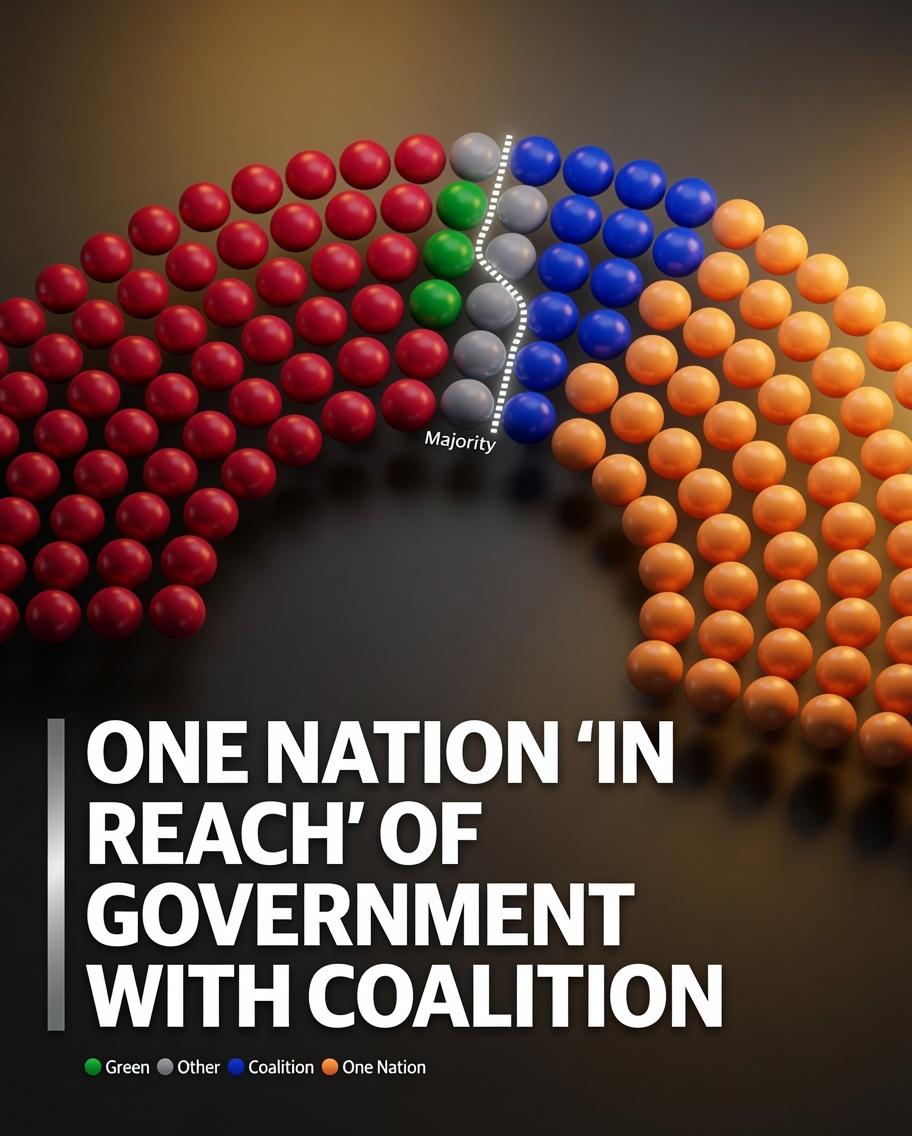
The latest Multilevel Regression and Poststratification (MRP) model from Australian polling firm DemosAU places One Nation on a primary vote of 30 per cent, ahead of Labor on 26 per cent, the Coalition on 21 per cent and the Greens on 13 per cent. The model is based on responses from 9,343 voters surveyed between May and July 2026.
Rather than forecasting a majority government, the modelling points towards a hung parliament in which no single party reaches the 76 seats required to govern in its own right.
DemosAU estimates One Nation could secure between 53 and 66 seats in the House of Representatives, while Labor is projected to win between 60 and 72 seats. Under that scenario, both sides would require support from other parties or independents to command a parliamentary majority.
George Hasanakos, Head of Research at DemosAU, said the figures place One Nation “within arm’s reach” of participating in government alongside the Coalition if parliamentary numbers allowed such an arrangement. He argued the model reflects a profound shift in Australian voting behaviour, particularly outside the major metropolitan centres.
The modelling indicates One Nation is now leading in 39 of Australia’s 41 regional and rural electorates, while also making significant inroads into outer suburban seats in Queensland, Western Australia, New South Wales and parts of Victoria.
Support remains comparatively weaker in inner-city electorates, where Labor, the Greens and teal independents continue to perform more strongly.
The findings add to a broader trend that has emerged throughout 2026, with One Nation recording stronger support in successive polls as cost-of-living pressures, housing affordability, immigration and public confidence in the major parties remain prominent political issues.
Political analysts say the party has been particularly successful in attracting voters from both Labor and the Coalition in regional communities and outer metropolitan areas, where dissatisfaction with traditional parties has grown.
Despite the headline figures, the modelling does not suggest One Nation could govern on its own.
Australia’s preferential voting system means primary vote support represents only one stage of determining election outcomes. Preference flows from eliminated candidates can significantly alter final seat results, especially in closely contested electorates involving multiple parties.
Under the DemosAU projections, Labor would likely require ongoing support from the Greens and members of the crossbench to remain in office, while One Nation would need cooperation from the Coalition if it hoped to participate in forming an alternative government.
The prospect of such cooperation remains politically contentious.
Opposition Leader Angus Taylor has repeatedly stated there are no plans for a formal Coalition agreement with One Nation, maintaining that the Coalition’s longstanding partnership remains with the National Party. However, several Liberal figures have previously suggested that any post-election arrangements would ultimately depend on the parliamentary arithmetic after voters cast their ballots.
The poll also reflects the continuing fragmentation of Australia’s political landscape.
For decades, federal politics has largely been dominated by Labor and the Coalition. In recent election cycles, however, support for minor parties and independents has steadily increased, making minority governments and more complex parliamentary negotiations increasingly plausible.
One Nation’s recent rise forms part of that broader shift, although whether polling momentum ultimately converts into seats remains uncertain. Campaign performance, local candidates, preference recommendations and electorate-specific issues all have the potential to significantly influence final outcomes.
The methodology used by DemosAU differs from traditional national opinion polling.
MRP modelling combines survey responses with demographic and geographic information to estimate likely voting behaviour across each electorate rather than simply measuring national vote shares. The approach has become increasingly common internationally because it attempts to account for local variations that ordinary national polls may overlook.
Even so, polling experts caution that MRP models remain projections rather than predictions. They rely on assumptions about turnout, demographic behaviour and preference flows that can change considerably during an election campaign.
The modelling nevertheless underlines the scale of the challenge facing Australia’s major parties.
For Labor, the projected decline in primary vote highlights ongoing pressure from both One Nation and the Greens across different parts of the electorate. For the Coalition, the figures suggest continued difficulty rebuilding support after losing voters to Pauline Hanson’s party, particularly in regional Australia.
Whether One Nation ultimately reaches the upper end of the projected 53-to-66-seat range remains highly uncertain. However, the latest DemosAU modelling indicates the party has evolved into a significantly larger electoral force than in previous federal contests and could play an influential role in determining who forms Australia’s next government if the election produces a hung parliament.






