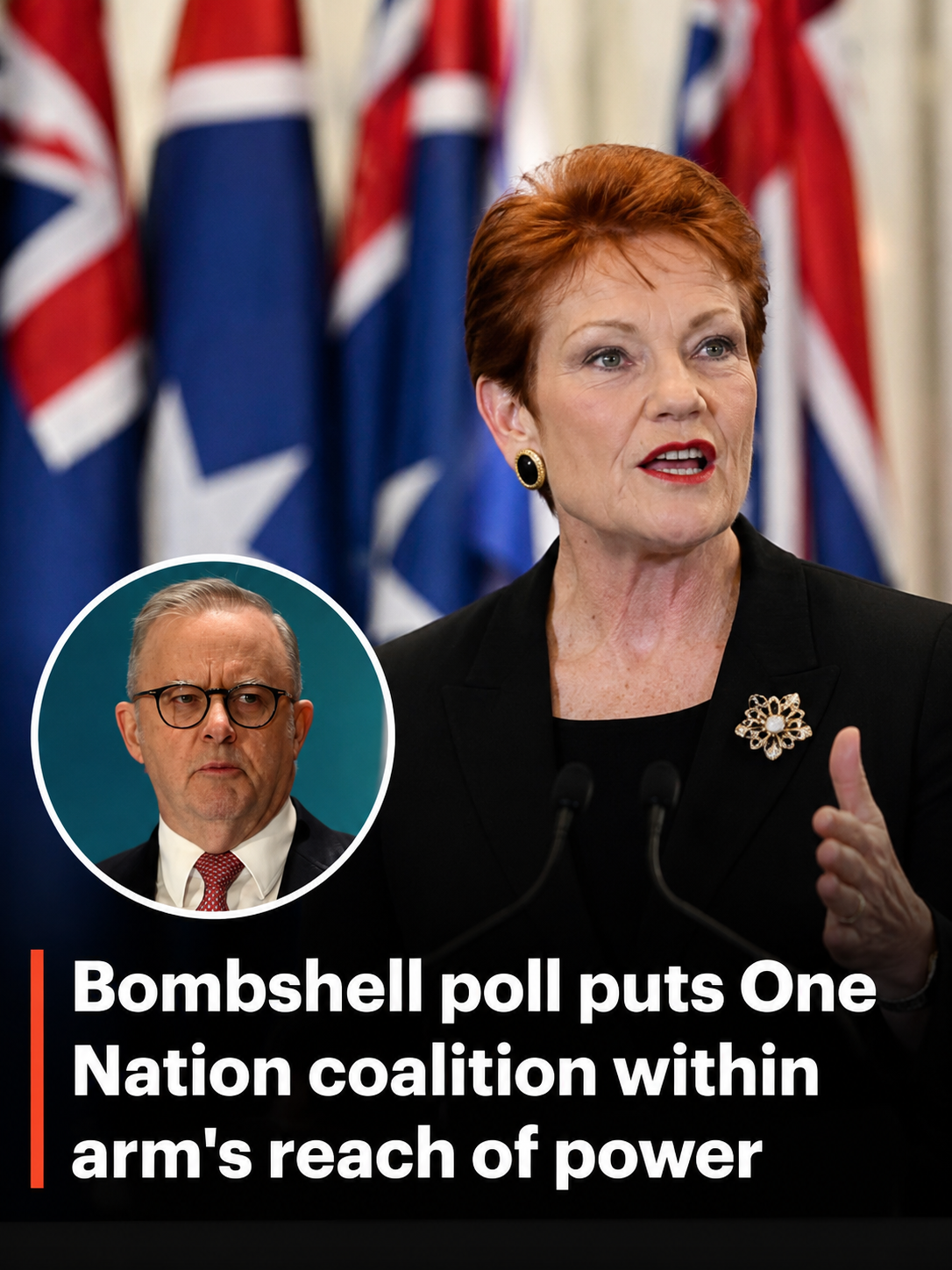
A major new national poll has dramatically reshaped the conversation surrounding Australia’s political landscape, suggesting Pauline Hanson’s One Nation could emerge as one of the country’s dominant parliamentary forces if a federal election were held today.
The DemosAU mega poll, based on responses from 9,343 voters collected between May and July 2026, projects a highly fragmented House of Representatives in which neither Labor nor One Nation would secure an outright majority, leaving Australia on course for a hung parliament.
Using a Multilevel Regression and Post-stratification (MRP) model to estimate outcomes across all 150 federal electorates, DemosAU projects Labor would win between 60 and 72 seats, while One Nation could secure between 53 and 66 seats.
The Coalition is forecast to win only 11 to 22 seats, while the Greens are projected to hold between one and five electorates.
With 76 seats required for an outright majority in the House of Representatives, the modelling indicates that no party would be capable of governing alone.
Although Labor remains projected to finish with the largest number of seats, the poll highlights the extraordinary rise of One Nation across many of Australia’s traditional battleground electorates.
According to the modelling, Pauline Hanson’s party now leads the primary vote in many outer metropolitan communities, recording around 30 per cent support across the 64 electorates considered most likely to determine the outcome of the next federal election.
Those suburbs have historically decided changes of government and have increasingly become the focus of campaigns centred on housing affordability, migration, energy prices and the cost of living.
The strongest support for One Nation continues to come from regional Australia.
DemosAU’s modelling suggests the party leads the primary vote in 39 of the 41 seats classified as regional or rural and indicates that, under favourable preference flows, it could potentially win all 41.
Researchers describe Queensland as the party’s strongest state, where One Nation records a projected primary vote of 34 per cent and is estimated to be leading in 20 of the state’s 30 federal electorates.
DemosAU Head of Research George Hasanakos said the modelling demonstrates how dramatically Australia’s electoral map has shifted.
Rather than following the traditional contest between Labor and the Coalition, the projections suggest One Nation is now competing directly with Labor in dozens of seats while the Coalition risks being pushed into third place across large parts of the country.
The findings have reignited debate over what might happen if neither Labor nor One Nation achieved a parliamentary majority.
Political attention has quickly turned to whether the Coalition could ultimately support a minority government involving One Nation.
Opposition Leader Angus Taylor has repeatedly rejected the prospect, arguing that One Nation’s economic policies would cause “an eternity of pain” for Australia.
However, Liberal senator Andrew Bragg recently left open the possibility of future parliamentary cooperation, saying political realities after an election could require parties to negotiate if no clear majority emerged.
The differing positions illustrate growing tensions within the Liberal Party.
Some conservatives argue that refusing any dialogue with One Nation risks alienating a substantial section of centre-right voters.
Others believe a formal arrangement could fundamentally reshape the Coalition’s identity and create long-term electoral risks in metropolitan Australia.
For Labor, the poll presents a different challenge.
Although the modelling still places Anthony Albanese’s government ahead in total seats, it suggests Labor’s support has become increasingly concentrated in inner metropolitan electorates.
The party continues to dominate many central-city seats, but the projected losses across regional and outer suburban Australia raise questions about Labor’s ability to maintain its traditional working-class base over the longer term.
The poll reflects broader changes that have been reshaping Australian politics in recent years.
Support for the two major parties has steadily declined as voters increasingly turn to independents and minor parties, producing more fragmented electoral contests and making preference flows significantly more important than in previous decades.
Australia’s preferential voting system means that primary vote alone does not determine who forms government.
Instead, lower-preference votes from eliminated candidates are redistributed until one candidate secures a majority in each electorate.
As a result, even substantial gains in primary vote do not automatically translate into parliamentary seats unless accompanied by favourable preference flows.
That remains one of the major uncertainties surrounding One Nation’s electoral prospects.
While the DemosAU modelling incorporates estimated preference behaviour, actual voter preferences during an election campaign can differ significantly from polling assumptions. Small shifts in preference flows could alter outcomes across dozens of closely contested seats.
Political scientists also caution that MRP modelling should be viewed differently from conventional opinion polling.
Rather than simply measuring national voting intention, MRP combines survey responses with demographic and electoral data to estimate likely results in individual electorates.
The technique has become increasingly popular internationally because it attempts to capture regional voting patterns that national polls may overlook.
However, like all modelling, its projections remain sensitive to underlying assumptions and should not be interpreted as election results.
For Pauline Hanson, the figures represent another indication of the party’s growing momentum.
One Nation has spent recent years focusing heavily on issues such as immigration, energy policy, cost-of-living pressures, housing affordability and government spending.
Supporters argue those themes have resonated with voters frustrated by both major parties, particularly in regional Australia and rapidly growing outer suburbs.
Critics, meanwhile, contend that polling conducted well before an election may overstate support for protest parties and that sustained campaigning tends to favour larger political organisations with greater financial and organisational resources.
Whether One Nation can convert polling momentum into parliamentary victories therefore remains one of the central questions heading towards the next federal election.
The Coalition also faces a strategic dilemma.
If One Nation continues expanding into traditional conservative electorates, Liberal and National candidates may increasingly compete against Pauline Hanson’s party for the same pool of voters.
That dynamic could split the conservative vote in some seats while simultaneously creating opportunities in others depending on preference recommendations and local campaigns.
For Prime Minister Anthony Albanese, the poll highlights the increasingly complex electoral environment confronting Labor.
Although the government remains competitive under the current projections, the modelling suggests that Australia’s political landscape is becoming substantially more fragmented than during previous elections.
The prospect of a hung parliament would almost certainly require negotiations between parties and independents before a government could be formed.
Such outcomes are uncommon at the federal level but have become more frequent in several Australian states over recent years.
Ultimately, the DemosAU modelling does not predict that One Nation will form government.
Rather, it suggests the party has entered a position where, under one possible electoral scenario, it could become a decisive parliamentary force if no party wins an outright majority.
With the next federal election still to come, campaign performance, economic conditions, leadership debates and preference decisions will all influence whether these projections ultimately become political reality.
For now, however, the poll underscores a remarkable shift in Australian politics: a party that for decades occupied the political fringe is now being modelled as a potential kingmaker—and, under some scenarios, a contender to help shape the nation’s next government.






