NSW One Nation leader Mike Newman’s call for tighter abortion controls has opened a new state political dispute over late-term termination and sex-selection abortion, while Premier Chris Minns has urged voters to examine One Nation’s policies closely.
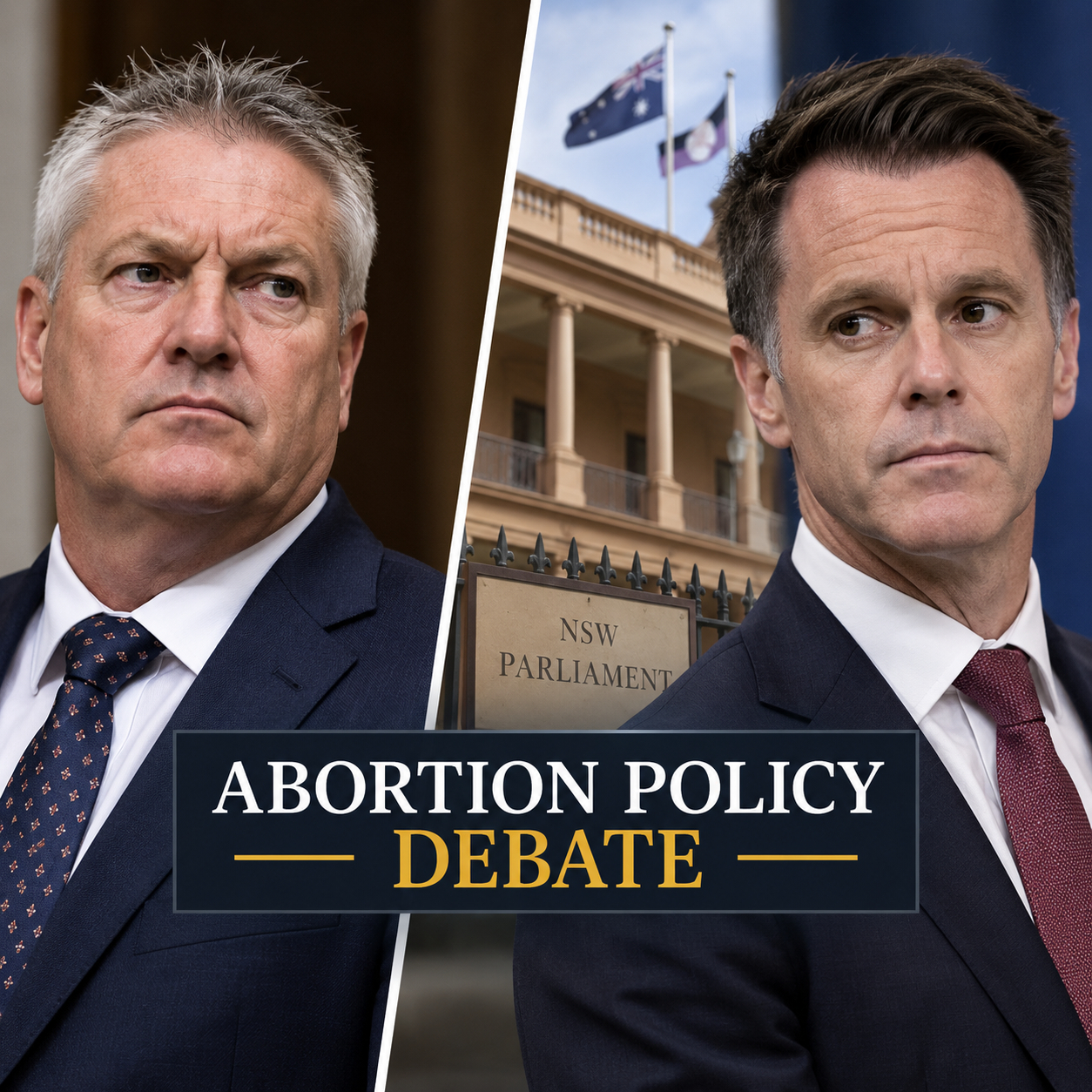
Newman told a rally outside NSW Parliament that his party wanted stronger restrictions and later clarified to the ABC that he was referring to abortions sought for the purpose of sex selection and to later-term abortions.
The clarification is important because NSW already has a legal and clinical framework governing abortion, and current NSW Health policy already restricts termination when the sole purpose is sex selection.
Under the NSW Health framework, if a practitioner determines that a termination is being sought solely for sex selection, the practitioner must not perform it unless refusing would create a significant risk to the woman’s health or safety. That rule operates through binding health policy for practitioners.
Newman’s position therefore should not be presented as though NSW currently has no rule on sex-selection abortion. The policy debate is about whether restrictions should be tightened or written more directly into legislation, and what additional rules One Nation would pursue if it gained power.
That issue is already before parliament in another form. Libertarian MP John Ruddick has promoted a private member’s bill that would create a statutory prohibition on abortion for the purpose of sex selection. Supporters argue that putting the restriction directly into law would make the rule clearer and provide stronger sanctions.
Critics argue the proposal is unnecessary because NSW Health policy already prohibits the practice and warn that new criminal penalties could discourage clinicians or be used as a path toward broader abortion restrictions.
Newman has said he supports the principles of the Ruddick proposal and has also spoken about tighter controls on later-term abortions.
Current NSW law distinguishes between abortions at or before 22 weeks of pregnancy and those after 22 weeks.
For a termination after 22 weeks, a specialist medical practitioner must consider that there are sufficient grounds for the procedure and must consult another specialist who also considers there are sufficient grounds. Except in an emergency, the procedure must take place in specified public hospitals or approved facilities.
Those requirements mean later-term abortion is already subject to additional clinical and procedural safeguards. A call for “tighter controls” would therefore require further detail about what Newman wants changed: the gestational threshold, the approval process, the grounds considered by specialists, the facilities where procedures can occur, or some combination of those elements.
That detail has not yet been fully set out in a comprehensive One Nation legislative package.
The distinction matters because abortion policy is highly sensitive and broad political statements can sound more sweeping than the legal proposal behind them.
Newman’s remarks at the rally initially included language that appeared broader than the clarification he later provided. When contacted by the ABC, he specified sex-selection and late-term abortion as the areas he wanted to address.
For accurate reporting, that clarification should be included rather than treating the broadest version of the rally language as the party’s final policy description.
NSW Greens MP Amanda Cohn has criticised the direction of the proposal and argued that efforts to legislate further restrictions are part of an attempt to reduce reproductive rights in the state.
Supporters of tighter controls reject that characterisation and say their focus is on specific circumstances rather than a wholesale reversal of abortion law.
The difference between those positions is political and substantive. It cannot be resolved by describing one side’s motive as fact.
The current legal baseline is clearer.
Abortion in NSW is governed by the Abortion Law Reform Act 2019 and subsequent amendments and health-policy frameworks. The 2019 law removed abortion from the Crimes Act framework that had previously governed it and established a statutory health-care model.
NSW Health requires terminations to be notified to the Ministry of Health within 28 days without identifying the patient. Clinical requirements vary according to gestation and the circumstances of the procedure.
The current framework also contains provisions for practitioners with conscientious objections and for counselling and referral support.
On sex selection, the relevant NSW Health policy is explicit that a practitioner must not perform a termination solely for that purpose unless refusing would create a significant health or safety risk.
That is why a political claim that NSW simply “allows sex-selection abortion” would be misleading.
The debate is instead about whether a health-policy prohibition should be reinforced with a separate statutory offence or stronger penalty, and whether any such change could affect access to lawful abortion in other circumstances.
Supporters of legislation point to the principle that sex selection should not be a reason for termination and argue a specific law would make that standard more durable.
Opponents question whether the problem exists at a scale that justifies criminalisation.
An earlier NSW Health review examined reported terminations and found a very small number recorded as being for the sole purpose of sex selection. The ABC reported that many of those records were likely reporting errors because the pregnancies had been terminated at a stage when reliable sex determination would not normally have been available.
That data does not prove the practice never occurs. It does show why claims about its prevalence need to be made cautiously.
Supporters of tighter laws have also pointed to research into birth-sex ratios among some migrant communities. Research cited in the debate has identified patterns that could be consistent with prenatal sex selection in some populations, while the authors themselves cautioned that the study did not establish causality.
That limitation is important. Population-level birth ratios cannot identify why an individual pregnancy ended and should not be treated as direct proof of a particular abortion practice.
The later-term abortion issue raises a different set of questions.
Abortions after 22 weeks are uncommon and can involve complex medical circumstances, including serious fetal conditions or risks to the pregnant patient. NSW law requires specialist involvement and additional clinical assessment.
Political proposals to tighten those rules need to specify how they would deal with emergencies, severe fetal abnormalities, threats to health and other difficult clinical situations.
Without that detail, it is not possible to determine the full practical effect of Newman’s stated position.
Premier Chris Minns has used the controversy to argue that voters should examine One Nation’s platform carefully. His comments are a political response to a rival party and should not be treated as an independent assessment of what voters ought to choose.
Newman, for his part, says One Nation intends to run candidates widely across NSW and argues the major parties are focusing on his party because they are concerned about its growing profile.
Those statements form part of the political contest around the policy. They do not change the underlying legal position.
The NSW government remains in office, the current abortion law remains in force and One Nation has not enacted any new restriction.
Any change would require a bill to pass parliament or, for some matters, a government to change health policy within the limits of existing law.
That process would involve scrutiny of the wording, medical evidence, human-rights implications and practical effect on health professionals and patients.
It is also important not to confuse policy debates about abortion with election predictions. The existence of a rally, a proposed bill or statements about One Nation’s electoral ambitions does not establish who will form the next NSW government.
The immediate issue is narrower: Newman is signalling that abortion regulation would be an area of policy action for One Nation, with a particular focus on sex selection and later-term procedures.
Minns and the Greens are challenging that direction, while supporters of tighter controls are arguing that existing rules should be strengthened.
For readers trying to understand what could actually change, the key is to compare proposals with the rules already in place.
NSW already requires additional specialist review after 22 weeks. NSW Health already prevents practitioners from performing a termination solely for sex selection except where refusal would create a significant health or safety risk. A new One Nation policy would have to go beyond those existing safeguards to create a substantive change.
Until a detailed bill or platform is released, it is not possible to say exactly how far Newman wants to go.
The responsible description is therefore a policy dispute over proposed tighter controls, not a claim that NSW has already changed abortion law or that existing rules permit sex-selection termination without restriction.
That factual boundary is especially important on a subject where political language can quickly become more absolute than the legislation and clinical rules it is describing.