Reform UK leader Nigel Farage has described Pauline Hanson as a “remarkable” political figure, declaring that Australia’s political establishment should be “absolutely terrified” of the veteran One Nation leader as he praised her longevity and ability to connect with voters.
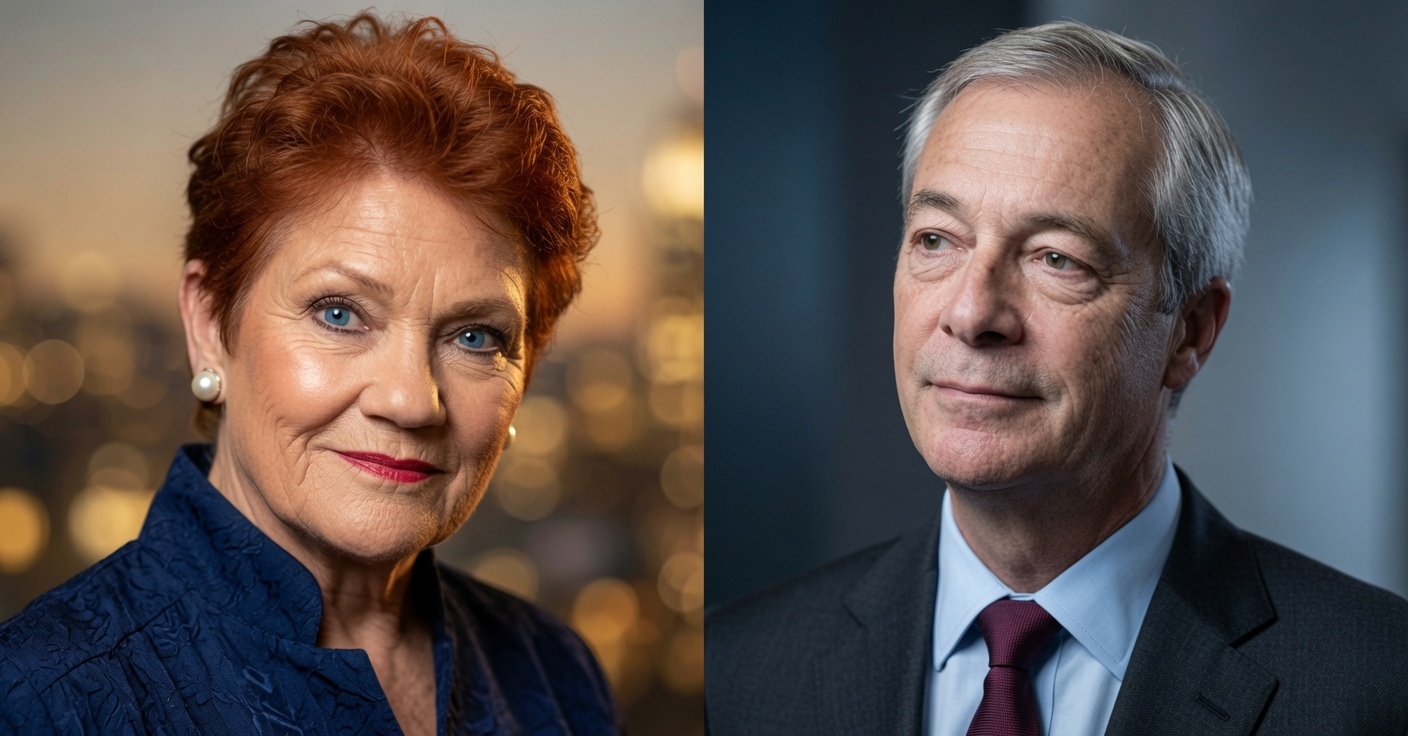
Farage made the comments after meeting Hanson during the Conservative Political Action Conference (CPAC) in London, where conservative politicians and commentators from several countries gathered to discuss issues including immigration, national sovereignty and cultural identity.
Speaking after the event, the Reform UK leader said he had known Hanson for many years and admired her consistency in Australian politics.
“I’ve met her on and off many times over the years,” Farage said.
Asked for his assessment of the One Nation leader, he responded: “Well, she never pretends to be what she’s not. She’s remarkable, she’s remarkable. And she keeps going, she keeps going, and I think the establishment in Canberra must be absolutely terrified.”
The comments come as Hanson has attracted renewed attention following a series of overseas appearances, including speeches at CPAC UK and meetings with several conservative political figures during her European trip.
Farage’s endorsement is significant because both politicians have become closely associated with populist movements in their respective countries. Hanson founded One Nation in 1997 after entering federal politics as an independent, while Farage became one of the most recognisable campaigners for Brexit before going on to lead Reform UK.
Although they operate in different political systems, both have built their careers around criticism of high immigration levels, opposition to what they describe as political correctness, and arguments that mainstream parties have become disconnected from ordinary voters.
Farage suggested Australia and the United Kingdom were experiencing similar political trends, arguing that many voters had lost confidence in traditional political parties.
Speaking while campaigning in his Clacton constituency, he said Australians appeared to be experiencing the same sense of political frustration that had fuelled support for Reform UK in Britain.
“I think in Australia, you’ve got some similar things going on down there,” Farage said, referring to the growing support for One Nation.
His remarks follow recent polling that has indicated increased support for One Nation in parts of Australia, particularly as debate intensifies over migration, housing affordability, cost-of-living pressures and energy policy.
While Labor and the Coalition continue to dominate Australian federal politics, Hanson has argued that dissatisfaction with the major parties is creating new opportunities for minor parties and independents.
The meeting between Hanson and Farage took place during the inaugural CPAC conference in London, an event that brought together conservative politicians from across the English-speaking world.
During her appearance, Hanson delivered a speech criticising Australia’s migration settings, multiculturalism and net zero policies, while warning that Australia risked following social and economic trends she believes have affected parts of Britain. Her remarks generated strong criticism from political opponents, who accused her of promoting divisive rhetoric, while supporters praised her willingness to address issues they believe mainstream parties avoid.
Farage has himself become one of Europe’s most recognisable anti-establishment politicians.
He first gained international prominence through the UK Independence Party (UKIP), campaigning for Britain’s withdrawal from the European Union before later establishing Reform UK as a significant force in British politics.
His political style—emphasising direct communication, criticism of established institutions and appeals to voters dissatisfied with mainstream parties—has frequently drawn comparisons with Hanson, despite differences between British and Australian politics.
For Hanson, the endorsement from Farage reinforces relationships she has built with conservative political figures overseas.
In recent years she has attended several CPAC events and has spoken alongside politicians advocating tighter immigration controls, greater national sovereignty and opposition to progressive social policies.
Those international connections have also become a source of political controversy.
Critics argue that some of the figures appearing at overseas conservative conferences promote rhetoric that is too polarising for Australian politics. Hanson has consistently rejected those claims, maintaining she attends such events to exchange ideas with like-minded politicians and to discuss policy approaches rather than endorse every individual speaker.
The latest comments from Farage are also likely to fuel debate about One Nation’s electoral prospects.
Although Hanson has remained a fixture of Australian politics for nearly three decades, her party’s level of parliamentary representation has fluctuated considerably over that period.
Support for One Nation has often increased during periods of economic uncertainty or heightened public concern about immigration, only to ease again as political priorities change.
Political analysts note that One Nation’s influence extends beyond the number of seats it wins.
The party has frequently shaped national debate by placing issues such as immigration, regional development, energy policy and government spending firmly on the political agenda, with both major parties at times responding to concerns that have resonated with sections of the electorate.
Farage’s suggestion that Canberra should be “terrified” is widely understood as political rhetoric rather than a literal prediction. His broader argument was that establishment parties should pay close attention whenever voters increasingly turn towards outsider movements promising major political change.
Whether that prediction proves accurate will ultimately depend on Australian voters.
With the next phase of political debate expected to focus heavily on migration, housing affordability, inflation and energy costs, Hanson and One Nation are seeking to position themselves as an alternative to the major parties on many of those issues.
For now, Farage’s endorsement provides another high-profile international boost for Hanson, while also highlighting the growing connections between conservative populist movements across several Western democracies.
At the same time, critics continue to argue that the political approaches championed by both leaders risk deepening social divisions, while supporters maintain they are giving voice to concerns that many voters believe have been ignored for too long.
As debate over immigration and the cost of living continues in both Australia and the United Kingdom, the relationship between Farage and Hanson is likely to remain under close political scrutiny, particularly as both continue to argue that dissatisfaction with mainstream politics is reshaping the electoral landscape.






