The son of independent Senator Lidia Thorpe has become the centre of a fresh political controversy after using his maiden speech in Victoria’s First Peoples’ Assembly to deliver a forceful critique of Australia’s colonial history and the state’s institutions.
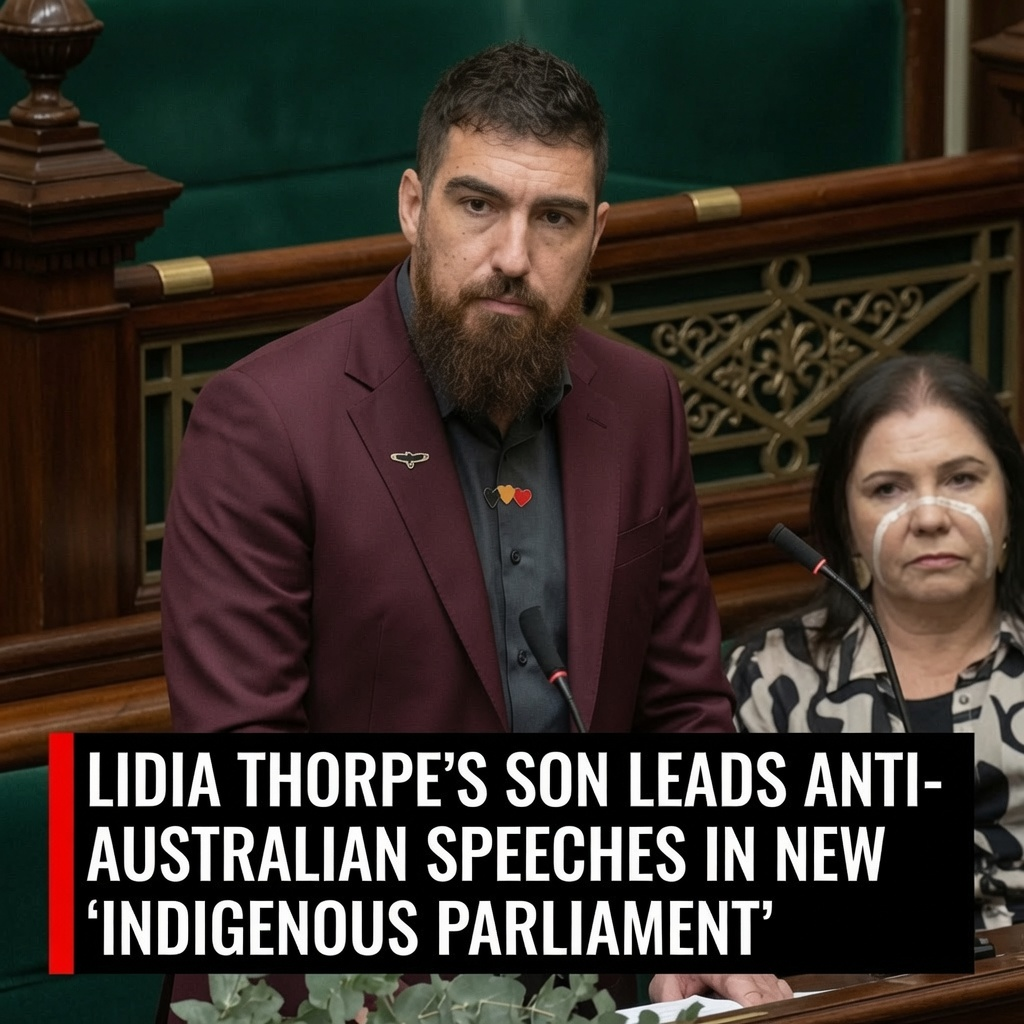
Andrew Thorpe, recently elected to represent Victoria’s South East Region in the First Peoples’ Assembly, opened his inaugural address by acknowledging that Parliament House stands on what he described as “stolen land”. Throughout his speech he also referred to Victoria as “so-called Victoria”, criticised historical government policies affecting Aboriginal communities and argued that Treaty negotiations should be viewed as only one step towards broader Indigenous self-determination.
His remarks immediately reignited one of Australia’s most contentious political debates, with supporters describing the speech as a legitimate expression of Indigenous sovereignty while critics accused Assembly members of promoting divisive and anti-Australian rhetoric.
The controversy comes as Victoria continues implementing Australia’s only active state-based Treaty process, an initiative that remains deeply polarising across the political spectrum.
Andrew Thorpe is one of more than 30 newly elected representatives who recently joined the First Peoples’ Assembly following elections held earlier this year. The Assembly serves as the representative body for Aboriginal Victorians during Treaty negotiations with the Victorian Government.
During his speech, Thorpe thanked his family for supporting him and spoke about what he sees as the long-term impacts of colonisation on Aboriginal communities. He also raised concerns about the number of Aboriginal children in out-of-home care and argued that structural reforms remain necessary.
Several other newly elected Assembly members also delivered speeches centred on Indigenous sovereignty, historical injustice and the Treaty process. Some referred to the phrase “sovereignty has never been ceded”, while others criticised the legacy of European settlement and called for greater recognition of Aboriginal perspectives.
Those comments quickly attracted criticism from conservative commentators and political opponents, who argued some of the language portrayed Australia unfairly and risked further dividing the community.
The debate reflects longstanding disagreements over how Australia’s colonial history should be understood and discussed in public institutions.
The First Peoples’ Assembly was originally established to negotiate the framework for Victoria’s Treaty process after legislation passed in 2018. Since then, it has played a central role in discussions between the Victorian Government and First Nations communities regarding future agreements on self-determination, decision-making and community governance.
In 2025, Victoria became the first Australian jurisdiction to formally sign a statewide Treaty agreement, expanding the Assembly’s future responsibilities as part of broader reforms involving Aboriginal representation and truth-telling initiatives. The Victorian Government says these reforms are intended to give First Peoples greater influence over policies affecting their communities.
Supporters argue that Treaty represents an opportunity to improve outcomes by allowing Aboriginal communities to participate more directly in decisions affecting health, education, child protection and cultural heritage.
Critics, however, argue that the arrangements create an additional layer of governance based on ancestry and may grant disproportionate influence to a relatively small elected body. The Victorian Liberal Party has pledged to dismantle the Assembly if it wins government at the next state election, making the future of the institution a significant campaign issue.
The election that produced the Assembly also drew attention because of relatively low participation. Approximately 43,000 Aboriginal Victorians were eligible to enrol, but significantly fewer registered to vote, and only around half of those enrolled ultimately cast a ballot, prompting ongoing debate about how representative the Assembly is of the broader Indigenous population.
Members of the Assembly receive remuneration comparable to many senior public office holders because their positions involve full-time responsibilities associated with Treaty negotiations, policy development and engagement with Aboriginal communities.
Andrew Thorpe’s election has also attracted attention because of his family connection.
His mother, Senator Lidia Thorpe, is one of Australia’s highest-profile Indigenous politicians and has frequently generated national headlines through her advocacy for Indigenous sovereignty, Treaty and land rights. After leaving the Australian Greens, she now sits as an independent senator and has consistently argued that sovereignty was never ceded by First Nations peoples.
Thorpe has previously criticised both major political parties over Indigenous policy and opposed the 2023 Indigenous Voice referendum on the basis that she believed Treaty and sovereignty should come before constitutional recognition. She has also drawn international attention for confronting King Charles III during the monarch’s Australian visit, rejecting the authority of the British Crown over First Nations peoples.
Many of the themes raised by Andrew Thorpe mirror positions his mother has publicly expressed over several years, including references to land dispossession, child removals and the importance of Indigenous self-determination.
The latest controversy illustrates how questions surrounding Australia’s colonial past continue to shape contemporary politics.
For many Aboriginal leaders and activists, phrases such as “sovereignty has never been ceded” represent longstanding political and legal principles that express continuing Indigenous identity and connection to Country. Others argue that such language unnecessarily challenges Australia’s constitutional arrangements and risks undermining social cohesion.
These competing perspectives have become increasingly prominent since the defeat of the Indigenous Voice to Parliament referendum in 2023, after which Victoria continued pursuing its own Treaty agenda while several other Australian jurisdictions either paused or abandoned similar initiatives.
The Assembly itself does not function as a second parliament capable of passing legislation. Instead, its primary role is to represent First Peoples in Treaty negotiations and, under proposed reforms, to provide advice on matters affecting Aboriginal Victorians. Supporters say this improves consultation with communities directly affected by government decisions, while opponents argue it creates unnecessary complexity within Victoria’s democratic system.
As campaigning intensifies ahead of Victoria’s state election, the future of the Treaty process is expected to become an increasingly significant political issue.
Andrew Thorpe’s maiden speech has therefore become more than an individual address. It has become another flashpoint in Australia’s broader national conversation about Indigenous recognition, historical responsibility, constitutional identity and the direction of reconciliation efforts.
Whether viewed as an important expression of Indigenous political identity or as unnecessarily confrontational rhetoric, the speeches delivered by newly elected Assembly members have once again highlighted the deep divisions that continue to surround Treaty and Indigenous affairs in contemporary Australian politics.