Andrew Thorpe, the son of independent Senator Lidia Thorpe, has delivered a strongly worded maiden speech after being elected to Victoria’s First Peoples’ Assembly, reigniting debate over the state’s Treaty process and the increasingly polarised discussion surrounding Indigenous recognition in Australia.
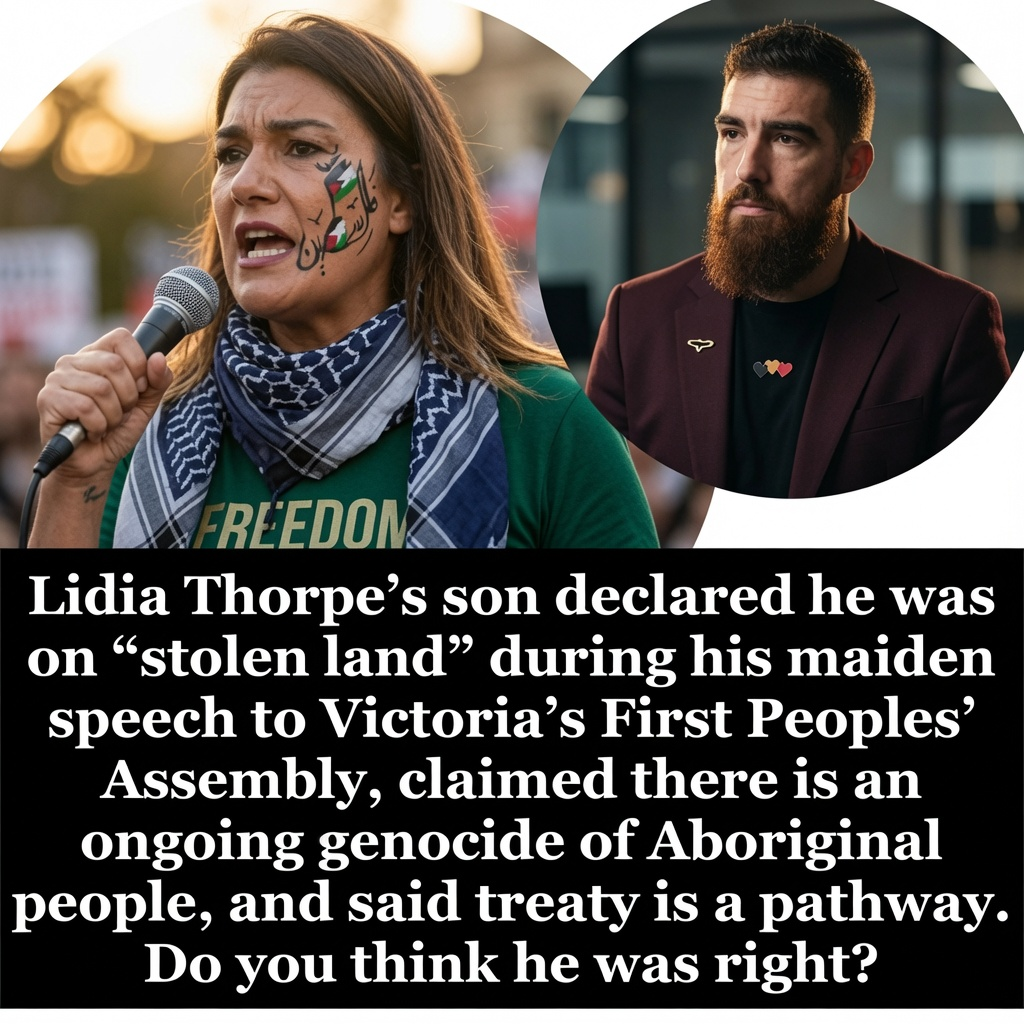
Speaking during the Assembly’s inaugural speeches at Parliament House, Thorpe opened by acknowledging that the Victorian Parliament stands on what he described as “stolen land” before outlining his vision for Treaty, Aboriginal self-determination and reform.
Representing Victoria’s South East Region, he thanked his family for supporting his political journey and spoke about what he described as the ongoing effects of colonisation on Aboriginal communities.
Thorpe also referred to Victoria as “so-called Victoria” and argued that the state’s Treaty process should be viewed as one step towards broader structural change rather than the final objective.
His speech was among dozens delivered by newly elected members following this year’s First Peoples’ Assembly election, marking the beginning of a new four-year term for the representative body responsible for advancing Victoria’s Treaty framework.
Several Assembly members expressed similar views during their inaugural addresses.
Keicha Day, representing the Gunditj Mirring Traditional Owners Aboriginal Corporation, began her speech with the statement that “sovereignty has never been ceded” before referring to the Convincing Ground killings, an event that remains the subject of historical debate regarding its scale and circumstances.
Day described Victoria as a “crime scene” and concluded with the phrase “always was, always will be”, a slogan widely used by many Aboriginal activists to express continuing Indigenous connection to Country.
Other Assembly members, including Lisa Rose Thorpe and Esme Bamblett, also spoke about sovereignty, intergenerational disadvantage and the continuing impact of colonisation on Aboriginal communities.
Some described the current situation facing Indigenous Australians as an “ongoing genocide”, while others argued that Aboriginal ownership of the land has never ceased.
Those statements reflect the views of the individual speakers and remain politically contested within broader Australian public debate.
Andrew Thorpe also used his speech to raise concerns about the disproportionate number of Aboriginal children in out-of-home care across Victoria.
He argued that government systems had failed many Indigenous families and said Treaty should ultimately deliver practical improvements rather than symbolic recognition alone.
Those themes closely mirror positions long advocated by his mother, Senator Lidia Thorpe.
The independent senator has consistently argued that Treaty and Indigenous sovereignty should take priority over constitutional recognition, opposing the 2023 Indigenous Voice referendum while continuing to campaign for self-determination and land rights.
Although Andrew Thorpe now serves in a different institution, many of the ideas expressed during his maiden speech reflected arguments his mother has advanced for many years.
The First Peoples’ Assembly occupies a unique place within Victoria’s political system.
Originally established to negotiate the framework for Treaty between Aboriginal Victorians and the state government, the Assembly has evolved following passage of Victoria’s Statewide Treaty legislation.
Its responsibilities now include representing First Peoples during Treaty negotiations, advocating on issues affecting Aboriginal communities and overseeing elements of the broader Treaty framework established under Victorian law.
The Assembly does not function as a parliament capable of passing legislation.
Instead, it serves as the representative body for First Nations people within Victoria’s Treaty process and participates in consultation on laws and policies affecting Aboriginal Victorians.
Victoria remains the only Australian state to have signed a statewide Treaty with First Nations representatives.
The Treaty framework, enacted last year, created new institutions designed to support truth-telling, accountability and Indigenous participation in government decision-making.
Under the legislation, ministers introducing new bills to Parliament are required to provide statements explaining how proposed laws align with Treaty principles and whether consultation has occurred with the First Peoples’ Assembly.
Supporters argue these reforms will help improve long-term outcomes by giving Aboriginal communities a stronger voice in policies that directly affect them.
Critics contend the arrangements create unnecessary bureaucracy and provide preferential treatment based on ancestry.
The Victorian Liberal Party has pledged to repeal the Treaty framework and abolish the Assembly if it wins government at the November state election, making Treaty one of the campaign’s most significant issues.
The election that produced the current Assembly also attracted public attention because of voter participation.
Approximately 43,000 Aboriginal Victorians were eligible to enrol, with around 10,000 registering to vote and roughly half of those ultimately casting ballots.
Critics have argued the turnout raises questions about how representative the Assembly is of the wider Aboriginal population.
Supporters respond that participation levels should be viewed in the context of a new institution and note that turnout in Indigenous representative elections has historically been lower than in compulsory Australian elections.
Assembly members receive salaries broadly comparable to Victorian backbench members of parliament because their roles are full-time and involve community engagement, governance responsibilities and participation in Treaty negotiations.
The debate surrounding the Assembly has intensified since Victoria became the first jurisdiction in Australia to formalise a statewide Treaty agreement.
Supporters describe the process as an historic opportunity to recognise past injustices, strengthen self-determination and improve practical outcomes in areas such as health, education, housing and economic development.
Opponents argue Treaty risks creating separate governance structures based on race and question whether the substantial public expenditure involved will deliver measurable improvements for Aboriginal communities.
Those contrasting perspectives have become increasingly prominent ahead of Victoria’s election, where Treaty has emerged as a defining point of difference between the major parties.
Andrew Thorpe’s maiden speech has therefore attracted attention not simply because of its language, but because it encapsulates many of the broader arguments now shaping public debate over Victoria’s Treaty project.
For supporters of Treaty, his remarks reflected long-held views about sovereignty, colonisation and Indigenous rights.
For critics, the speeches reinforced concerns that the Assembly is becoming an overtly political institution disconnected from practical service delivery.
Whatever interpretation voters adopt, the speeches delivered by Thorpe and his fellow Assembly members have ensured the First Peoples’ Assembly will remain firmly at the centre of Victoria’s political conversation as campaigning intensifies ahead of the November election.






