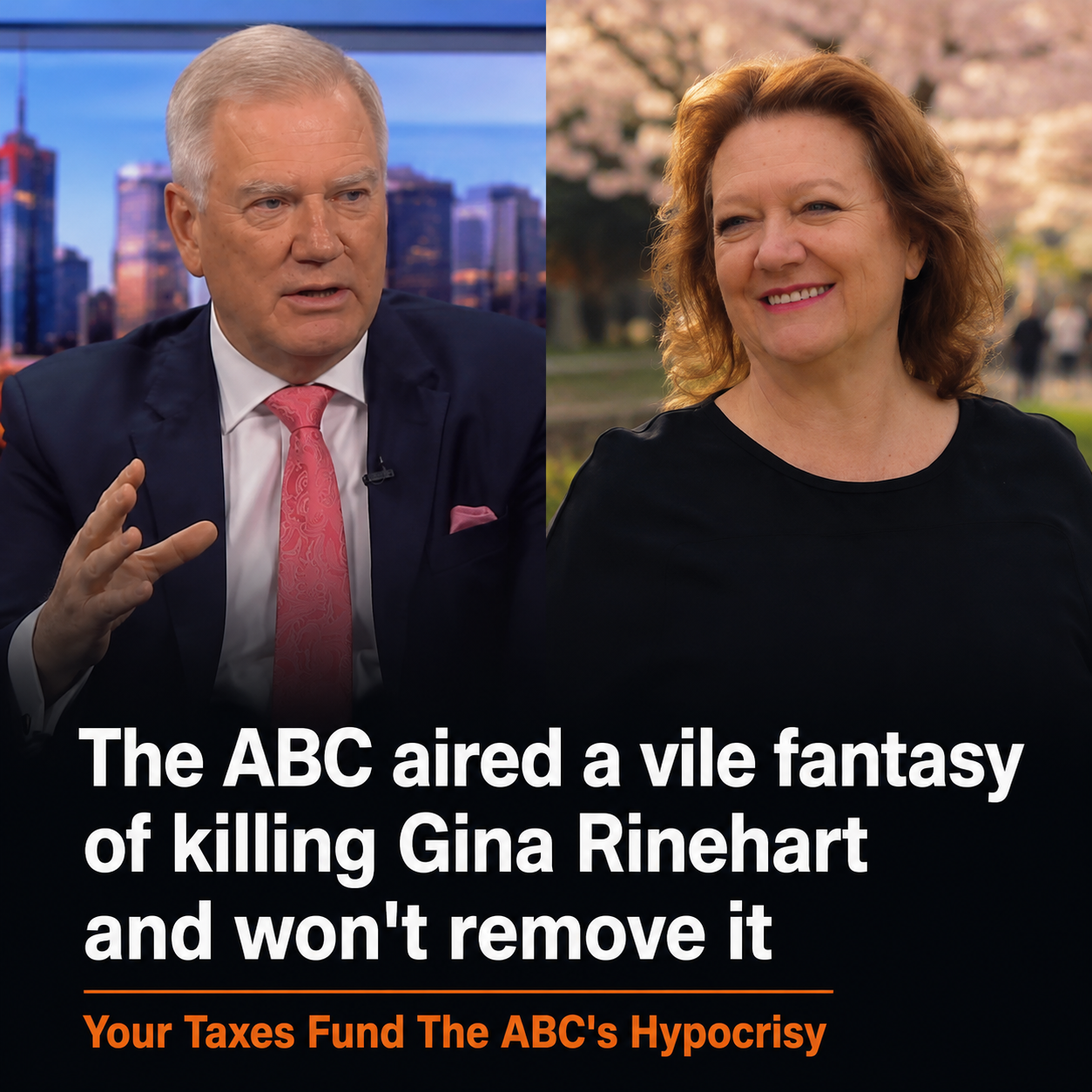
The Australian Broadcasting Corporation (ABC) is facing mounting scrutiny after refusing to remove a controversial segment from its television program Race Around the World that depicts graphic violence directed at mining executive Gina Rinehart.
The segment has generated significant political and media attention after the national broadcaster defended the material as being “satirical in tone” and “editorially justifiable”, despite demands from Hancock Prospecting for the footage to be removed and for a formal public apology.
The dispute has evolved beyond criticism of a single television program. It has instead become a broader debate about the responsibilities of Australia’s taxpayer-funded national broadcaster, the limits of satire, editorial accountability and whether content portraying graphic violence against public figures should be broadcast under the protection of artistic expression.
The controversy centres on a four-minute film titled A Very Relaxing Video, produced by contestant Kate McGuinness and broadcast during ABC’s Race Around the World. The piece follows an intentionally surreal format before ending with an extended graphic description of violence directed at Ms Rinehart. The remarks were broadcast nationally and remain available through ABC platforms despite subsequent complaints.
Following the broadcast, Hancock Prospecting strongly condemned the segment, describing it as material that glorified sexualised violence and murder while arguing it had progressed through multiple editorial review processes before reaching viewers.
The company said the content could not reasonably be dismissed as an off-the-cuff remark because it was filmed, edited, reviewed and ultimately approved for national broadcast.
Hancock Prospecting subsequently called on ABC management to issue a public apology and investigate how the segment received editorial approval, arguing that describing such content as satire failed to address the seriousness of the imagery presented.
ABC, however, has maintained its position.
In a statement reported by multiple Australian media outlets, the broadcaster said that while contributors to the program were not ABC journalists, all content remained subject to the organisation’s editorial policies and review processes.
The broadcaster stated that the film was intended to be satirical in tone and was considered editorially justifiable within the context of the program. It also noted that audiences may respond differently to creative content and pointed out that criticism expressed by one of the program’s judges was included in the final broadcast.
That explanation has done little to quieten criticism.
Several commentators have argued that the issue is no longer simply whether viewers found the material offensive, but whether Australia’s publicly funded broadcaster should air graphic depictions of violence against an identifiable individual while simultaneously maintaining editorial standards intended to minimise harm and uphold public confidence.
The controversy has also reignited longstanding political debate surrounding perceptions of ideological balance within the ABC.
Critics have questioned whether similar material would have been considered acceptable had the target been another prominent Australian public figure holding different political views. Others have argued that public broadcasters should be held to particularly high standards because they receive taxpayer funding and occupy a unique position within Australia’s media landscape.
Supporters of artistic freedom, meanwhile, have generally argued that satire has historically used exaggeration, shock and provocation to challenge influential individuals and institutions.
That broader debate has long existed across democratic societies, where courts and broadcasters frequently distinguish between legitimate political satire, offensive humour and speech that may cross into incitement or harmful conduct.
The current dispute demonstrates how difficult those boundaries can become when graphic imagery is directed toward a real individual rather than a fictional character or abstract political concept.
The incident has also drawn attention because it occurred only weeks after Prime Minister Anthony Albanese publicly warned against normalising violence against women during parliamentary debate, although the government has largely declined to comment directly on the ABC controversy itself. Critics have pointed to that timing as adding another dimension to the public discussion surrounding the broadcast.
Western Australian Premier Roger Cook has described the language used in the segment as “confronting” and “unacceptable”, although he stopped short of calling for an apology from the ABC, saying the broadcaster would need to deal with complaints through its own established processes.
Communications Minister Anika Wells has also declined to be drawn into commenting publicly on the editorial decision, reflecting the longstanding principle that governments should avoid interfering directly in editorial judgments made by the national broadcaster.
ABC’s editorial framework is designed to balance freedom of expression with obligations relating to impartiality, harm, fairness and public expectations. Those standards acknowledge that creative works, comedy and satire may contain controversial material while still requiring editorial oversight before publication or broadcast.
Whether the broadcaster correctly applied those standards in this case has become one of the central questions emerging from the dispute.
Critics argue that because the segment contained explicit descriptions of violence against a named individual, the broadcaster should have concluded that it exceeded acceptable editorial boundaries regardless of any intended satirical purpose.
Supporters of the ABC’s decision counter that removing controversial material simply because it provokes strong reactions risks narrowing creative freedom and encouraging external pressure on editorial independence.
The debate therefore extends beyond one individual or one television episode.
It raises broader questions about how publicly funded media organisations should approach politically sensitive material, particularly where humour intersects with depictions of violence and where editorial decisions themselves become the subject of intense public scrutiny.
Gina Rinehart remains one of Australia’s most prominent and polarising business figures. As executive chair of Hancock Prospecting, she oversees one of the country’s largest privately owned resource companies and has frequently attracted strong public commentary because of her business interests, political views and role in national economic debates.
Her public profile has often made her the subject of satire and criticism across Australian media. However, supporters argue that criticism of powerful individuals should remain distinguishable from graphic depictions of violence, while others contend that satire has historically targeted influential figures in provocative ways.
For ABC, the controversy arrives during a period in which the broadcaster continues to face regular political examination over questions of impartiality, governance and public accountability.
Although complaints about individual programs are not uncommon, this incident has attracted unusual attention because it combines questions of editorial judgment, political neutrality, taxpayer funding and the acceptable limits of satirical expression.
At the time of writing, the broadcaster has not indicated any intention to remove the segment or alter its public position that the material was editorially justified within the context of the program. Hancock Prospecting continues to seek an apology and greater transparency regarding the editorial approval process, while public debate over the appropriate balance between satire, creative freedom and broadcaster responsibility shows little sign of subsiding.






