Kalyn Ponga has undergone surgery on a broken left arm after a remarkable Rugby League World Cup debut for New Zealand, with his team’s hopes of seeing him return later in the tournament still uncertain. The Newcastle Knights fullback scored two tries against Australia and continued playing despite suffering a fracture early in the second half. The Kiwis lost a dramatic opening match 24–22, and their focus now turns to the health of a player who had quickly become central to their attack.
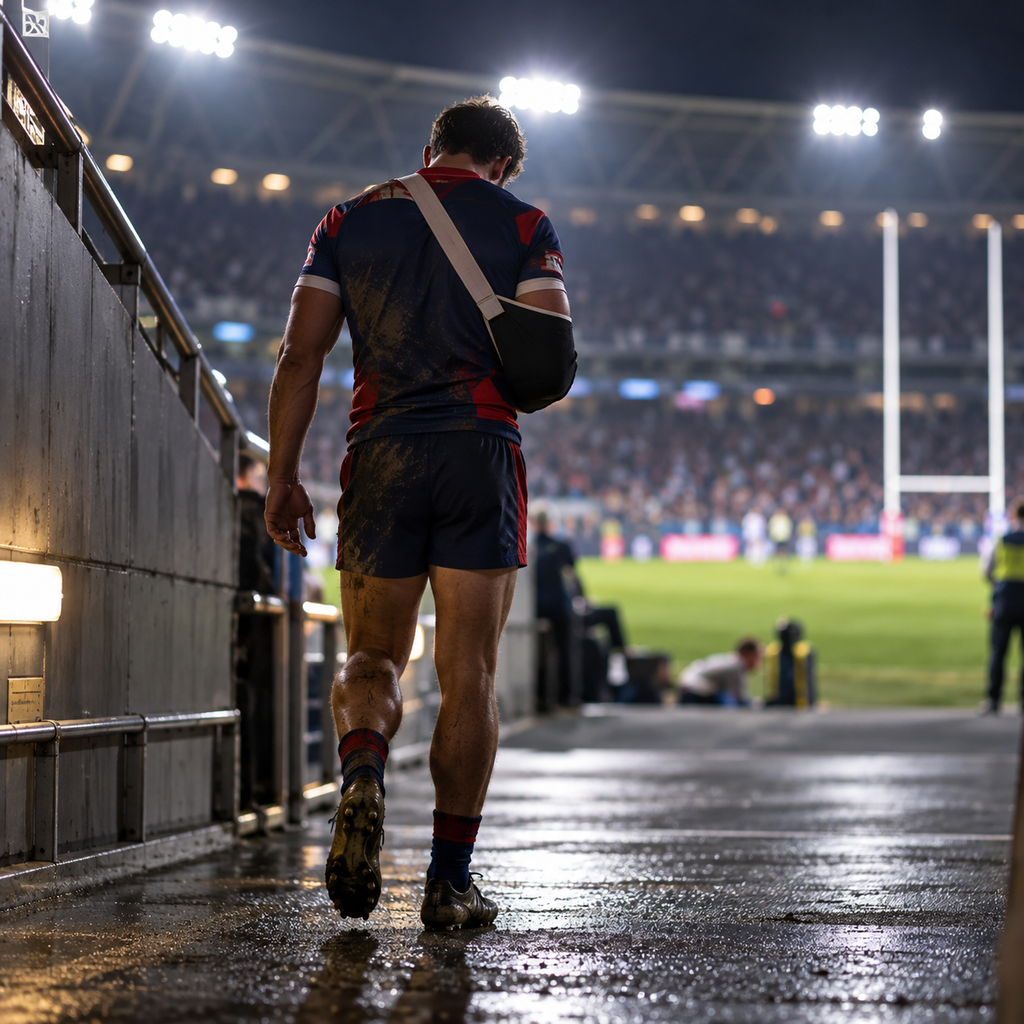
New Zealand Rugby League confirmed that Ponga fractured the radius in his left arm during the match in Sydney. The organisation said he was booked for surgery and would remain in camp with the national team. A later NRL injury update reported that he had undergone the procedure and described his chances of returning before the tournament ended as outside. That wording is important: it leaves open the possibility of a recovery but gives no assurance that he will play again in the competition.
The injury occurred during a tackle involving Australia’s Cameron Munster. Ponga stayed on the field for approximately another 20 minutes and did not leave until the 70th minute. During a performance that had already electrified the crowd, he managed to score again before being replaced by Keano Kini. The fact that he played on does not establish the injury was minor. Medical assessment and scans afterwards identified the fracture, prompting the decision to have it repaired surgically.
Ponga’s individual numbers underline what the Kiwis may be missing. New Zealand Rugby League credited him with two tries, 253 running metres from 16 carries, three line breaks and five tackle breaks. His Test debut was striking not just because of the totals but because he created opportunities against the reigning Australian side in a match settled by two points. Those performance figures come from the national governing body’s account of the game, rather than an estimate based on short highlight clips.
Kiwis coach Stacey Jones was initially cautious about the fullback’s condition because scans had not yet been completed. NRL reporting from the immediate aftermath described Ponga’s enthusiasm for remaining involved despite the setback. New Zealand Rugby League’s later confirmation of a broken radius superseded the earlier uncertainty about whether there had been a fracture. The surgical update then added another stage in the medical chronology. Coverage should reflect the latest checked status rather than leave readers with the initial description of a merely suspected break.
Keano Kini, the young Titans fullback who replaced Ponga late in the match, has made clear that he is prepared to take responsibility if selected. The NRL reported that Kini was looking to play his own style rather than imitate the injured star. Jones also indicated that Kini had experience within the New Zealand setup. Those comments make him a credible option as the Kiwis prepare for their next assignment, although the final team selection is a separate decision to be announced by the coaches.
The narrow opening defeat brought mixed emotions for New Zealand. Ponga’s attacking display and the work of the forwards showed they could challenge Australia, yet the side still came away without the win. His injury compounds that disappointment, but it would be premature to suggest the entire campaign has been lost. A World Cup requires depth across several matches, and the ability to adjust to injuries is part of the test for every squad.
An estimated date for Ponga’s return has not been officially established in the checked material. Surgery is not itself a guarantee of a rapid recovery, and the team must balance his desire to participate against a medical decision about whether his arm can withstand elite contact. Any discussion of a possible appearance later in the competition should be framed as contingent on both the Kiwis progressing and medical clearance. The immediate certainty is that the break required treatment and that another player may be needed at fullback.
For Australian fans, the spectacle of Ponga’s performance remains one of the defining early moments of the tournament even though he was playing in New Zealand colours. The closely fought contest demonstrated the appeal of international rugby league, with individual brilliance on both sides and a margin narrow enough to keep the result in question. The injury means attention now shifts from what Ponga produced in his debut to what the Kiwis can manage without him and whether rehabilitation can bring him back.
The match itself offered an explanation of why Ponga’s absence could be so important. NRL’s official match report credited Australia winger Jack Bostock with a hat-trick on debut and described a contest in which the lead changed hands amid several extraordinary individual plays. The fullbacks attracted much of the attention: Ponga gained 253 metres for New Zealand, while Australia’s Reece Walsh recorded 206 metres and nine tackle breaks according to the match report. These are concrete measures of the attacking responsibility carried by the two players, even though the final score was determined by the collective efforts of both teams.
The NRL’s play-by-play account said New Zealand took a 16–10 lead before Bostock crossed again to bring the scores level. Ponga then produced another solo try to restore an advantage for the Kiwis. Walsh responded with an extraordinary long-range run, and Bostock’s late third try delivered the winning margin for Australia. The sequence explains why New Zealand could take encouragement from the quality of its performance without ignoring the result. It also puts Ponga’s injury into context: the fullback had been central to a thrilling second-half contest even after being hurt.
A crowd of 41,255 watched at Allianz Stadium, according to NRL and New Zealand Rugby League reports. The New Zealand organisation described it as Sydney’s biggest Test attendance in decades. Kiwis captain James Fisher-Harris and Kangaroos captain Isaah Yeo praised the spectacle and the atmosphere in their post-match comments as reported by the national rugby league body. Those observations matter because the opening match was not simply a medical story. It was a major international occasion with a close result, a strong turnout and an injury that could shape one of the tournament’s leading contenders.
New Zealand’s forward performance was another reason for optimism. The official match coverage highlighted the work of James Fisher-Harris and Naufahu Whyte, while Jahrome Hughes’ kicking game also attracted praise. Ponga benefited from the field position and opportunities that the pack created, and he turned them into points through his running and footwork. Losing a player who can finish those chances forces adjustments, but the same underlying forward effort may give the replacement fullback opportunities in later matches. That assessment should not be mistaken for a guarantee that New Zealand’s attacking output will remain unchanged.
Kini has already been involved in New Zealand’s international setup and came on during the closing stages of the opener. In his comments to the NRL, he expressed confidence that he could contribute if asked to wear the No.1 jersey. Jones, too, has said the substitute can operate behind the team’s forward pack. The coaching staff must now decide how to distribute attacking responsibility, whether other combinations need adjustment and how Ponga’s rehabilitation progresses. Until the side is named, it is more accurate to describe Kini as the likely replacement than to claim an official selection has been locked in.
The result also matters for the Kangaroos, who began their title defence with a hard-fought victory rather than an easy win. Bostock’s late try was decisive after Australia had struggled to keep New Zealand at a distance. NRL reporting said the Australian team would next face Fiji while New Zealand prepared for the Cook Islands. Those fixtures put the medical deadline into sharper focus for the Kiwis: any potential return for Ponga depends on how long the team remains in the tournament and what his doctors advise, not simply on a player’s determination to return.
Ponga’s display may be remembered for its brilliance and the apparent courage of playing through discomfort. The more significant question for the team is what happens after the surgery. The national side has a capable replacement, a forward pack that performed strongly and a narrow loss from which it can learn. It also has a high-profile player whose recovery cannot be rushed on the basis of an emotional World Cup opener. The confirmed news is that surgery was required; a return remains a possibility subject to medical assessment.






