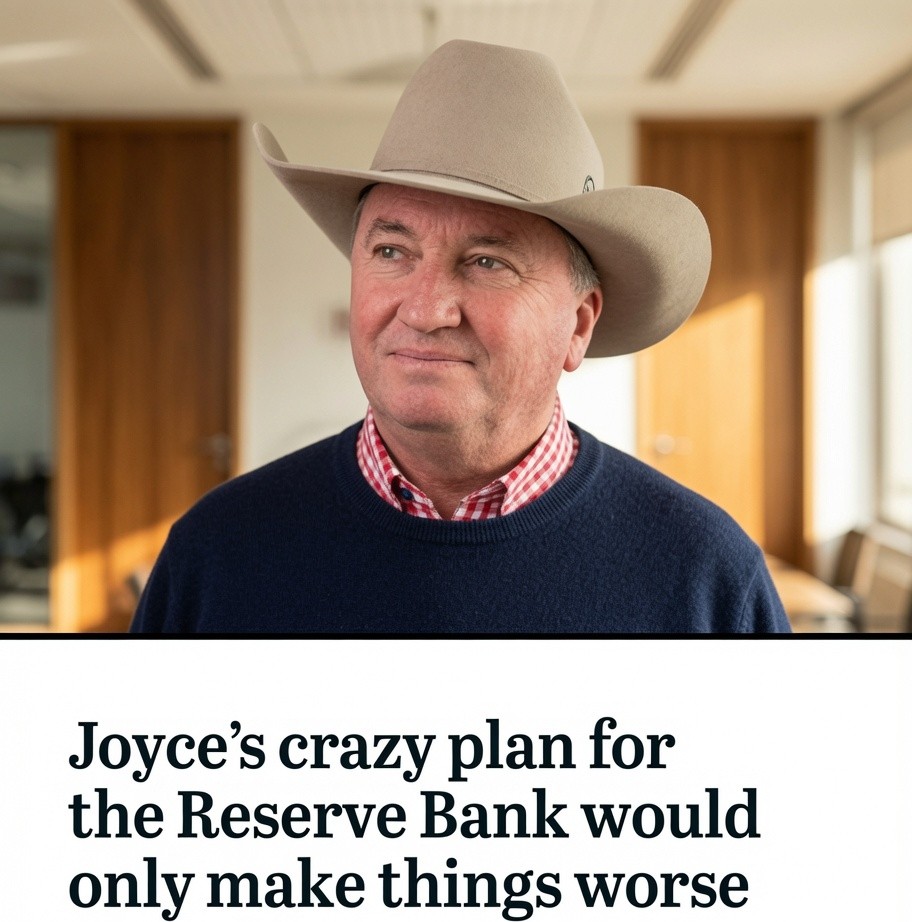
Barnaby Joyce has identified a real problem in Australia’s economic debate.
Then he has proposed a solution that risks making the problem worse.
The One Nation treasury spokesman is frustrated that the Reserve Bank is left using interest rates as a blunt instrument against inflation while governments can continue making spending decisions that may add pressure to the economy.
His complaint is easy to understand.
The RBA raises the cash rate.
Banks increase mortgage rates.
Households lose disposable income.
Businesses face higher borrowing costs.
Demand slows.
Inflation is eventually brought under control.
Meanwhile, a government can announce new spending, subsidies, tax changes or household assistance that puts additional money into the economy.
To a mortgage holder watching thousands of dollars disappear into higher repayments, the system can look absurd.
One arm of economic policy presses the brake.
The other appears to press the accelerator.
Joyce wants the Reserve Bank to say so.
More specifically, he has argued the central bank should have greater independence and should be able to publicly tell the government when its actions are contributing to inflation.
But once the RBA moves from explaining economic conditions to telling an elected government what it should do, Joyce is no longer strengthening central bank independence. He is outsourcing economic policy to unelected officials.
That distinction matters.
Australia elects governments to make fiscal choices.
Governments decide how much to tax.
Governments decide how much to spend.
Governments determine whether money goes to defence, hospitals, pensions, childcare, roads, energy subsidies or tax relief.
Those decisions are political because they involve values and trade-offs.
There is no purely technical answer to the question of whether Australia should spend another $10 billion on defence or use the same money to reduce income tax.
An economist can model the consequences.
Treasury can estimate the budget impact.
The Reserve Bank can assess the implications for demand and inflation.
But the choice belongs to elected politicians.
Australians can remove them at the next election.
They cannot vote out the governor of the Reserve Bank.
This is precisely why central bank independence has traditionally been defined carefully.
The RBA is given operational independence over monetary policy.
The Monetary Policy Board sets the cash rate target.
Its job is to pursue price stability and full employment within the monetary policy framework established under Australian law.
The current framework retains a flexible inflation target centred on consumer price inflation of between 2 and 3 per cent.
The government does not telephone the governor before every monetary policy meeting and order a rate cut because an election is approaching.
That separation protects the country from short-term political manipulation of interest rates.
It does not turn the RBA into a second Treasury.
Nor should it.
Joyce appears to believe the central bank needs a stronger voice on fiscal policy.
There is a respectable argument for more transparency.
The RBA should explain how public demand affects inflation.
It should discuss the interaction between fiscal and monetary policy.
It should tell Australians when government consumption is adding pressure to capacity.
It should identify economic risks without worrying about whether its analysis embarrasses the Treasurer.
In fact, the bank already assesses many of these factors.
The RBA’s Statement on Monetary Policy sets out its assessment of economic and financial conditions and the outlook considered by the Monetary Policy Board when making interest-rate decisions.
The question is how far Joyce wants it to go.
Suppose the federal government delivers a budget containing $20 billion in new household assistance.
The RBA believes the package will add to demand and make inflation more persistent.
Should the governor say that?
Probably.
Should the bank explain the expected inflationary effect?
Absolutely.
Should it publish the assumptions behind its forecast?
Greater transparency would help public debate.
But should the governor then say the government must cancel the spending?
Should the Monetary Policy Board recommend which programs should be cut?
Should it tell Parliament to raise taxes?
Should it advise voters that the opposition’s fiscal policy is preferable?
That is where economic analysis becomes political authority.
Once a central bank begins prescribing fiscal policy, its own independence becomes harder to protect.
Every RBA statement would become a partisan weapon.
A governor who criticised a Labor budget would immediately appear in Coalition advertisements.
A governor who questioned Coalition tax cuts would be accused by conservatives of defending big government.
A warning about One Nation’s spending promises would be described as an establishment attack on Pauline Hanson.
Board appointments would become political battles.
Senate estimates hearings would become interrogations about the personal economic philosophy of individual monetary policymakers.
Governments would search for governors who shared their fiscal instincts.
Oppositions would accuse the bank of electoral interference.
The institution Joyce wants to make more independent could become more politicised than ever.
There is another difficulty with his proposal.
The Reserve Bank has already been reviewed.
Not decades ago.
Three years ago.
The independent review commissioned in 2022 delivered its final report to the Treasurer on March 31, 2023.
It examined the RBA’s performance over the previous 30 years and considered the monetary policy framework, governance, leadership and institutional culture.
The review made 51 recommendations.
Its conclusions did not suggest Australia should transform the central bank into a public fiscal referee telling elected governments how to construct their budgets.
Instead, the review retained the core monetary policy framework.
Former governor Philip Lowe later summarised its conclusion clearly: the framework was fit for purpose, based on an operationally independent central bank and a flexible inflation target centred on 2 to 3 per cent.
The review focused on improving the quality of decision-making.
It sought stronger governance.
More expertise.
Greater internal challenge.
Better communication.
Clearer accountability.
The resulting reforms were substantial.
Australia created a separate Monetary Policy Board responsible for monetary policy and the RBA’s contribution to financial system stability.
A Governance Board was established to oversee the management of the institution.
The government’s reform legislation was explicitly presented as a measure to reinforce the RBA’s independence, clarify its role and modernise its structure.
The RBA’s own progress report says the updated Statement on the Conduct of Monetary Policy reaffirmed government support for the bank’s operational independence.
These are not ancient arrangements waiting to be modernised.
The new structure is still young.
Joyce therefore needs to answer a basic question before One Nation launches another review.
What did the 2023 review get wrong?
Perhaps he has an answer.
Perhaps One Nation believes the review defined central bank independence too narrowly.
Perhaps Joyce wants a statutory requirement for the RBA to publish a fiscal impact assessment after every federal budget.
Perhaps he wants Treasury and the RBA to provide a joint public analysis of whether fiscal and monetary policy are working in the same direction.
Perhaps he wants the governor to appear before Parliament more frequently.
Those are proposals that can be debated.
But “the RBA should tell the government what it should be doing” is not an institutional design.
It is an abdication.
The timing makes that especially uncomfortable for One Nation.
Joyce has admitted the party has not yet established sufficient credibility on economics.
One Nation is under pressure to explain and cost a rapidly expanding policy platform.
Joyce has declined to guarantee every policy will be submitted to the Parliamentary Budget Office, citing the party’s limited resources. Recent reporting has highlighted that refusal as scrutiny intensifies over whether One Nation is prepared for government.
The Coalition is attacking the party’s economic competence.
Angus Taylor has argued One Nation’s major commitments could dramatically worsen the budget and inflation.
His broader strategy is obvious.
Do not fight Hanson primarily over cultural grievances.
Fight her over arithmetic.
Force One Nation to explain the numbers.
Ask what policies cost.
Ask what taxes rise.
Ask what spending falls.
Ask what happens to debt.
Ask what happens to inflation.
Joyce’s RBA argument risks walking directly into that attack.
If One Nation has not yet developed economic credibility, the answer cannot be to ask central bankers to provide economic direction after the election.
A government must arrive with a fiscal strategy.
It must know its priorities.
It must understand the budget constraints.
It must be capable of receiving advice from Treasury, Finance, the Productivity Commission and the Reserve Bank without surrendering political responsibility to any of them.
Expert advice is essential.
Expert government is something different.
Australia has spent years arguing about the power of unelected institutions.
One Nation itself has frequently criticised bureaucrats, regulators and experts who it believes exercise too much influence over ordinary Australians.
That makes Joyce’s proposal philosophically strange.
A populist party suspicious of elite institutions now appears to want one of the country’s most powerful unelected institutions to take a larger role in directing elected governments.
Imagine the RBA told a One Nation government that its fuel excise cuts were inflationary.
Would Joyce cancel them?
Imagine the bank said a dramatic increase in defence spending was adding too much demand.
Would Hanson abandon the commitment?
Imagine monetary policymakers argued that severe migration cuts were reducing labour supply and creating wage pressure in key industries.
Would One Nation increase immigration?
If the answer is no, then the RBA is not really being asked to tell the government what to do.
It is merely being asked to publicly criticise governments Joyce disagrees with.
If the answer is yes, One Nation is proposing to transfer extraordinary influence over fiscal policy to unelected central bankers.
Neither interpretation solves the party’s economic credibility problem.
The real issue Joyce has identified is coordination.
Fiscal and monetary policy can work against each other.
This is not a new discovery.
Economists, Treasury officials and central bankers have debated the interaction for decades.
When government spending strongly supports demand while inflation is high, interest rates may need to remain tighter than otherwise.
When fiscal policy contracts sharply, monetary policy may have more room to ease.
But even this relationship is not mechanically simple.
Government spending can increase demand today while expanding productive capacity tomorrow.
A new road, port or electricity network may create short-term activity but remove supply constraints later.
A subsidy can lower the measured consumer price index without permanently reducing underlying inflation.
Tax relief can support household consumption.
Spending cuts can damage essential services or future productivity.
This is why economic policy involves judgment.
Central bankers possess expertise.
So do Treasury officials.
So do academic economists.
They regularly disagree.
Democratic government exists to make choices between competing priorities and then accept responsibility for the result.
The RBA’s independence protects its ability to use monetary policy without short-term political interference.
That does not mean every economic decision should be pushed through Martin Place.
Joyce would be on firmer ground if he demanded more explicit RBA analysis of fiscal conditions.
Require clearer language about public demand.
Publish more detailed modelling where possible.
Strengthen parliamentary scrutiny.
Make the interaction between budgets and interest rates easier for ordinary Australians to understand.
Ask why mortgage holders repeatedly carry such a visible burden in the inflation fight.
Those are legitimate reforms to debate.
But One Nation must still do its own work.
It must develop a fiscal framework.
It must cost its policies.
It must decide how much government should spend.
It must identify the taxes it would cut and the revenue it would replace.
It must explain its debt strategy.
It must demonstrate how its program affects inflation.
It must accept responsibility for those choices.
The RBA cannot do that for Pauline Hanson.
Nor should Australians want it to.
Joyce is right that the central bank’s interest-rate hammer imposes enormous pain on a relatively concentrated group of Australians, particularly mortgage holders.
He is right that fiscal policy deserves much greater scrutiny when inflation is persistent.
He is right that governments should not pretend their budget decisions exist in a universe separate from monetary policy.
But the answer to political failure is not to give unelected experts more political responsibility.
The answer is to elect governments capable of making economic decisions and defending them.
One Nation says it wants to become that government.
Joyce has admitted the party is not yet credible enough on economics.
That admission may be the most economically honest thing One Nation has said in months.
Now it has to fix the problem itself.
Outsourcing the job to the Reserve Bank would only prove the critics’ point.






