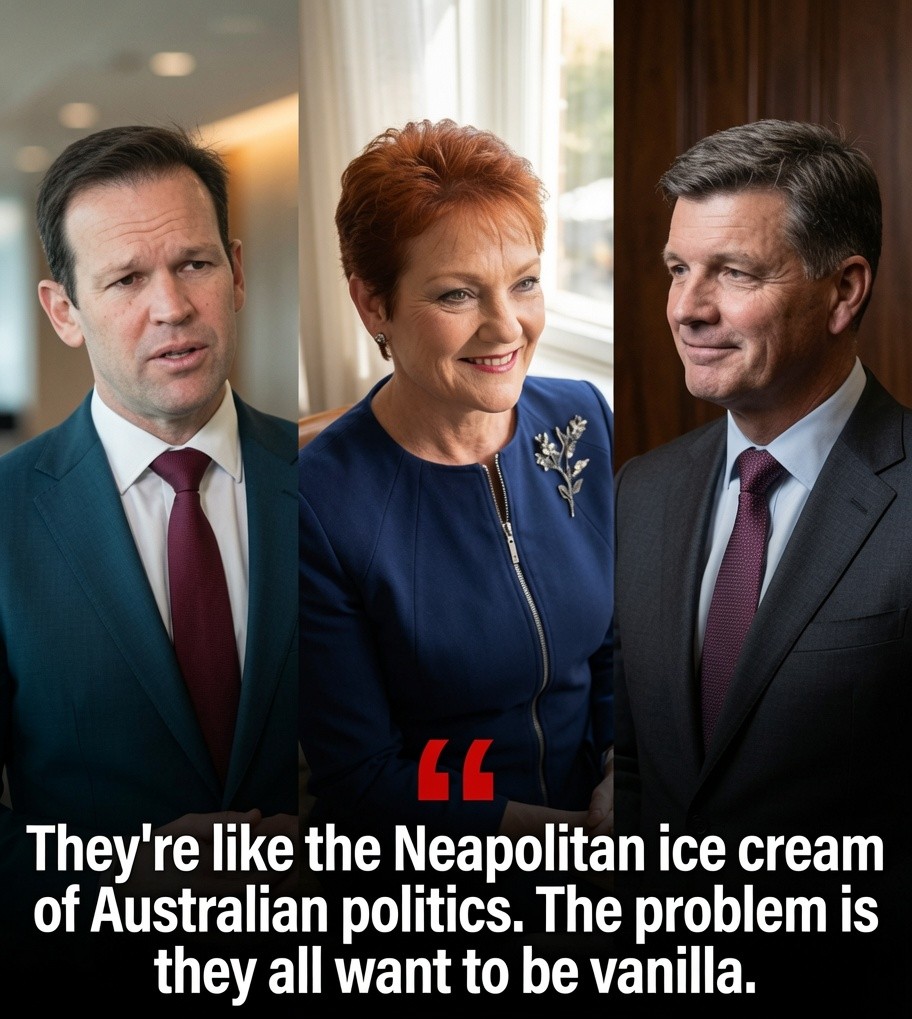
Education Minister Jason Clare has accused Australia’s major right-of-centre political parties of competing for the same political territory, likening One Nation, the Liberal Party and the Nationals to different flavours of ice cream before declaring that, in the end, “they all want to be vanilla”.
Clare made the remarks while responding to the continuing political fallout from One Nation leader Pauline Hanson’s call for an Australian “monoculture” during her recent National Press Club address—a term that has since become one of the most debated issues in Australian politics.
Using an ice cream analogy, Clare said Australia’s conservative parties were effectively competing for the same section of the electorate.
“They’re like Neapolitan ice cream,” he said. “But they all want to be vanilla.”
His comments reflected Labor’s broader argument that the Coalition has become increasingly reluctant to defend multiculturalism as it attempts to retain conservative voters who may otherwise support One Nation.
Clare described Hanson’s “monoculture” proposal as “ridiculous” and argued that Australia had become stronger because successive governments embraced multiculturalism rather than abandoning it.
He also praised the Liberal Party’s historical role in building Australia’s multicultural society, saying it was surprising that today’s Liberal leadership appeared reluctant even to use the word “multiculturalism”.
“The fact that the Liberal Party, with all of that record that they should be proud of, can’t even say the word multiculturalism reeks of desperation,” Clare said.
The latest exchange follows weeks of intense political debate after Hanson used her first National Press Club address to argue Australia should pursue what she described as a “monoculture”.
Although the phrase immediately generated widespread criticism, One Nation representatives have since sought to clarify that the party is not advocating racial or ethnic uniformity.
Instead, they argue the term refers to a shared national identity built around common Australian values, laws and civic responsibilities regardless of ethnicity or religion.
That explanation has not ended the controversy.
Critics contend that the word “monoculture” carries historical and cultural implications that are incompatible with modern Australia, while supporters argue the debate has become distracted by terminology rather than focusing on broader questions of social cohesion, migration and national identity.
The discussion has placed additional pressure on Opposition Leader Angus Taylor and the Coalition.
Many Liberal MPs represent electorates with large migrant communities and have publicly defended Australia’s multicultural model while simultaneously advocating tougher character tests for migrants, stronger border controls and lower migration levels.
Earlier in the week, Taylor delivered his clearest rejection yet of any suggestion that the Coalition could pursue a closer political relationship with One Nation.
He warned that a One Nation electoral victory would bring “an eternity of pain”, signalling a significant cooling of speculation about possible cooperation between the parties despite policy overlap on some issues.
The dispute illustrates the increasingly complex political competition on Australia’s centre-right.
While One Nation continues campaigning on reducing migration, opposing aspects of multicultural policy and tightening border controls, Liberal leaders have sought to differentiate their own approach by supporting multiculturalism while arguing for stronger migration management.
Labor has attempted to exploit those differences by portraying the Coalition as internally divided over Australia’s multicultural identity.
Clare argued that Australia’s diversity has become one of its greatest national strengths and rejected suggestions that multiculturalism had weakened social cohesion.
He said Australians from a wide variety of cultural backgrounds had made enormous contributions to the country’s economic growth, education system, business sector and community life.
Australia’s multicultural framework has developed over several decades.
Following the formal abolition of the White Australia policy in the early 1970s, successive governments led by both Labor and the Coalition supported immigration from across the world while promoting equal citizenship regardless of cultural background.
Former Liberal prime ministers including Malcolm Fraser and John Howard each defended multiculturalism, although they often coupled that support with expectations that migrants learn English, respect Australian laws and integrate into Australian civic life.
That bipartisan consensus has increasingly come under pressure as migration, housing affordability, infrastructure capacity and the cost of living have become dominant political issues.
One Nation argues that rapid population growth has placed unsustainable pressure on housing, public services and infrastructure.
Labor accepts that migration levels need to be carefully managed but maintains Australia’s economic prosperity has long depended on skilled migration and a successful multicultural society.
The debate also reflects broader political trends seen in other Western democracies.
Across Europe and North America, questions surrounding immigration, national identity and social integration have become increasingly prominent, with governments attempting to balance economic demand for migration against community concerns about population growth and cultural cohesion.
Australia has largely avoided many of the social tensions experienced elsewhere, although political disagreement over migration settings has become increasingly pronounced in recent years.
Political analysts note that language often plays an important role in these debates.
While supporters of Hanson’s position say “monoculture” is intended to describe common civic values, opponents argue the term evokes ideas of cultural uniformity that do not reflect contemporary Australia.
The disagreement therefore extends beyond immigration policy itself to competing visions of national identity.
As Parliament prepares for further debate on migration, citizenship and social cohesion, the exchange between Clare and Hanson demonstrates how questions surrounding multiculturalism remain among the most politically sensitive issues facing Australia.
Whether voters ultimately respond more strongly to Labor’s defence of multiculturalism or One Nation’s emphasis on cultural integration is likely to become clearer as the next federal election approaches. For now, Clare’s “vanilla ice cream” comparison has added another memorable phrase to an already heated national conversation.






