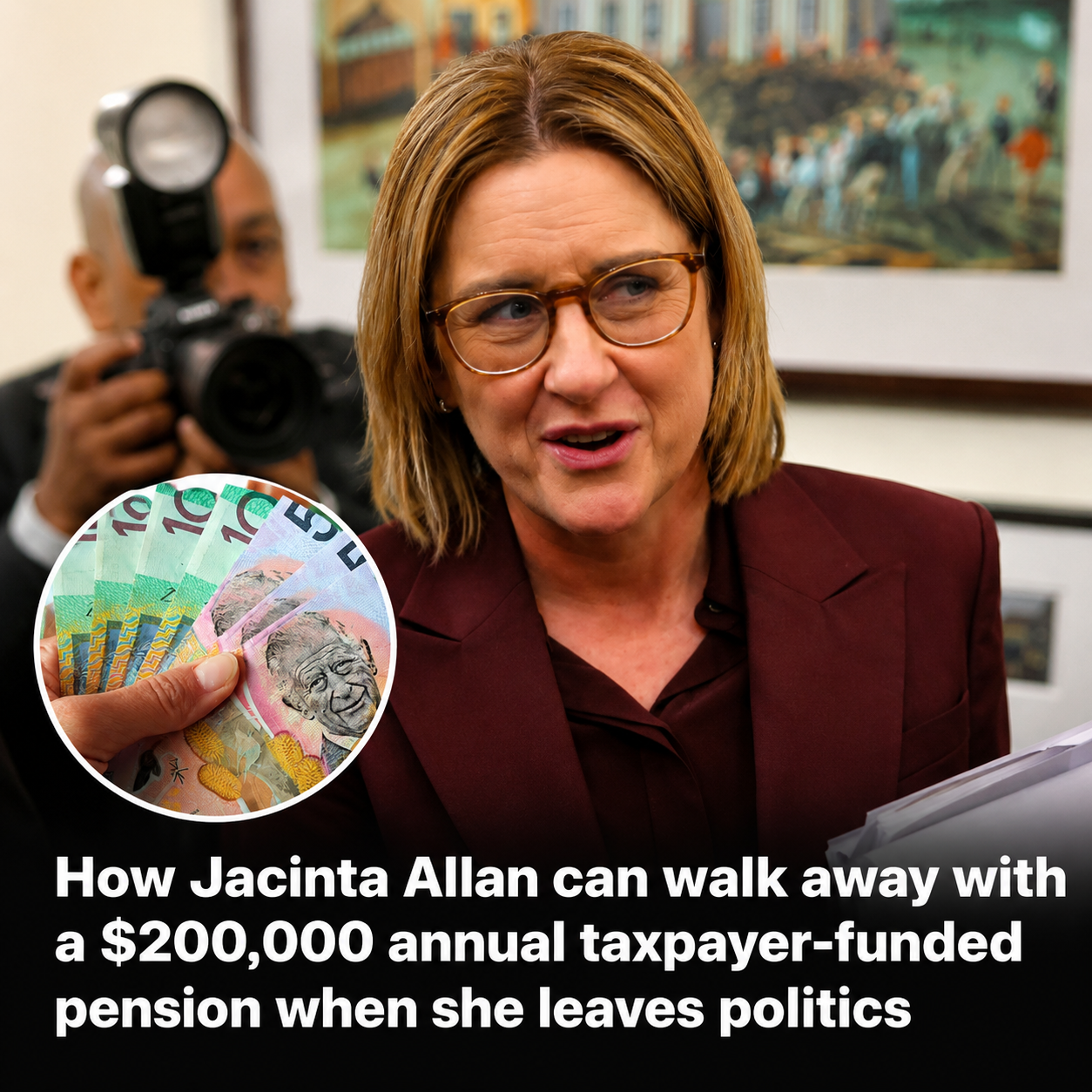
Former Victorian Premier Jacinta Allan could eventually receive one of Australia’s most generous parliamentary pensions if she chooses to retire from politics, with estimates suggesting her annual taxpayer-funded entitlement could exceed A$240,000 under a legacy retirement scheme that is no longer available to newly elected MPs.
The potential pension has attracted renewed attention following Allan’s resignation as Victorian Premier and Labor leader, prompting questions about how Australia’s older parliamentary superannuation schemes continue to operate more than two decades after they were closed to new entrants.
Allan announced earlier this week that she would step down as Premier after losing the confidence of enough colleagues within the Victorian Labor caucus, bringing to an end her leadership only months before the state election scheduled for 28 November.
Deputy Premier Ben Carroll was subsequently elected by the parliamentary Labor Party to replace her, becoming Victoria’s new premier as the government attempts to reset before voters head to the polls.
Although Allan has resigned as Premier and Labor leader, she has not yet confirmed whether she intends to leave Parliament immediately or continue serving as the Member for Bendigo East through to the election or beyond.
That decision will ultimately determine when any parliamentary pension becomes payable.
A legacy scheme no longer available to new MPs
The pension attracting attention is not available to today’s newly elected Victorian politicians.
Instead, Allan remains eligible because she first entered Parliament in 1999, five years before Victoria closed its generous parliamentary defined benefit superannuation scheme to new members.
Members elected after November 2004 joined accumulation-style superannuation arrangements similar to those used across much of the Australian workforce.
Those newer schemes operate very differently from defined benefit pensions.
Under an accumulation fund, retirement savings depend primarily on employer contributions, investment returns and voluntary personal contributions.
By contrast, defined benefit schemes guarantee eligible members a predetermined retirement payment calculated using factors such as years of parliamentary service, ministerial responsibilities and senior offices held during their careers.
Because the pension formula is linked to office rather than investment performance, the financial obligation ultimately falls upon taxpayers rather than depending entirely on accumulated investment balances.
It is precisely for that reason that governments across Australia progressively closed similar defined benefit arrangements over the past two decades, replacing them with modern superannuation systems designed to reduce long-term liabilities.
How much could Jacinta Allan receive?
Based on estimates published following her resignation, Allan’s annual parliamentary pension could fall somewhere between A$240,000 and A$270,000, reflecting the numerous senior ministerial positions she held before becoming Premier.
The exact figure would depend upon several factors, including the date of retirement, final salary calculations and the legislative formula applying to her years of parliamentary service.
Allan entered Parliament in September 1999 at just 25 years of age, becoming the youngest woman ever elected to the Victorian Parliament.
Over more than a quarter of a century she held numerous senior portfolios, including transport, regional development, major projects and infrastructure before succeeding Daniel Andrews as Premier in September 2023.
Those lengthy periods in senior ministerial office significantly increase her entitlement under the legacy defined benefit formula.
Because she served continuously throughout that period, she is regarded as one of only a very small number of remaining Victorian MPs still covered by the original parliamentary pension arrangements.
Why the scheme still exists
The existence of the pension has prompted understandable public debate, particularly at a time when governments continue urging Australians to rely primarily on compulsory superannuation savings.
However, governments generally chose not to abolish existing defined benefit entitlements retrospectively when reforms were introduced.
Instead, the schemes were closed to future members while preserving benefits already earned by politicians who had entered Parliament before the reforms took effect.
Supporters argued that retrospectively removing accrued retirement benefits would have created complex legal issues and potentially breached contractual obligations owed to serving members.
As a result, legacy liabilities continue to be paid decades after the schemes officially closed.
Victoria is not unique in this respect.
Several Australian jurisdictions still make pension payments to former politicians who remained eligible under earlier parliamentary superannuation systems, although the number of beneficiaries steadily declines each year as fewer active MPs remain covered.
Daniel Andrews provides a comparison
The issue has inevitably drawn comparisons with Daniel Andrews, who resigned as Premier in 2023 after almost nine years leading Victoria.
Because Andrews also entered Parliament before the 2004 reforms, he qualified under the same legacy defined benefit system.
Reports at the time estimated his parliamentary pension exceeded A$300,000 annually, reflecting both his lengthy service and extended period as Premier.
That comparison illustrates how senior offices can substantially increase retirement entitlements within the old scheme.
Although Allan served as Premier for a much shorter period than Andrews, her long ministerial career still places her among the highest beneficiaries remaining under Victoria’s legacy arrangements.
Taxpayer-funded—but legally established
Critics of defined benefit pensions often describe them as unusually generous when compared with retirement incomes available to most Australians.
Many argue it is difficult to justify pensions worth hundreds of thousands of dollars annually at a time when governments continue encouraging fiscal restraint and reducing public expenditure.
Supporters respond that these pensions are not discretionary gifts awarded after retirement but legal entitlements earned under employment arrangements that existed when those MPs first entered Parliament.
They also note that no newly elected Victorian MP has been able to join the scheme for more than twenty years.
Consequently, taxpayer liabilities will gradually decline over coming decades as remaining beneficiaries leave public life.
A broader debate over public sector liabilities
The renewed focus on parliamentary pensions arrives amid broader discussion surrounding Victoria’s long-term financial obligations.
The Victorian Parliament has recently debated reforms to public sector superannuation legislation while government and opposition members have argued over how best to manage unfunded defined benefit liabilities affecting public employees.
Although parliamentary pensions represent only a relatively small component of Victoria’s overall superannuation obligations, they remain politically sensitive because of their visibility and because they involve elected representatives.
Successive governments have acknowledged the importance of reducing long-term unfunded liabilities, while also maintaining commitments already made to existing beneficiaries.
What happens next?
For now, Allan’s retirement plans remain uncertain.
She has not confirmed whether she will remain in Parliament through the November election, contest another term or retire before voters head to the polls.
Until that decision is made, any discussion of her parliamentary pension remains prospective rather than immediate.
Nevertheless, her resignation has once again highlighted the lasting legacy of parliamentary retirement schemes created decades ago under very different political and economic circumstances.
For many Australians, the figures involved inevitably invite comparison with modern superannuation balances accumulated over an entire working life.
For others, the issue illustrates why governments moved away from defined benefit systems in favour of accumulation-based superannuation for future parliamentarians.
Whatever Allan ultimately decides about her political future, her potential retirement entitlement has reopened a familiar debate about taxpayer-funded parliamentary pensions, fairness between generations of elected representatives and the continuing financial legacy of schemes that officially closed more than twenty years ago but continue to shape Australia’s political landscape today.






