Iran may have discovered that it does not need a nuclear weapon to hold the world hostage.
It already controls the geography for an economic one.
That is the blunt warning from Liberal frontbencher Andrew Hastie as renewed fighting between the United States and Iran again threatens shipping through the Strait of Hormuz and sends anxiety through global energy markets.
Hastie has described Iran’s ability to disrupt the critical waterway as an “economic nuclear bomb”, warning Australia is not insulated from the consequences simply because the fighting is thousands of kilometres away.
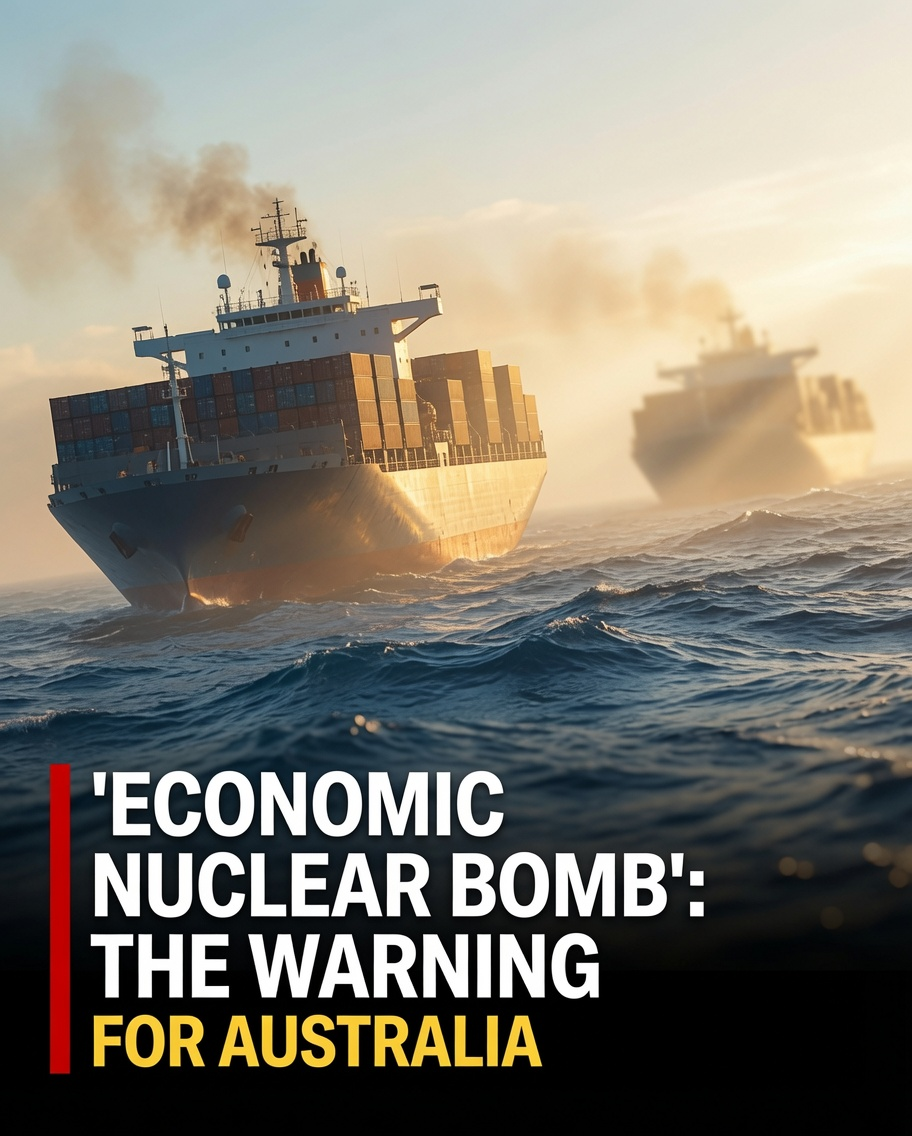
The phrase is dramatic.
The vulnerability behind it is not.
Australia can produce extraordinary amounts of energy, export coal and gas across the world and still find its economy exposed when tankers stop moving through a narrow strip of water between Iran and Oman.
That contradiction has become one of the most uncomfortable lessons of the Iran conflict.
The latest escalation has again put the Strait of Hormuz at the centre of the confrontation between Washington and Tehran.
American forces have struck Iranian military targets.
Iran has retaliated and claimed authority over shipping through the strait.
Commercial vessels have faced threats, attacks and competing demands over how they should transit the waterway.
The United States and Iran are now making rival claims about control and security arrangements in one of the most strategically important shipping corridors on Earth.
Before the war, roughly 20 million barrels a day of crude oil and petroleum products moved through Hormuz.
When traffic through the strait falls from normal levels to a trickle, the problem does not remain in the Persian Gulf.
It travels.
To refineries.
To fuel terminals.
To airports.
To farms.
To trucking companies.
To supermarket supply chains.
And eventually to the household budget of an Australian family filling the car on a Tuesday afternoon.
This is what Hastie’s “economic nuclear bomb” analogy is trying to capture.
A nuclear weapon destroys through explosive force.
A maritime chokepoint can inflict economic damage through scarcity, delay and fear.
Iran does not need to sink every tanker in the Persian Gulf.
It does not need to permanently seal the Strait of Hormuz.
It does not even need to physically stop every ship.
It needs to make the route dangerous enough.
Insurers increase premiums.
Shipowners reconsider voyages.
Crews become harder to deploy.
Freight costs rise.
Tankers wait.
Refiners search for alternative crude.
Governments begin securing emergency supplies.
Traders price the possibility of a worse disruption into oil.
The economic weapon is uncertainty.
And Iran has repeatedly demonstrated that it can create enormous amounts of it.
The International Energy Agency’s assessment of the 2026 crisis has been extraordinary.
Following the collapse in transit through Hormuz earlier this year, the agency estimated global oil supply would plunge by about eight million barrels a day in March.
Export flows of refined products through the strait were brought close to a standstill.
More than three million barrels a day of regional refining capacity was shut because of attacks and the inability to move products out of the Gulf.
Those figures explain why a military confrontation involving Iran can rapidly become an economic crisis for countries that have no intention of joining the war.
Australia is one of them.
The Albanese government has sought to reassure motorists that current fuel stocks are secure.
Home Affairs Minister Tony Burke said Australia was well stocked across different fuel categories as the latest exchange of strikes intensified.
That reassurance matters.
Panic buying can turn a manageable supply problem into a visible shortage within hours.
Australians have already seen how quickly service stations can be overwhelmed when drivers believe petrol or diesel may disappear.
A queue creates another queue.
A social media post becomes a photograph of an empty bowser.
The photograph convinces another thousand motorists to fill vehicles they would otherwise have left half-full.
Demand surges before the underlying physical supply situation has materially changed.
Governments are right to discourage that behaviour.
But “fuel stocks are secure today” is not the same statement as “Australia has solved its fuel security problem”.
It has not.
The Iran war has exposed the difference.
Australia is one of the world’s great energy exporters.
It is a major producer of coal and natural gas.
It possesses significant crude oil resources.
It has enormous renewable energy potential.
Yet the transport economy remains dependent on liquid fuels moving through a complicated international production and trading system.
Australia imports much of the refined fuel it consumes.
Petrol, diesel and jet fuel are connected to refineries and trading hubs across Asia.
Those refineries, in turn, depend on crude oil flows, shipping availability and global prices.
A disruption in Hormuz therefore does not need to involve a tanker sailing directly from Iran to Sydney.
The effect can arrive indirectly.
Suppose a major Asian refinery loses access to its preferred Middle Eastern crude.
It searches for barrels from another producer.
Other refiners want the same supply.
Prices rise.
Shipping routes change.
Voyage times increase.
Available tankers become more valuable.
Refined fuel cargoes are redirected towards buyers willing to pay more.
Australian importers are suddenly competing in a tighter market.
The service station at the end of the chain may be 10,000 kilometres from the Persian Gulf.
The price board still moves.
This is the uncomfortable reality behind Australia’s fuel debate.
Energy abundance is not the same as fuel resilience.
A country can possess resources beneath its soil and still be vulnerable if it lacks sufficient capacity to convert those resources into the products its economy needs, store them and distribute them during an international shock.
Australia has experienced that vulnerability throughout 2026.
The government has already taken emergency measures during the Iran conflict.
Fuel quality requirements were temporarily adjusted earlier in the crisis to expand the range of petrol and diesel available to the domestic market.
Fuel reserves have been released.
Officials have provided regular stock updates.
The government has worked to secure alternative imports.
The fuel excise was temporarily reduced as higher global oil prices flowed into household costs.
Each intervention can be defended as a response to an extraordinary international emergency.
Together, however, they tell a more troubling story.
Australia’s normal fuel system was not designed to comfortably absorb the scale of disruption created by the 2026 Iran war.
That is why Hastie’s warning deserves to be examined beyond the immediate political attack.
Iran has spent decades pursuing nuclear capability while facing sanctions, sabotage, military threats and diplomatic pressure.
The possibility of an Iranian nuclear weapon has dominated international security policy.
But Tehran’s geographic position provides another form of leverage.
The Strait of Hormuz is a natural chokepoint.
Oil producers inside the Persian Gulf cannot simply move all their exports by another route.
Some pipeline capacity can bypass the strait.
It is not enough to replace normal maritime flows.
When Hormuz is disrupted, global energy markets must compete for the remaining supply.
Iran understands this.
So does Washington.
That is why military operations around the strait carry risks far beyond the direct combatants.
Hastie has suggested Iran may be attempting to use economic pain to influence American politics, including the United States midterm elections.
The theory is straightforward.
American voters are highly sensitive to fuel prices.
A sustained oil shock can push up petrol costs.
Higher transport costs move through the broader economy.
Inflation becomes harder to control.
Consumer confidence weakens.
The government in Washington faces political pressure.
Iran cannot defeat the United States in a conventional military contest.
It may believe it can increase the domestic political cost of continuing that contest.
Whether Tehran can successfully engineer an American electoral outcome is another question.
But the economic mechanism is real.
Australia is caught inside the same mechanism without possessing America’s military power or its enormous domestic oil production.
If crude prices rise sharply, Australian motorists pay.
If diesel becomes more expensive, freight operators pay.
When freight operators pay more, the cost of moving food and consumer goods rises.
Farmers need diesel for machinery.
Mining operations consume fuel.
Construction companies run heavy equipment.
Emergency services require reliable supplies.
Airlines depend on jet fuel.
Defence requires liquid fuel to move ships, aircraft and military vehicles.
Fuel is not merely another retail product.
It is an input into almost everything.
That is why the economic effects can resemble a chain reaction.
The first explosion is the oil price.
Then come transport costs.
Then production costs.
Then food.
Then inflation.
Then interest rates become more complicated.
Then household confidence falls.
The Reserve Bank faces an especially difficult problem when inflation is driven by an external energy shock.
Higher interest rates cannot reopen the Strait of Hormuz.
They cannot repair a damaged refinery in the Middle East.
They cannot produce a tanker.
They cannot manufacture diesel.
Monetary policy can suppress demand and reduce the risk that an initial price shock spreads into broader inflation.
But that process imposes additional pain on households already paying more for fuel and goods.
This is how a conflict on the other side of the world can become a mortgage story in Australia.
It is also why Australia’s fuel security debate cannot end when the current crisis ends.
For years, the country has discussed strategic fuel resilience in bursts.
A war begins.
A shipping route is threatened.
A pandemic interrupts supply chains.
A refinery closes.
Politicians demand a review.
The immediate crisis eases.
Oil prices fall.
Motorists stop queuing.
The debate disappears.
Then the next shock arrives.
The Iran conflict has made that cycle harder to defend.
Australia needs a clearer answer to a simple national security question.
How long can the country continue operating if normal fuel imports are seriously disrupted?
The answer cannot exist only as a headline number.
Different fuels matter in different ways.
Petrol stocks do not keep a diesel truck moving.
Diesel cannot simply replace aviation fuel in a passenger aircraft.
Crude oil sitting somewhere in a reserve is not immediately useful if refining and transport arrangements cannot convert it into fuel where it is needed.
Location matters.
Product type matters.
Storage matters.
Refining capacity matters.
Shipping contracts matter.
Distribution matters.
A genuine fuel security policy must examine the entire chain.
Australia’s two remaining major oil refineries have strategic importance far beyond their commercial balance sheets.
Domestic refining does not make Australia immune from global oil prices.
Refineries still require feedstock.
Crude markets remain international.
Maintenance failures can occur.
But local capacity provides options during disruption.
That option has value.
The same is true of storage.
Strategic reserves are expensive until the day they are needed.
Then the argument reverses.
The cost of holding fuel must be compared with the economic damage caused when trucks cannot move, farms cannot operate and essential services begin rationing supply.
Australia also needs to examine alternative liquid fuels more seriously.
Biofuels are often discussed primarily through climate policy.
They are also a resilience issue.
A domestically produced fuel source capable of replacing part of imported petroleum demand can provide strategic value even if it never replaces conventional fuel entirely.
Electrification matters for the same reason.
Every passenger vehicle that can operate on domestically generated electricity represents one vehicle less exposed to an international oil shock.
That does not mean electric vehicles solve the entire problem.
Heavy transport, aviation, agriculture, mining and Defence present much harder technical challenges.
Australia’s electricity system has its own reliability and infrastructure questions.
But reducing oil dependence is not only an emissions policy.
It is geopolitical insurance.
This is where Australia’s energy debate frequently becomes trapped by partisan politics.
One side talks about fossil fuels.
The other talks about renewables.
Fuel security requires a less ideological conversation.
The question is not which technology wins a political argument.
The question is whether Australia can keep moving during a global emergency.
That may require domestic refining.
It may require larger and better distributed fuel stocks.
It may require long-term import agreements with a wider group of suppliers.
It may require biofuels.
It may require more electric transport.
It may require governments to identify priority fuel users before a crisis rather than during one.
It may require all of those things.
Hastie’s warning also raises a larger national security issue.
Modern warfare increasingly targets systems rather than armies.
A country does not always need to invade another country to hurt it.
Cyber attacks can disable infrastructure.
Trade restrictions can choke industries.
Critical mineral controls can disrupt manufacturing.
Undersea cables can be threatened.
Shipping lanes can be made dangerous.
Energy can become a weapon.
Iran’s position beside the Strait of Hormuz is an extreme example of that reality.
Tehran possesses leverage because the global economy concentrated so much critical trade through one narrow maritime route.
Australia’s exposure exists because decades of economic efficiency created long and sophisticated supply chains that work exceptionally well under normal conditions.
Efficiency reduced costs.
Specialisation improved productivity.
International trade allowed Australia to buy refined fuel from large overseas facilities rather than produce every litre domestically.
There was economic logic behind those decisions.
The weakness appears when normal conditions disappear.
A resilient system contains spare capacity.
It contains redundancy.
It contains stock that may sit unused.
It may cost more.
For decades, businesses and governments have often treated those characteristics as inefficiency.
The pandemic changed part of that thinking.
The Iran war should change more.
There is a difference between wasting money and paying for insurance.
Australia does not build a Defence Force because war is the most likely event tomorrow morning.
It maintains military capability because the consequences of being unprepared are unacceptable.
Critical fuel deserves similar strategic thinking.
That does not mean attempting complete energy autarky.
Australia will remain part of global markets.
Trying to manufacture every product domestically would be economically destructive.
But critical dependence should be identified honestly.
Governments should know which supply disruptions can stop the country.
They should know how quickly.
And Australians should be told what is being done about them.
The current government can point to secure fuel stocks and emergency actions taken throughout the year.
Those measures have helped Australia navigate an extraordinary crisis.
The opposition can point to the underlying structural weakness exposed by the same emergency.
Both things can be true.
Australia may have enough fuel today.
Australia may also be too vulnerable tomorrow.
The danger is allowing the first fact to silence debate about the second.
Iran’s military confrontation with the United States will eventually change.
There may be another ceasefire.
There may be negotiations.
Shipping traffic may recover.
Oil prices may fall.
The immediate pressure on Australian fuel supplies may ease again.
But the Strait of Hormuz will remain where it is.
The geography will not change.
Neither will the strategic lesson.
A hostile state does not always need a nuclear warhead to threaten the prosperity of countries far beyond its borders.
Sometimes it needs missiles.
Sometimes it needs drones.
Sometimes it needs the ability to make commercial shipping afraid.
And sometimes it simply needs control over the right piece of water.
Iran has spent years at the centre of a global argument about whether it can obtain a nuclear bomb.
Hastie’s warning is that Tehran may now understand the economic weapon it already possesses.
For Australia, the most important question is not whether the phrase “economic nuclear bomb” is exaggerated.
It is why a country with our energy resources remains so exposed to anyone capable of threatening to detonate it.






