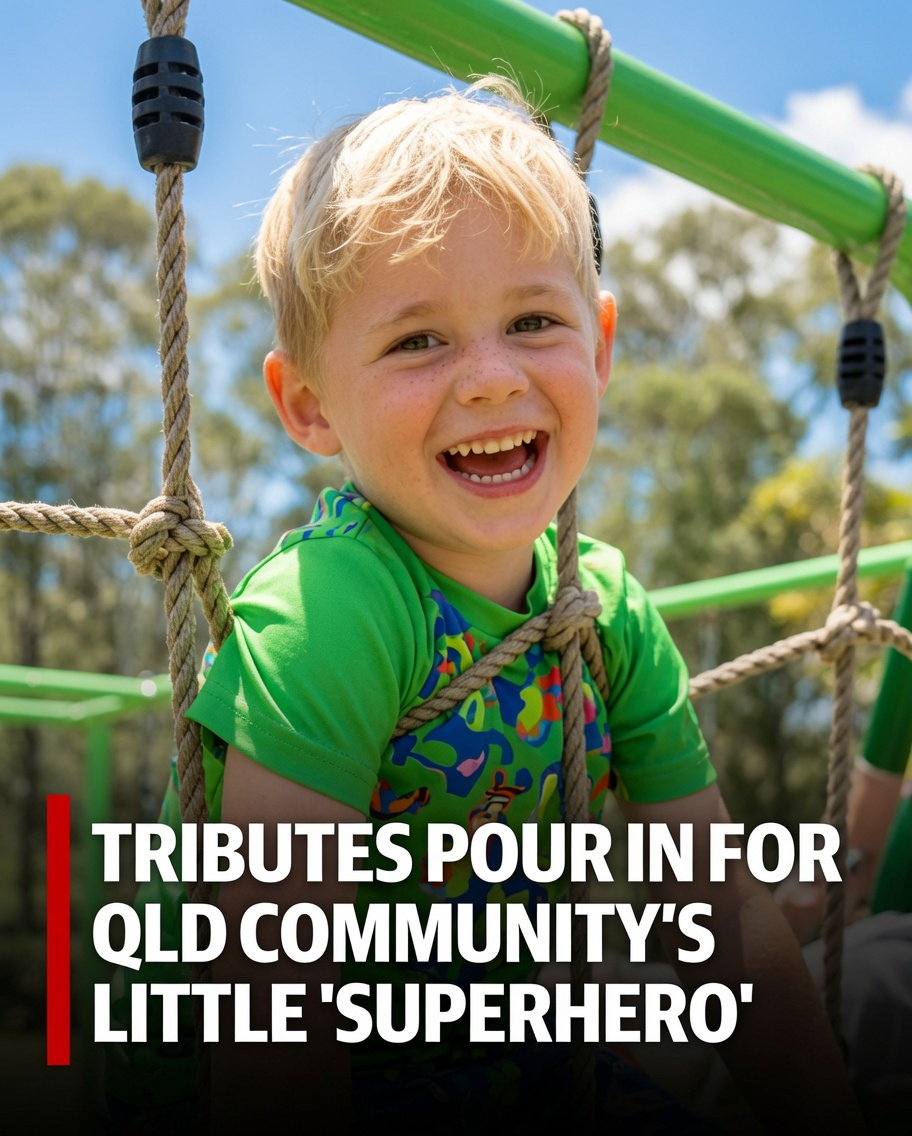
Ari Currie loved superheroes. Spider-Man and the Power Rangers were among his favourites. His family never imagined that, at just six years old, they would one day describe Ari as a real-life superhero himself.
The little Queensland boy died after suffering critical injuries in a horrific school holiday crash south of Brisbane.
He had spent five days in a paediatric intensive care unit as his family stayed close, hoping desperately for a different ending.
When Ari died, his parents Sharni and Bradley were confronted with a decision no mother or father expects to make.
They agreed to organ donation.
According to Ari’s family, his organs saved the lives of two children and improved the quality of life of two others.
“He was really into Spider-Man and Power Rangers but now he is a real-life superhero,” his aunt Melissa Bunn said.
For the family now trying to understand life without Ari, the word “hero” is more than a comforting tribute.
Somewhere, other children have been given a future because of the little boy with the enormous smile.
The crash happened at Gleneagle in Queensland’s Scenic Rim on July 6.
Ari was travelling in a Nissan Qashqai with his 56-year-old grandmother Gaye and 15-year-old cousin Hollie when the vehicle was involved in a collision with a Subaru Impreza at the intersection of Mount Lindesay Highway and Gould Hill Road.
The crash occurred about 2.14pm.
Emergency crews rushed to the scene.
Ari had suffered life-threatening injuries and was airlifted to hospital.
His grandmother and cousin were also injured.
For five days, Ari remained in intensive care.
He died on Friday surrounded by the people who loved him.
Police investigations into the circumstances of the crash remain ongoing.
But as investigators continue their work, Ari’s family and the Beaudesert community have begun the much harder task of saying goodbye to a child whose life was measured in only six years.
The tributes have not described Ari through grand achievements.
They have remembered the things that make a child real.
His cheekiness.
His laughter.
His love of soccer.
His jokes.
The way his smile could fill a room.
“He liked to make people laugh,” Melissa, known affectionately to Ari as “Mel Mel”, said.
“He had the perfect big smile that would just light up any room that he walked into.”
Ari’s grandfather Brad remembered a boy who seemed to approach life with a joy many adults spend decades trying to recover.
“Ari lived every day with a joy that most of us spend a lifetime trying to find,” he wrote.
“More than anything, Ari had the biggest heart.”
His family says that heart was visible long before organ donation became part of his story.
Melissa recalled how Ari’s emotional intelligence had begun to emerge as he grew older.
At soccer, he met a boy with autism.
Other children had apparently struggled to connect with the boy.
Ari did not.
He befriended him.
“Not many kids wanted to be friends with this little boy but Ari made best friends with him,” Melissa said.
“He just made everybody feel included and made sure that they all had friends.”
If someone was sad, Ari noticed.
If someone needed help, he tried to help.
Sometimes, his family said, he appeared to understand what another person needed without being told.
A cuddle.
A smile.
A cheeky thumbs-up.
These are small acts.
But for Ari’s family, they were evidence of a child with a maturity and generosity far beyond his age.
“He wasn’t our little boy,” Melissa said.
“He was our little man.”
Ari was also a proud Mununjali boy.
He participated in the Jabu Jabuny Club, an after-school program incorporating culture, song, dance and language into children’s education.
His family had deep connections to Beaudesert and the surrounding community.
For much of Ari’s life, three generations of the family lived under the same roof.
That closeness is visible in the memories now being shared.
His brothers remember wrestling with him.
Eight-year-old Van described Ari as the best little brother and recalled how their playful fights could become a little more competitive than expected.
His nine-year-old brother Levi Bullock remembers broccoli.
Ari, apparently, had a habit of shoving it into Levi’s mouth.
They are the strange, funny details grief preserves.
Ari liked fishing.
He loved showing his family soccer tricks.
He admired Cristiano Ronaldo and had firm opinions about Lionel Messi.
“Ronaldo’s the best but Messi is the worst,” became one of the phrases his family remembered.
He sang Sunflower by Post Malone in the shower.
He frightened his grandfather by jumping out from behind doors.
Then he would deliver another favourite line.
“Just tricking ya.”
Brad wrote that he would forever be on his toes, half-expecting Ari to appear from behind a door again.
That is the cruelty of losing a child.
A family home is filled with habits created around someone who is suddenly no longer there.
A bedroom remains.
Toys remain.
There are songs nobody can hear in quite the same way.
A joke that once produced laughter can become almost impossible to repeat.
For Ari’s parents, siblings and extended family, grief will not exist only at a funeral or on an anniversary.
It will arrive in ordinary moments.
At a soccer field.
At dinner when broccoli is served.
During a song in the shower.
When a door opens and, for half a second, somebody expects the cheeky six-year-old to jump out.
The family’s public tribute described Ari as a cherished son, adored brother, grandson, nephew, cousin and friend.
“His absence has left an unimaginable void in the lives of those who loved him most,” the family said.
There is no decision that can remove that void.
Organ donation does not make a child’s death fair.
It does not reduce the grief of parents to a simple story about hope.
But in the most devastating hours of their lives, Ari’s family allowed something life-giving to emerge from the loss.
Organ donation is possible in only a small proportion of deaths.
The clinical circumstances have to be right and a potential donor must be medically suitable.
Australia’s national DonateLife program exists because the need for transplantable organs remains much greater than the opportunities for donation.
Official data released this year shows 557 deceased organ donors enabled 1,438 Australians to receive a life-saving transplant in 2025.
That was the highest number of deceased donors recorded in Australia.
Yet about 2,000 Australians remain on the organ transplant waitlist, while another 14,000 people are on dialysis for kidney failure and many could benefit from a transplant.
Australia’s donation consent rate was 53 per cent in 2025.
DonateLife estimates that increasing the consent rate to 60 per cent could have resulted in about 200 additional life-saving transplants during the year.
Behind those statistics are families having conversations in intensive care units.
They are often exhausted.
They may still be processing the fact that a loved one will not survive.
Then they are asked to consider people they have never met.
For the parents of a child, the decision carries an almost unbearable emotional weight.
Ari was six.
His parents had spent years making decisions designed to protect him.
Then, after a road crash, they were asked to make a decision that could protect somebody else’s child.
They said yes.
Two children, Ari’s family says, were saved.
Two more had their quality of life improved.
The recipients’ private stories are not known publicly.
They do not need to be.
Somewhere there are families whose lives were also shaped by hospital rooms, medical uncertainty and fear.
For them, a transplant may have changed what the future looked like.
Their hope arrived at the same moment another family was experiencing unimaginable loss.
That is the painful reality of deceased organ donation.
One family’s worst day can become another family’s chance to keep living.
Ari’s generosity after death also reflected the boy his family says he had already become in life.
Brad described his grandson as the first to help others.
Ari shared what he had.
He tried to make people feel loved.
He looked for the child who needed a friend.
His aunt said he had an instinct for recognising sadness.
It is impossible to know what Ari himself would have understood about the medical complexity of organ donation.
He was only six.
But his family sees a direct line between the child they knew and the lives helped after his death.
The boy who made sure another child at soccer was not alone became a donor who helped four other children.
That is why the superhero description has resonated.
It connects Ari’s childhood imagination with the final gift made in his name.
He loved Spider-Man.
He loved the Power Rangers.
Superheroes, in the world of a six-year-old, save people.
Ari did too.
Beaudesert has now wrapped itself around the Currie family.
The Beaudesert Kingfishers rugby league community honoured Ari by wearing armbands bearing his name.
The club said it was a way of showing the family they were surrounded by love, strength and the unwavering support of their community.
“There are simply no words that can ease the pain of such an unimaginable tragedy,” the Kingfishers said.
A fundraising campaign has also been established to support Ari’s family and relatives injured in the crash.
The money is intended to ease financial pressure as family members take time away from work, grieve and support one another.
Ari’s grandmother Gaye and cousin Hollie were also injured.
The family’s supporters have described an extraordinary response from Beaudesert and beyond.
There have been meals.
Messages.
Practical help.
Donations.
Quiet acts of kindness from people trying to do something when there is no way to fix what happened.
Brad called it the true “Beauy spirit”.
He also thanked the emergency services, CareFlight crews, firefighters, hospital staff and first responders who tried to help Ari and his family.
For those who arrived at the crash scene, the events of July 6 will carry their own difficult memories.
The family’s gratitude does not change the outcome.
It recognises the people who fought for Ari during the final days of his life.
There is a danger, when a child dies, of allowing the manner of death to become the entire story of the child.
Ari Currie was killed after a road crash.
That fact will always be part of his story.
But it was not his life.
His life was six years of family, soccer, culture, brothers, jokes and an apparently relentless campaign to make people laugh.
It was a friendship with a boy who needed a friend.
It was a thumbs-up when somebody was sad.
It was Ronaldo over Messi.
It was singing in the shower.
It was hiding behind doors to frighten Grandad.
It was “just tricking ya”.
Those are the memories his family is fighting to hold alongside the hospital and the crash.
Brad ended his tribute to his grandson with Ari’s favourite phrase.
Then came the words that will now follow the six-year-old’s name through a grieving community.
“Forever six. Forever our hero. Forever in our hearts.”
For two children whose lives were saved, Ari’s final gift may mean years that once seemed uncertain.
For two others, his donation has helped improve the life ahead of them.
His family will never get their little boy back.
But the child they remember for making sure other people were okay has, in the most extraordinary and heartbreaking way, continued to help others.
Ari Currie loved superheroes.
He died at six years old.
And four children were helped because his family said yes to donation.






