The argument between Peter Dutton and Richard Marles over military decorations was more than a contest of political insults. It exposed a difficult question about the Australian Defence Force: how should responsibility travel up the chain of command when an investigation identifies grave failures in a military operation? Dutton challenged the fairness and timing of the government's approach. Marles countered that Dutton had failed to resolve the same accountability issue when he held the defence portfolio. Neither argument can be assessed properly without separating command responsibility from the criminal allegations that prompted the review.
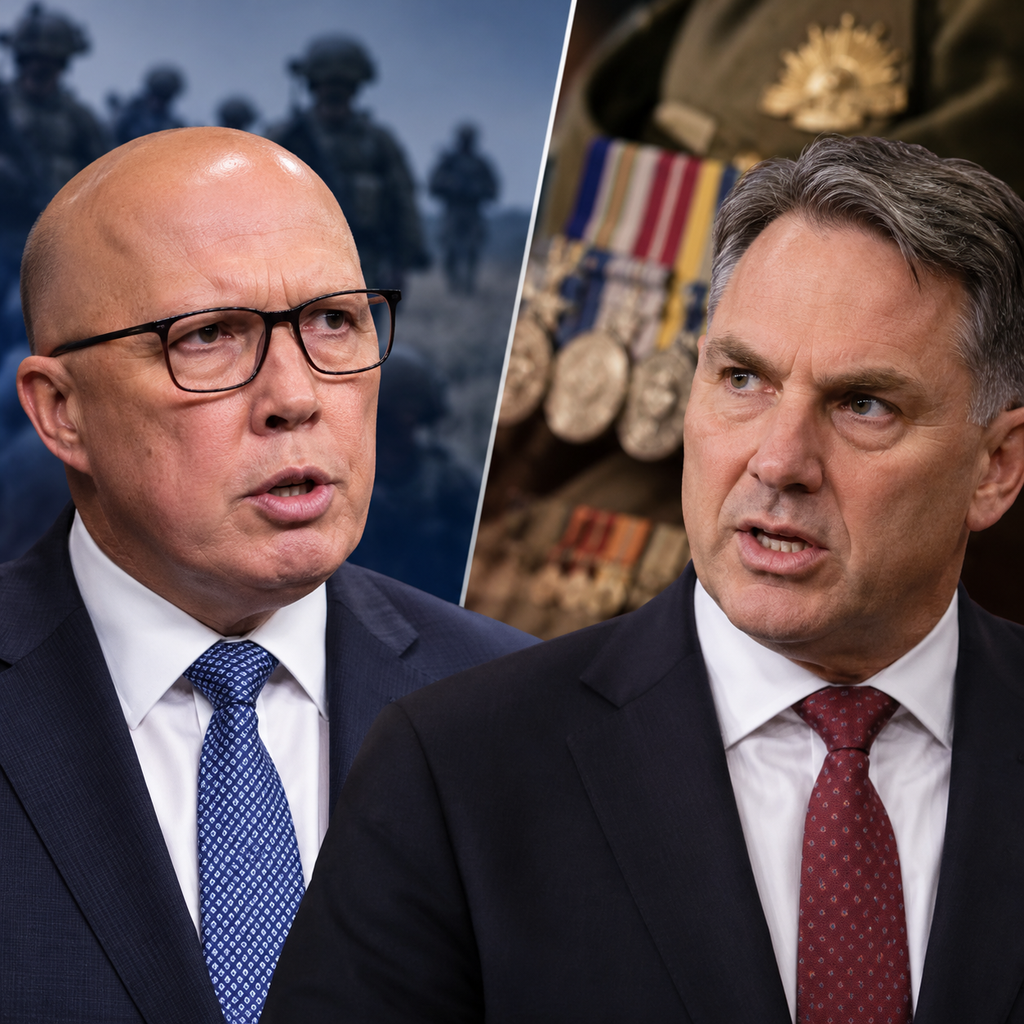
The immediate trigger was the decision to remove distinguished service decorations from a small number of serving and former officers who had held command responsibilities in Afghanistan. The decision followed the Brereton inquiry, which examined allegations involving Australian special forces and identified serious problems with conduct and oversight. The decorations question was a response to failures of command. It was not a public determination that every recipient had personally committed a war crime, nor was it the equivalent of a criminal verdict delivered by a court.
Dutton, speaking as opposition leader and a former defence minister, argued that the action treated different levels of the military hierarchy inconsistently. He questioned why commanders at one level might lose honours while people further up the hierarchy appeared to avoid comparable consequences. That objection was closely tied to his argument about morale: serving personnel, veterans and their families could reasonably ask whether those with the greatest authority also carried the greatest accountability. His criticism was directed at the decisions of Marles and the government rather than at any individual soldier accused of an offence.
The language was unusually sharp. Dutton accused the government of throwing lower-ranked diggers under the bus, saying senior figures had avoided scrutiny. His complaint was also about the political calendar. The announcement coincided with the release of the final report of the royal commission into defence and veteran suicide, an inquiry dealing with the treatment of people who serve and the failures that can follow them into civilian life. Dutton argued the timing was insensitive to a community already absorbing difficult findings.
Marles rejected the suggestion that acting on command accountability represented a failure of leadership. He pointed instead to the period when Dutton was defence minister, accusing him of suspending a decision on the medals. “Difficult decisions require leadership,” Marles said. That response placed a different test before voters: if the Brereton findings raised an unresolved responsibility issue, should a minister have left it pending indefinitely because the consequences were uncomfortable? Marles maintained he was bringing an outstanding response to a conclusion.
The exchange presented two distinct questions, not necessarily one answer. Was the line drawn through the command structure the right one? And was there a reason for the process to remain unfinished after the inquiry's findings had been published? Dutton concentrated on the first and on the effect of the announcement. Marles concentrated on the second and on the duty to make a decision. Neither position, standing alone, proves that the full system of military accountability operated fairly or unfairly.
An important legal distinction sits underneath the political rhetoric. A military honour may recognise service at a particular level of leadership and be reviewed against criteria connected with that leadership. Criminal liability requires a different process, different evidence and its own standard of proof. Reports of suspected unlawful killings in Afghanistan are serious allegations. They should not be converted into declarations of guilt about an identifiable officer simply because a decoration was removed or because a politician used forceful language about commanders.
The Brereton inquiry also raised a broader question about institutions: whether people with authority could be aware of risks without receiving reliable information about what was happening in their units. That is relevant to the effectiveness of reporting systems, operational oversight, culture and the way concerns travel upward. It is possible for senior commanders to have responsibility for the environment in which troops operate while not being personally responsible for every alleged criminal act. A responsible account of the dispute has to preserve that difference.
For Defence, the impact extends beyond medals. Decisions about promotions, career recognition and formal commendations send signals about the qualities the institution rewards. A decoration is not merely an object placed in a cabinet; it is a public statement about service. Taking it away can therefore carry reputational consequences even when no criminal accusation is made against its holder. That makes transparency about the reason for the decision particularly important. Service members and the public need to understand which standards were applied and why.
There is a financial dimension too, although it should not be exaggerated into an invented price tag for the dispute. Defence is a major public institution with substantial expenditure on personnel, training, operations and veteran support. Weak accountability can create operational, legal and reputational costs, while poorly explained disciplinary decisions can undermine confidence in leadership. Those consequences are difficult to express as a single dollar figure. The political exchange contained no verified calculation of what the medals decision would cost taxpayers, and none should be invented.
The veterans' suicide royal commission belongs in this wider discussion for a specific reason. Its work examined the experiences of serving people, former personnel and families seeking support, as well as the institutional systems around them. It did not decide the Afghanistan decorations question. Dutton's complaint was that the presentation of one Defence decision risked compounding stress around another major announcement. Marles's reply was that difficult accountability questions did not disappear because the wider environment was emotionally charged. Both propositions can be tested without confusing the remit of the two inquiries.
Another issue is what people outside the armed forces should expect from the decision-making process. Public confidence does not depend on every observer agreeing with the outcome. It depends partly on a clear statement of who considered the evidence, which powers were used, whether the people affected had an opportunity to respond and whether review mechanisms exist. If those details are absent from a headline, the reader cannot tell whether a decision was arbitrary or simply contested. The public record of the Dutton–Marles clash does not, by itself, answer every procedural question.
Nor should political argument be mistaken for an operational finding. Dutton raised questions about higher command levels; that does not establish that a named senior officer deserved a particular sanction. Marles defended the completion of an administrative process; that does not establish that its scope could not be criticised. Other political figures also voiced concerns about leadership responsibility. Their comments demonstrate that the argument was broader than a personal feud, but they remain political assessments unless tied to findings and identifiable evidence.
There is a lesson for employers and other organisations with complex reporting lines. When serious misconduct allegations emerge, investigators may have to examine both the conduct of the individuals directly implicated and whether management systems failed to detect or deter it. Those are related but separate inquiries. If a board, departmental head or military command treats them as interchangeable, accountability can become either too narrow or unfairly broad. The analogy helps explain why the decorations argument resonated without suggesting civilian workplace rules and military justice are identical.
For veterans, public discussion can also have an unintended effect. The overwhelming majority of people who served were not accused in the Brereton process. Reporting that speaks loosely of collective guilt risks attaching allegations to an entire generation of service personnel. Equally, insisting that criticism of commanders is an attack on all veterans can discourage legitimate scrutiny. Precision about the small number of people directly affected, and about what the inquiry did and did not find, is essential to fairness.
The most useful way to judge the politicians' competing claims is to ask what each leaves unanswered. Dutton's fairness argument needs a clear account of how different command levels were assessed. Marles's leadership argument needs a clear explanation of how the eventual decisions followed the inquiry and why a ministerial determination was appropriate. The timing criticism requires sensitivity to the royal commission's audience, while the case for action requires acknowledging that delayed accountability can itself damage institutional trust.
The public confrontation was memorable because it compressed those complicated questions into a direct personal challenge. Dutton accused Marles of disadvantaging soldiers lower down the chain. Marles accused Dutton of avoiding an uncomfortable decision. A headline can capture the exchange, but it cannot resolve the underlying ethics of command responsibility. That requires evidence about individual decisions, procedural fairness and the standards attached to military honours.
Australians are entitled to expect both compassion for those who serve and scrutiny of institutions that exercise exceptional power in their name. In this dispute the two ambitions were sometimes presented as rivals. They need not be. The enduring question is whether Defence can respond to serious findings, protect the distinction between allegations and convictions, explain the consequences for commanders and maintain the confidence of the people whose service its decorations are intended to honour.






