The federal Coalition has revived one of its most controversial election policies, arguing that Australia’s rapidly expanding data centre industry provides a fresh reason to embrace nuclear energy despite voters overwhelmingly rejecting the proposal at the last federal election.
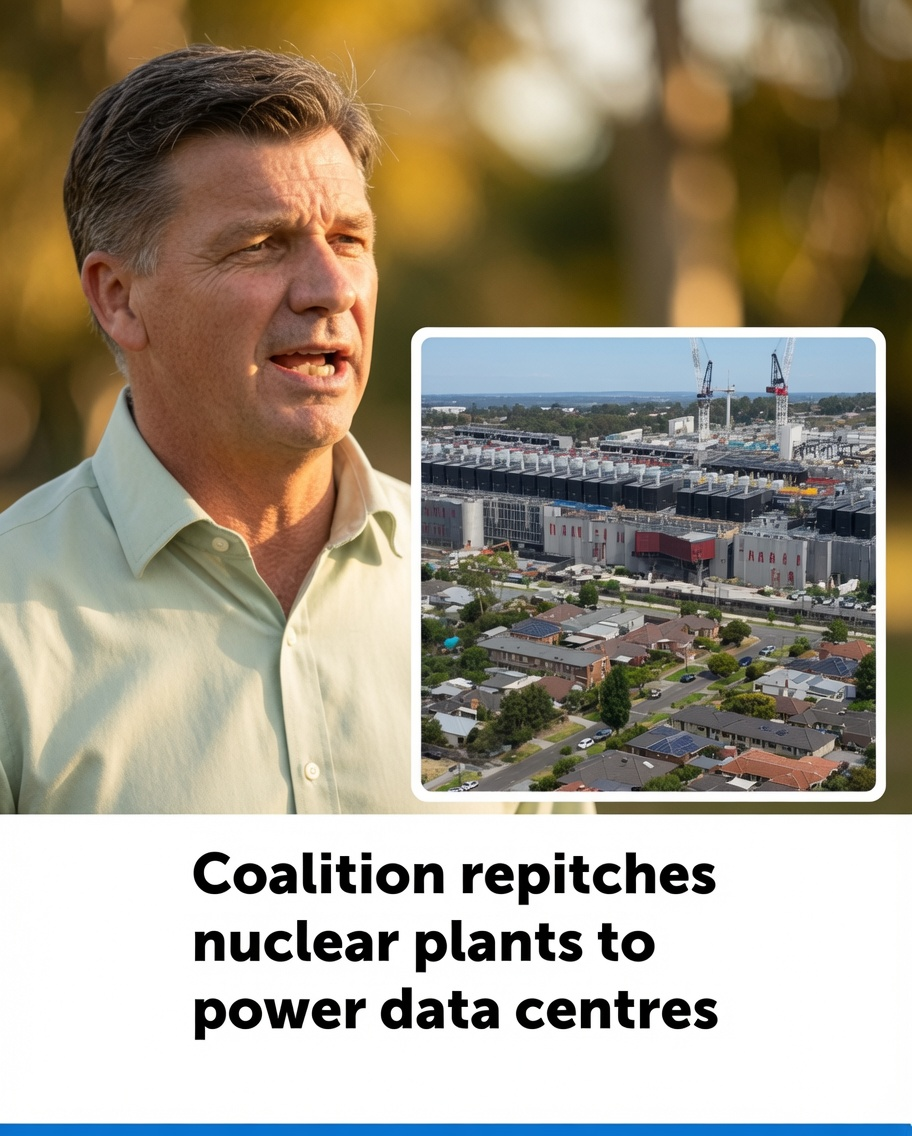
Shadow Minister for Science, Technology and the Digital Economy Aaron Violi says the explosive growth of artificial intelligence, cloud computing and hyperscale data centres will place unprecedented pressure on Australia’s electricity network, making nuclear power an option that should not be dismissed.
Speaking to Sky News, Violi argued Australia simply would not have enough renewable generation to simultaneously power households, industry and the next generation of large-scale computing facilities.
“We literally don’t have enough renewable energy in this country to power the country and to power data centres,” he said.
His comments mark the Coalition’s latest attempt to reframe a policy that became one of the defining—and most divisive—issues of the recent federal election campaign.
During the election, the Coalition proposed constructing seven nuclear power stations across Australia as ageing coal-fired generators retired from the electricity grid.
The proposal was promoted as a pathway to achieving reliable, low-emissions electricity while maintaining energy security.
However, Labor strongly opposed the plan, arguing nuclear reactors would take too long to build, cost taxpayers tens of billions of dollars and delay investment in renewable energy and electricity storage.
The policy became one of the Coalition’s most heavily criticised election commitments, with many political analysts concluding it contributed to the party’s substantial electoral defeat.
Rather than abandoning the idea after the election, Coalition figures are now attempting to connect nuclear energy with one of the fastest-growing sectors of the Australian economy.
Data centres—the highly specialised facilities that store information, host cloud services and power artificial intelligence systems—are consuming increasing amounts of electricity worldwide.
The expansion of AI applications has accelerated that trend, with technology companies investing billions of dollars in larger computing facilities capable of processing enormous volumes of data around the clock.
Unlike many industrial users, data centres require an exceptionally reliable electricity supply because even brief interruptions can disrupt critical digital services.
That requirement has prompted governments around the world to examine whether existing electricity networks can support rapidly growing demand while continuing the transition towards lower-emissions energy systems.
Violi argues nuclear energy could help solve that challenge because reactors operate continuously, producing electricity regardless of weather conditions while generating virtually no greenhouse gas emissions during operation.
Supporters of nuclear power frequently cite these characteristics as particularly valuable for industries requiring uninterrupted electricity, including hospitals, manufacturing and increasingly, AI data centres.
However, the technology remains highly contentious in Australia.
Critics point to the enormous capital costs associated with constructing nuclear reactors, the lengthy approval and construction timelines, long-term radioactive waste management, community concerns surrounding safety and the absence of an established domestic nuclear power industry.
Australia also maintains a legislative prohibition on commercial nuclear power generation under both Commonwealth and several state laws, meaning significant legislative reform would be required before any reactor could be built.
The Albanese Government has consistently rejected calls to revisit those laws.
Instead, Labor continues to argue Australia’s comparative advantage lies in expanding renewable generation—including solar, wind and hydroelectricity—supported by batteries, pumped hydro storage and upgraded electricity transmission infrastructure.
Energy Minister Chris Bowen has repeatedly argued that renewable technologies can be deployed far more quickly than nuclear reactors while delivering lower overall costs to consumers.
The debate nevertheless reflects a genuine challenge confronting Australia’s electricity system.
Electricity demand from digital infrastructure is expected to increase significantly over the coming decade as artificial intelligence becomes more deeply integrated into business operations, government services and consumer technology.
Modern hyperscale data centres can require hundreds of megawatts of continuous electricity, with some of the world’s largest facilities consuming as much power as medium-sized regional cities.
Australia has already experienced strong growth in major data centre developments, particularly around Sydney and Melbourne, where cloud computing providers and AI companies continue expanding their operations.
Industry analysts expect that demand to accelerate further as businesses adopt increasingly sophisticated machine learning systems and generative AI applications.
The growing electricity requirements of those facilities have intensified discussion about how Australia should balance energy reliability, affordability and emissions reduction.
Some energy experts argue that a diversified generation mix—including renewables, energy storage, flexible gas generation and potentially emerging technologies such as small modular reactors—may eventually provide greater resilience.
Others maintain Australia possesses some of the world’s best renewable energy resources and should concentrate investment on technologies that are already commercially available rather than embarking on an expensive nuclear industry from scratch.
Internationally, governments have adopted differing approaches.
Countries including France continue to rely heavily on nuclear power for electricity generation, while the United Kingdom is investing in both large nuclear stations and next-generation small modular reactor projects alongside substantial renewable energy expansion.
Meanwhile, the United States has seen major technology companies explore direct partnerships with electricity providers—including nuclear operators—to secure reliable long-term energy supplies for rapidly expanding AI infrastructure.
Those developments have contributed to renewed international discussion about whether artificial intelligence could reshape long-term energy planning.
For Australia, however, the question remains deeply political as well as technical.
The Coalition argues Labor exaggerated the risks associated with nuclear energy during the election campaign and questions why Australia continues exporting uranium to countries that successfully operate nuclear power stations while refusing to consider the technology domestically.
Violi suggested Australians should ask why the nation is comfortable supplying uranium overseas yet unwilling to debate using similar technology at home.
Labor rejects that argument, maintaining that Australia’s energy transition should prioritise renewable electricity backed by storage rather than pursuing what it describes as an expensive and slow alternative.
Business groups, meanwhile, remain focused on ensuring sufficient electricity capacity becomes available regardless of the generation technology ultimately adopted.
For operators of large-scale data centres, reliability, affordability and predictable long-term electricity supply remain the overriding commercial priorities.
The Coalition’s renewed emphasis on powering AI infrastructure demonstrates that the debate over nuclear energy is unlikely to disappear from Australian politics.
Although voters rejected the policy at the last election, the rapid expansion of artificial intelligence and the digital economy has provided opponents and supporters alike with a new battleground over how Australia should generate the electricity needed for the decades ahead.






