Question time in the NSW Parliament was interrupted when a climate protester crossed a barrier from the public gallery and entered the chamber floor, prompting members and parliamentary staff to intervene. The disruption was organised by environmental campaign group Rising Tide, which said it was drawing attention to a coal mine extension in the Hunter Valley. The protest was quickly brought under control, but it raised two distinct questions: the political dispute over coal and climate policy, and the security arrangements that allow members of the public to watch their elected representatives at work. Reporting should distinguish the motives claimed by activists from the response of parliamentary authorities and avoid treating an intervention by security staff as a final criminal finding.
The incident occurred during question time, when members of parliament were gathered in the chamber. Accounts and video shared by the protest group show one protester climbing across the barrier separating the public gallery from the parliamentary floor. Independent MP Michael Regan and Labor MP David Saliba were among those reported to have helped staff restrain the person who entered the chamber. The Speaker, Greg Piper, interrupted the parliamentary feed as the disturbance unfolded. Other activists were reported to have thrown pages of climate-related documents into the chamber. The available account does not establish that every person present in the public gallery participated or supported what took place.
Rising Tide linked the action to the NSW Independent Planning Commission’s approval of an extension to the Hunter Valley Operations coal mine. The group argues that further coal extraction is inconsistent with the state’s emissions-reduction objectives and says the government has not adequately addressed climate risks. Those are the protesters’ policy claims. The approval is a decision made through a planning process, and it carries conditions. Reporting the protest should not transform a political allegation into a judicial finding that officials acted unlawfully. Equally, describing the security breach accurately does not require dismissing the policy argument the group says it wanted to raise.
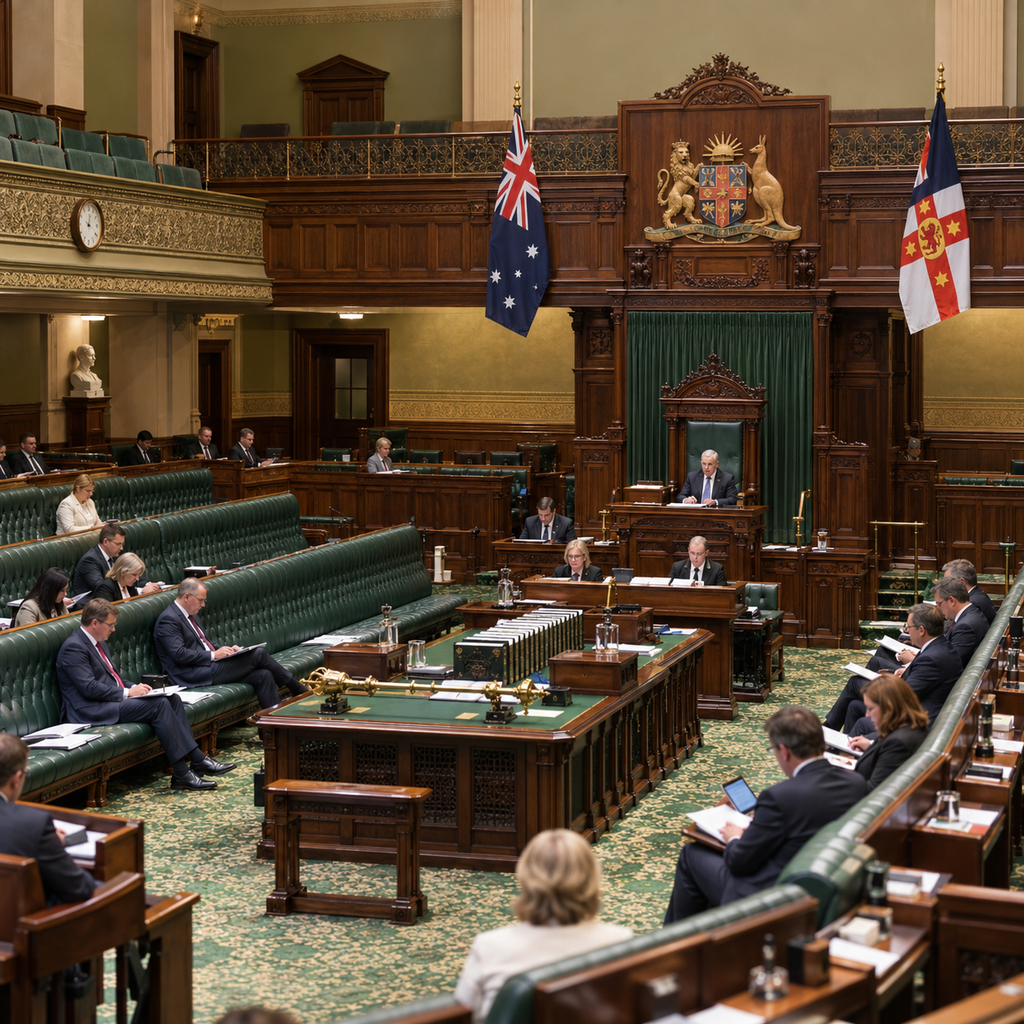
The protest was dramatic because the public gallery and the floor of a parliamentary chamber have different functions. Members of the public can observe proceedings from designated spaces, but entering the working floor disrupts the conduct of parliamentary business and may create uncertainty for those responsible for safety. The immediate response involved MPs and staff intervening physically while the session was interrupted. A fast intervention does not establish what consequences will ultimately follow under parliamentary or criminal procedures. Any report of charges, prosecution or conviction would require an independently verified legal update rather than inference from footage of a person being restrained.
NSW Attorney-General Michael Daley criticised the incident and argued that the chamber’s security and democratic procedures must be respected. Other government figures also expressed concern about a protester crossing the physical boundary into the working chamber. Those responses reflect elected officials’ views on how public protest should be conducted around parliament. They should be attributed rather than expanded into claims that every lawmaker shares one position. Public disagreement over mining does not disappear because of a breach of parliamentary rules, but a protest against a policy is not a blanket exemption from safety requirements or rules governing access to the chamber.
The Speaker has indicated that security procedures will be examined following the incident. That review is relevant because parliamentary precincts must balance openness with effective protection of members, staff and visitors. A legislature that is too difficult for the public to enter risks becoming detached from the people it represents, while an inability to maintain boundaries can interfere with debate and public confidence. The case does not yet establish that a particular guard, screening process or access policy failed. Identifying what should change requires evidence about the security arrangements, and those details have not been fully set out in the available reporting.
The group behind the demonstration also described a wider protest within the chamber. According to Guardian reporting, several activists threw pages from government and academic climate documents, including material connected with the NSW Net Zero Commission’s work. The action was intended to direct attention to the argument that mine expansions conflict with emissions targets. The contents and significance of those documents are matters for policy debate and source-specific examination. The act of scattering papers should not be reported as proof that the cited documents established every claim made by the demonstrators, nor should an activist’s interpretation be passed off as the official position of the commission.
At the centre of the mining dispute is the distinction between state planning approval and other approvals that may still be required. The NSW Independent Planning Commission has approved the Hunter Valley Operations extension with conditions, but federal environmental assessment is a separate process. In comments reported in the Guardian’s parliamentary coverage, a federal minister explained that state approval does not automatically settle the project’s position under Commonwealth law. This matters because arguments that the mine is either finally authorised in every respect or already legally prohibited would misstate the procedural status. The protest focused on a real planning decision, but its legal and political consequences remain broader than one chamber disturbance.
The mine issue has attracted disagreement between environmental campaigners, industry supporters and people concerned about jobs in coal-producing communities. Activists emphasise the climate consequences of extending fossil-fuel production. Supporters of continued mining point to employment, regional economic activity and existing approval systems. Those positions are not automatically equal in scientific or legal weight, and readers need evidence to assess particular claims. This report does not attempt to decide the long-term merits of Hunter Valley Operations by reference to one protest. Its immediate subject is a specific parliamentary incident and the facts needed to understand why it happened.
Rising Tide has used direct-action protests to attract public attention to fossil-fuel projects, and it presented the parliamentary disruption as an act motivated by urgency over climate policy. That explanation should be attributed to the organisation, not adopted as the newsroom’s own endorsement. The group’s account also does not settle whether all of its participants approved of crossing into the chamber or whether the tactic was effective in changing public opinion. News coverage can report the stated objective and the conduct without instructing readers that the breach was justified or that parliamentary safety concerns are merely a distraction from climate issues.
There is a broader democratic tension in the episode. Public galleries exist so citizens can see parliamentary work, yet the rules governing them are intended to protect orderly proceedings. Protest is a recognised form of political expression, including protest against government decisions. The fact that a cause is strongly held does not erase rules about entering restricted spaces, and the fact that a rule has been breached does not determine the validity of the underlying policy criticism. Keeping those questions separate allows readers to judge the political disagreement and the response to the interruption on their own merits.
Footage of the disruption has drawn attention partly because the moment is visually striking. It is important, however, to distinguish images captured during the actual sitting from a staged recreation. Verified parliamentary footage or an authenticated news image can show the scene. An illustration using an invented activist, a fabricated struggle or a dramatic altered chamber could mislead viewers about who did what. This is especially important where the precise actions of individuals may be relevant to any later investigation. The responsible visual approach is documentary material with clear provenance, or a neutral Parliament image that does not pretend to capture the breach.
There are also differences among reports about the identity and legal status of the individual who crossed the barrier. Some outlets have published a name, but spelling and detail vary in the inspected sources. The story can be reported without naming the person until that information is independently confirmed. It is clear from available reporting that the person was restrained and removed from the chamber area; it is not necessary to assert that a specific charge has been laid or a penalty imposed. The practical distinction between being detained, arrested, charged and convicted must be maintained throughout coverage of a developing incident.
In the immediate aftermath, officials were faced with the practical task of restoring order and allowing parliamentary business to continue. The interruption itself lasted several minutes, according to the Guardian’s coverage. That is a defined consequence of the protest. The reviewed material does not establish that a vote was invalidated, that a particular bill failed or that emergency evacuation procedures were triggered. Each of those would be a separate factual claim requiring verification. The confirmed effect was disruption of question time and a renewed discussion of parliamentary security, not a demonstrated change in the legislative outcome of the mining dispute.
Political leaders may face questions about how a security review will affect public access to NSW Parliament. Stronger boundaries could include procedural or physical measures, but no specific new system has been confirmed as the final response in the material reviewed. Officials will need to consider how to protect members without discouraging legitimate visitors and observers. The fact that a review has been promised does not guarantee that every proposed reform will be adopted. Those debates are likely to unfold separately from any legal response concerning individual protesters and separately again from environmental approval processes for coal projects.
For communities in the Hunter Valley, the coal extension and the parliamentary protest are linked politically but not identical in their effects. A mining decision has implications for operators, workers, regional services and people concerned about emissions. A chamber breach raises questions about protest methods, access and security. It is possible to evaluate both subjects seriously without allowing one to overwhelm the other. Reporting that focuses only on the spectacle risks leaving readers without the planning background, while an article that ignores the breach would fail to explain why parliamentary officials reacted so strongly.
The known account is that activists connected with Rising Tide interrupted question time, one person crossed the barrier into the chamber, and MPs and staff intervened. The group cited the Hunter Valley Operations extension as its motivation, while politicians criticised the disruption and the Speaker indicated that security procedures would be reviewed. The case does not establish a final criminal outcome or a conclusion about the merits of coal policy. For readers, the most reliable summary is of a forceful protest over a contested mining decision that also exposed a need for scrutiny of how Parliament protects its proceedings while remaining open to the public.