A diplomatic dispute overshadowed part of the Australian Labor Party’s 50th National Conference in Adelaide after members of China’s diplomatic delegation walked out in protest over the attendance of representatives from Taiwan’s de facto embassy in Canberra.
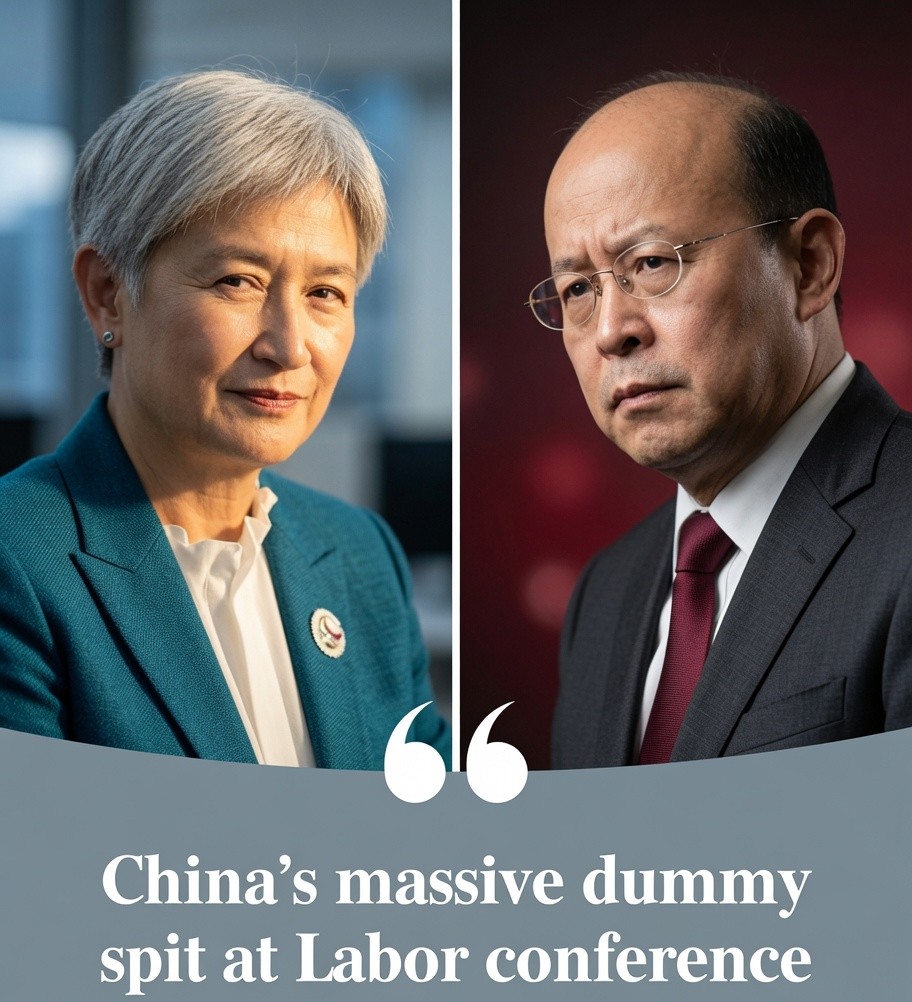
The incident unfolded during the opening stages of Labor’s three-day national conference at the Adelaide Convention Centre, where diplomatic representatives from numerous countries had gathered as invited observers.
According to multiple reports, three Chinese diplomats confronted ALP National Secretary Paul Erickson after discovering that two representatives from the Taipei Economic and Cultural Office (TECO) in Australia were also attending the conference.
The Chinese delegation argued that Taiwan’s presence was unacceptable under Beijing’s long-standing “One China” position and demanded the Taiwanese representatives be removed from the event.
Labor officials rejected that request.
The ALP confirmed Erickson informed the Chinese diplomats that the Taiwanese representatives had been invited as observers and were entitled to remain at the conference.
Following that decision, members of the Chinese delegation withdrew from the conference before several major foreign policy sessions were held.
A spokesperson for the Chinese Embassy later said Beijing had formally lodged diplomatic representations over the matter.
The embassy reiterated China’s long-established position that it “firmly opposes any wrongful moves that could create ‘two Chinas’ or ‘one China, one Taiwan'”, describing Taiwan-related issues as matters affecting China’s sovereignty and territorial integrity.
The incident represented one of the most visible diplomatic confrontations at an Australian political party conference in recent years.
Labor’s National Conference routinely invites foreign diplomats, political parties and international observers to attend proceedings covering party policy, foreign affairs and Australia’s international relationships.
Representatives from New Zealand, Canada, Japan and several other countries were also present during this year’s conference.
The diplomatic disagreement therefore unfolded in front of an unusually large international audience.
The timing was particularly sensitive.
Foreign Minister Penny Wong was attending diplomatic meetings in Southeast Asia before returning to address the conference’s international delegates.
Only days earlier, Wong had criticised China’s actions in the South China Sea, prompting a response from Beijing and adding to existing diplomatic tensions.
Australia officially recognises the People’s Republic of China as the sole legal government of China under the 1972 Joint Communiqué, but maintains extensive unofficial economic, educational and cultural ties with Taiwan.
Those unofficial relations are conducted through the Taipei Economic and Cultural Office in Australia and the Australian Office in Taipei rather than through formal diplomatic embassies.
Under Australia’s long-standing policy, Taiwanese representatives regularly participate in commercial, cultural and educational engagements despite the absence of formal diplomatic recognition.
Their attendance at public conferences and policy events has periodically attracted objections from Beijing, which views any official treatment of Taiwan as inconsistent with its interpretation of the One China principle.
Political analysts noted that Labor’s refusal to remove the Taiwanese observers reflected Australia’s practice of allowing unofficial Taiwanese participation in appropriate public forums while maintaining its established diplomatic relationship with Beijing.
The episode also illustrated the continuing sensitivity surrounding Taiwan in Australia’s foreign policy.
Although relations between Canberra and Beijing have improved significantly since the Albanese Government came to office—with trade restrictions eased and ministerial dialogue restored—Taiwan remains one of the issues most likely to generate diplomatic friction.
China has consistently opposed actions it believes could imply official recognition of Taiwan, while Australia maintains that engagement with Taiwanese economic and cultural representatives is compatible with its existing One China policy.
Those differing interpretations have produced occasional diplomatic disagreements over many years.
The walkout also highlighted the increasingly complex strategic environment facing Australia.
Canberra continues to expand economic cooperation with Taiwan in areas including trade, investment, education and technology while simultaneously seeking to stabilise its broader relationship with China, Australia’s largest trading partner.
Managing those competing interests has become one of the central challenges of Australian foreign policy.
Observers said the incident was unlikely to derail broader Australia-China engagement on its own, but it serves as another reminder that issues relating to Taiwan remain among the most politically sensitive subjects in the bilateral relationship.
For the ALP, the conference was intended to showcase policy unity, economic priorities and Labor’s agenda for its second term in government.
Instead, part of the event became dominated by an unexpected diplomatic confrontation that quickly attracted national and international attention.
Neither the Taiwanese representatives nor the ALP indicated that the incident affected their participation in the remainder of the conference.
Chinese diplomats, however, chose not to return after leaving the venue, underscoring the depth of Beijing’s objection.
The episode demonstrates how questions surrounding Taiwan continue to influence diplomatic interactions far beyond formal government meetings.
Even at domestic political gatherings, Australia’s efforts to balance unofficial engagement with Taiwan alongside stable relations with China remain capable of generating significant international attention.






