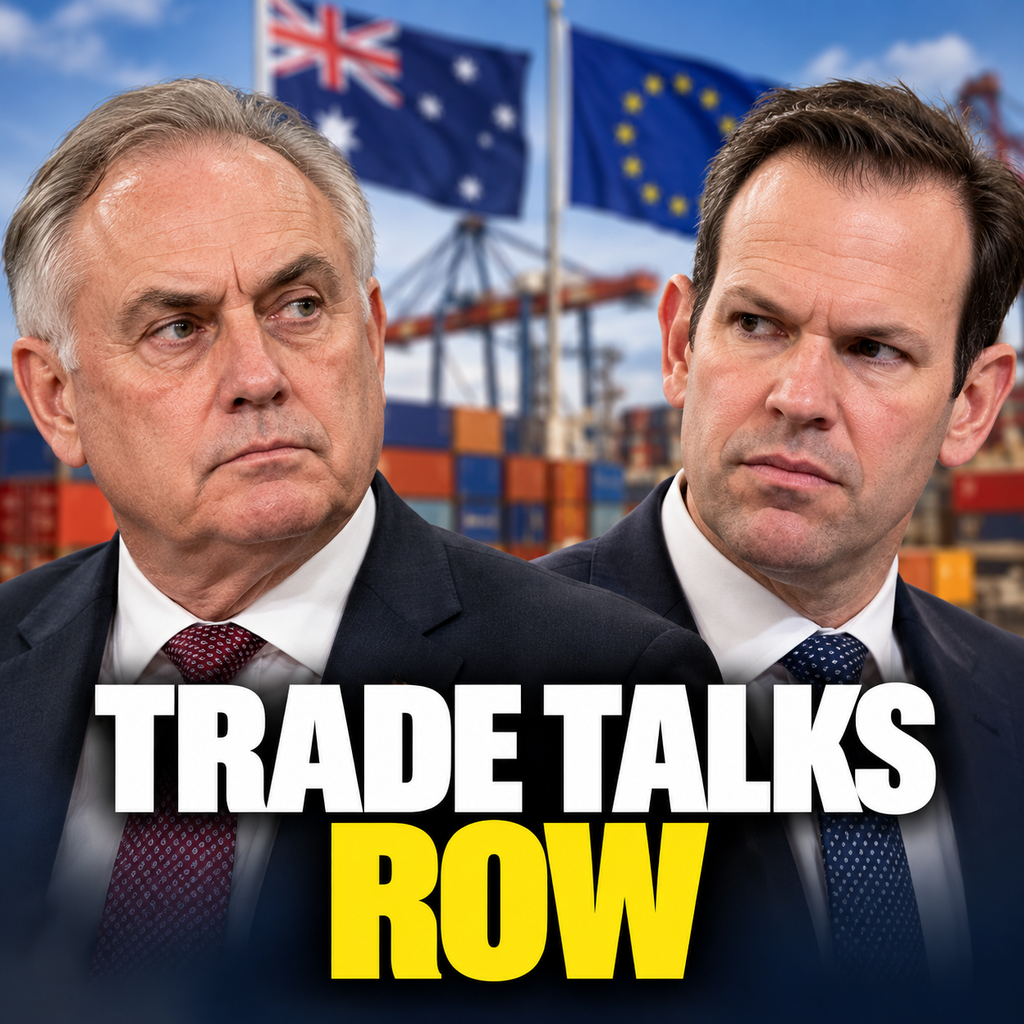
A disagreement between Trade Minister Don Farrell and Nationals senator Matt Canavan has put an awkward question at the centre of Australia’s proposed trade agreement with the European Union: what happened when government and opposition figures discussed the deal, and how much support will it ultimately command?
Farrell said Canavan and Coalition colleague Ted O’Brien walked out of a meeting. Canavan disputed the account, saying Farrell ended their discussion and that he remained willing to meet. The competing versions are clear; what is not established by the public statements is a definitive account of who physically concluded the meeting.
That distinction is important because the argument is about more than political courtesy. Australia and the European Union have concluded negotiations on a trade agreement, but completion of talks is not the same as the agreement entering into force. Businesses considering new export or import arrangements need to understand what the text proposes, which rules remain unchanged and what legislative and treaty steps stand between a political announcement and an operating tariff concession.
The Department of Foreign Affairs and Trade lists the Australia–EU agreement among trade agreements not yet in force. Its published explanation says the draft text must complete legal and linguistic work, receive the necessary approvals and pass domestic procedures before the agreement can become binding. Australia has its own parliamentary scrutiny and legislative processes, while the European side must complete its approval requirements.
That means an exporter cannot assume that a tariff scheduled to disappear under the proposed agreement has already been abolished. Contracts, quotations and supply-chain budgets still need to use the rules actually applicable to the shipment. Treating a negotiated outcome as an operating customs concession could expose a business to unexpected costs.
The economic stakes are substantial. The European Union is a major destination and investment partner for Australia. DFAT describes a market of about 450 million people and says the agreement would provide duty-free access for around 97.8 per cent of the current value of Australian goods exports from the start, rising to about 98 per cent once the planned implementation is complete. Those are government estimates of the agreement’s coverage, not guarantees that every Australian business will save the same amount.
The tariff changes differ by product. Some agricultural goods would receive improved access while others would remain subject to quotas, transitional periods or specific safeguards. On industrial products, DFAT highlights opportunities for machinery, chemicals and other manufactured exports. Businesses cannot simply apply an average percentage saving to all exports.
A tariff is a duty applied to goods crossing a customs border. Reducing it can help a producer compete against suppliers from countries with more favourable access, but it does not remove every cost involved in trade. Freight, insurance, exchange-rate movements, warehousing, border documentation, compliance with product standards and the importer’s retail margin can still influence the final price.
Rules of origin are especially important. Trade agreements normally require an exporter to demonstrate that a product qualifies as originating in the participating countries. Merely shipping an item from Australia does not necessarily establish that status if much of its production took place elsewhere. DFAT says the proposed agreement includes simplified origin procedures, but firms would still need to understand and document their eligibility.
The agreement is also presented as an opportunity for small and medium-sized enterprises. DFAT says it would improve access to procurement markets and reduce some administrative burdens. The government highlights electronic submission of documents, greater transparency on regulations and opportunities for eligible businesses to bid for public contracts in Europe. Those benefits would depend on individual firms’ capacity to satisfy tender conditions and deliver competitively, not simply on the existence of a treaty.
Australian importers may also be affected. Lower duties on some European machinery, equipment, food products or other inputs could reduce supply-chain costs. That does not automatically translate into cheaper consumer goods. Retail prices also depend on competition, transport, currency rates and how suppliers and sellers distribute any savings. A business might use improved margins to expand or hire rather than reduce its shelf price.
For farmers and regional producers, the debate is particularly sensitive. Greater access to European consumers may be valuable, but the size of quotas, the treatment of sensitive products and restrictions on product names can matter just as much as the headline percentage. A dairy producer, wine exporter or manufacturer cannot assume that every negotiating concession has equal practical value.
Canavan’s criticism of what he called a poor deal represents a political judgment about the balance of concessions. Farrell’s support reflects the government’s argument that expanded market access and trade diversification benefit the country. Assessing those positions requires looking at the actual sector-by-sector provisions, rather than treating the disputed meeting as a verdict on the agreement’s merits.
Trade agreements also create questions about professional qualifications, technical standards and government procurement. These issues can matter to Australian architects, engineers, consultants and other service providers seeking work across borders. Yet access remains subject to the detailed professional, licensing and regulatory arrangements in each jurisdiction.
For businesses, the sensible approach is to distinguish three stages: what negotiators have agreed in principle, what law currently permits, and what will become available if the final agreement enters into force. The distinction matters for investment forecasts, pricing and contractual promises. It is premature to book savings from tariff rules that are not yet operating.
Farrell and Canavan have offered conflicting accounts of their meeting. Neither account establishes whether the negotiated package is economically sound or politically acceptable. That judgment will be contested through parliamentary debate and the detailed examination of its trade provisions.
The implications for an Australian exporter can be illustrated without pretending that all firms will benefit equally. A producer selling packaged food into Europe has to identify the correct tariff classification, check whether the product qualifies under the origin rules and consider any quantity restrictions. A machinery manufacturer may face a different tariff schedule and a separate set of technical standards. Both need commercial arrangements with buyers, reliable logistics and competitive pricing. The elimination of a customs duty is only one part of the transaction.
Exchange-rate risk is especially relevant for small businesses with limited financial buffers. An Australian exporter paid in euros may receive a different amount in Australian dollars by the time its invoice is settled. Importers buying equipment from Europe face the reverse exposure. Some businesses use hedging arrangements, while others adjust prices or accept the risk. Those decisions carry costs and require commercial judgment independent of the trade agreement itself.
Compliance documentation also has a cost. Even with streamlined origin certificates or electronic submissions, firms must maintain records to substantiate claims for preferential treatment. Misclassifying a product or failing to keep adequate origin documentation may result in a duty liability or delayed clearance. The proposed administrative improvements could help, but businesses will still need to understand the rules before making representations to customers.
One sector’s advantage can also be another sector’s challenge. Lower duties on European products may benefit Australian importers and consumers while increasing competition for domestic suppliers. The total effect depends on whether firms can innovate, improve productivity or identify new export customers. Policymakers should explain these distributional effects rather than suggesting an aggregate trade benefit means no business will face adjustment costs.
Access to government procurement in the EU is potentially valuable but can be misread. DFAT’s estimate of the market’s size describes a broad pool of potential contracts. It is not a forecast that Australian companies will win that volume of business. Tender eligibility, technical requirements, local presence, competition, insurance and performance guarantees may all affect the feasibility of a bid. For a small Australian contractor, those costs may exceed the value of a theoretical opportunity.
The agreement also contains provisions that matter to service firms and digital traders. Better regulatory transparency and rules supporting electronic commerce may reduce uncertainty, but they do not eliminate privacy obligations, consumer laws or professional licensing. A consultant offering services across borders still needs to consider tax arrangements, contracts and which jurisdiction’s rules apply.
The distinction between a negotiated benefit and a realised saving should govern business planning. A firm could monitor the final legal text and model possible tariff outcomes, but should label any projected benefit as contingent. Existing trade arrangements and customs schedules remain the basis for present-day pricing unless an applicable concession has formally commenced.
None of this resolves the Farrell–Canavan disagreement about a meeting. It does explain why disagreements over the deal’s content are consequential. Farmers, importers, manufacturers and service providers have legitimate reasons to scrutinise the implementation schedule and sector-specific terms rather than accept either side’s political shorthand.
A supplier also needs to know when a phased tariff reduction is scheduled to occur. Some concessions may begin on entry into force, while others would unfold in stages. A business planning purchases for a coming season has little use for an eventual percentage if it cannot identify the applicable rate when goods clear customs. That is one reason DFAT’s provisional schedules and final implementation notices matter more than a single nationwide trade headline.
The real test for Australians is how the proposed agreement would affect exporters, importers, regional producers and consumers if it clears the remaining steps. A disputed walkout may dominate the headlines, but tariff schedules and implementation requirements will determine what happens to actual businesses.