A new seat-by-seat election model has delivered one of the most dramatic projections seen in modern Australian politics, suggesting Pauline Hanson’s One Nation could be within reach of helping form the nation’s next government if current voting trends were replicated at a federal election.
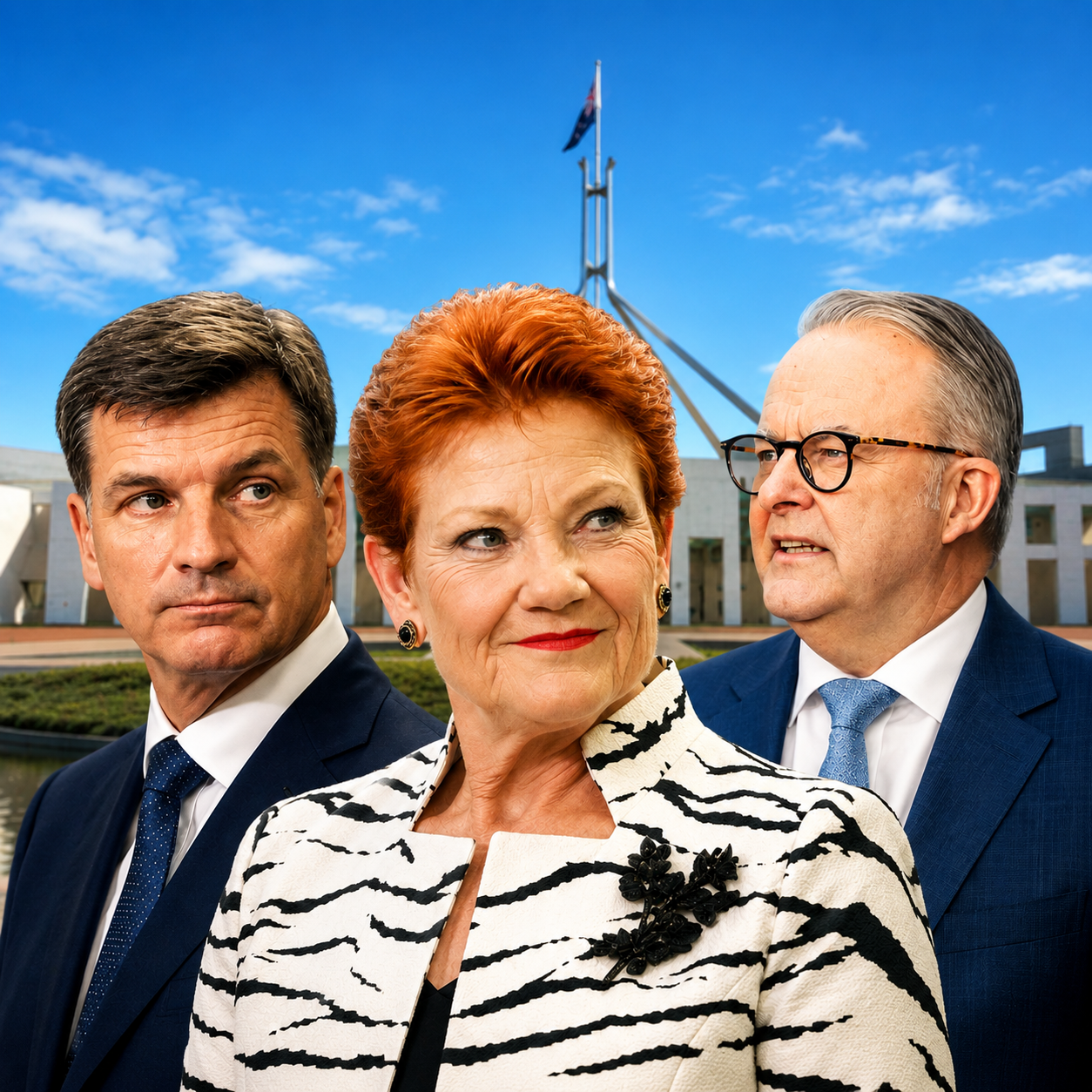
The latest Multilevel Regression and Poststratification (MRP) model from polling firm DemosAU places One Nation on a 30 per cent primary vote, ahead of Labor on 26 per cent, with the Coalition on 21 per cent, the Greens on 13 per cent and other parties collectively on 10 per cent. The model draws on polling conducted between May and July 2026 involving 9,343 respondents across Australia.
Unlike a conventional national opinion poll, the MRP model estimates voting behaviour in each of Australia’s 150 House of Representatives electorates before running 20,000 Monte Carlo election simulations to generate likely seat ranges.
Those simulations project Labor winning between 60 and 72 seats, One Nation 53 to 66 seats, the Coalition between 11 and 22 seats, the Greens between one and five seats, and other parties and independents between three and seven seats. Since 76 seats are required for a majority in the House of Representatives, neither Labor nor One Nation reaches government in its own right under the central projection.
Instead, the modelling points towards a hung parliament in which post-election negotiations would determine who forms government.
DemosAU Head of Research George Hasanakos said the numbers suggest One Nation could be “within arm’s reach” of participating in government if it were able to secure parliamentary support from the Coalition after the election. He stressed that the modelling describes one possible parliamentary outcome based on current polling rather than predicting what will definitely occur.
The modelling indicates One Nation’s strongest support continues to come from regional and outer metropolitan Australia.
According to DemosAU, the party leads on a 41 per cent primary vote across regional and rural electorates and is projected to lead in 39 of Australia’s 41 seats in that category. In outer metropolitan electorates—the battleground seats most likely to determine government—the party also records the highest projected primary vote at around 30 per cent and is estimated to be leading in 21 seats.
Labor remains strongest in Australia’s inner metropolitan electorates, where the model suggests it retains a clear advantage despite a decline in national primary vote since DemosAU’s previous survey earlier this year.
The projections add to a series of polls throughout 2026 showing increasing support for Pauline Hanson’s party.
Earlier DemosAU surveys had already suggested One Nation was overtaking the Coalition in national primary vote support and making significant gains among voters concerned about cost-of-living pressures, immigration, housing affordability and energy policy. The latest model represents the strongest projection yet for the party.
Even so, election analysts caution that MRP models are forecasting tools rather than election predictions.
They combine survey responses with demographic and geographic data to estimate electorate-level outcomes, but they cannot account for every factor that influences an election campaign. Candidate quality, local issues, preference recommendations, campaign performance and late shifts in voter sentiment can all substantially alter the final result.
Australia’s preferential voting system also means primary vote figures alone do not determine election outcomes.
Many electorates are decided after preferences from eliminated candidates are distributed. Consequently, a party’s ability to convert primary votes into parliamentary seats depends not only on its own support but also on how preferences flow between parties.
That issue has become central to political discussion because One Nation’s pathway to government under the DemosAU modelling depends on parliamentary cooperation rather than winning an outright majority.
Coalition leader Angus Taylor has repeatedly ruled out any formal coalition agreement with One Nation, maintaining that the Coalition’s longstanding partnership remains with the National Party. At the same time, some Liberal figures have suggested that any post-election parliamentary arrangements would ultimately depend on the numbers returned by voters.
The modelling also illustrates the continuing fragmentation of Australia’s political landscape.
For decades, federal politics has largely revolved around Labor and the Coalition. However, increasing support for minor parties and independents has made minority governments and complex parliamentary negotiations progressively more likely.
Political scientists note that this trend is not unique to Australia, with several comparable democracies experiencing declining support for traditional major parties as voters seek alternatives on issues ranging from economic management to immigration and public trust.
For Labor, the projections underline the challenge of defending outer suburban and regional electorates while maintaining its dominance in metropolitan Australia. For the Coalition, the figures highlight the continuing erosion of conservative support to One Nation in many parts of the country.
For Pauline Hanson, the modelling represents another indication that One Nation has moved beyond being solely a Senate-focused party.
Whether the party ultimately achieves anything close to the projected 53-to-66-seat range remains uncertain. Nevertheless, the DemosAU model suggests One Nation has become a significantly more influential electoral force than at any previous federal election and could play a decisive role if Australia returns a hung parliament.
Ultimately, however, the projections remain exactly that—projections. Australian voters have not yet cast their ballots, election campaigns can shift public opinion rapidly, and the preferential voting system means final outcomes often differ substantially from headline primary vote figures. The true test of One Nation’s growing support will come only when Australians next go to the polls.






