Mining company BHP has confirmed job cuts across its iron ore business in Western Australia, with the ABC reporting that approximately 300 positions are expected to be affected at several operations in the Pilbara. BHP has not publicly confirmed that figure as its own final count. The company says it will work directly with staff and seek redeployment opportunities where possible as changes to its operations are put into effect.
The sites identified in the ABC's report are South Flank, Mining Area C, Jimblebar and Newman. They are important parts of BHP's Western Australia Iron Ore network, which connects mines, processing facilities, rail links and export ports across a vast region. The announcement therefore concerns multiple established operations rather than the closure of a single isolated site.
The distinction between a confirmed reduction and an estimated number of affected jobs is important for employees, contractors and regional communities. BHP confirmed that positions would be cut, while the ABC said it understood around 300 jobs were involved. BHP has not released a final count; the figure of about 300 positions remains an ABC estimate.
BHP said it regularly reviews its business to ensure operations remain safe, effective and productive. It also said it would engage with impacted workers and pursue other internal roles where possible. That description does not settle how many people might be redeployed, whether particular functions will be removed or how the final workforce size will compare with the current one. Those details are not established by the initial public statement.
The Pilbara's iron ore system is highly integrated. On its official Western Australia site, BHP describes five mining hubs, four processing hubs and more than 1,000 kilometres of railway connected to port facilities. Ore travels through a sequence of extraction, preparation, train loading and export. A change in staffing at one part of this chain may be important to the whole operation, but it would be wrong to infer from that integration that every mine or department is being cut equally.
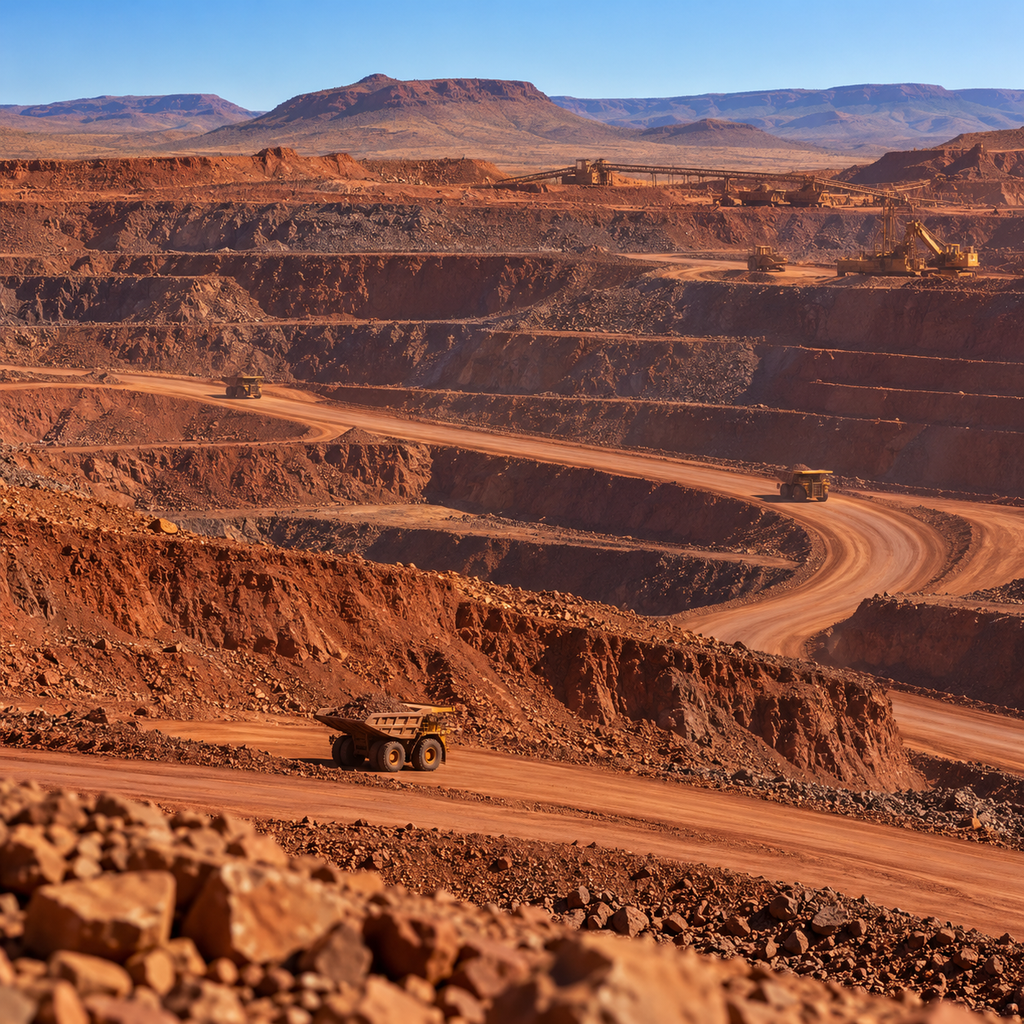
South Flank, one of the named sites, sits north-west of Newman and near Mining Area C. BHP says the two form a major iron ore production hub with the capacity to produce about 145 million tonnes annually. Capacity is not the same as actual output in a particular year and cannot be used to calculate how many workers any mine needs. It does, however, explain the scale of the assets involved in the staffing changes.
Mining Area C has open-cut mines, ore-handling plants and a rail loading facility that links into BHP's wider transport system. Newman Operations cover major mine areas further inland, while Jimblebar is another open-cut operation connected to the network. Those descriptions come from BHP's own operational information, which is useful for geographical context but does not reveal the distribution of the proposed workforce reductions.
For communities across the Pilbara, employment at major mines can support more than the direct wages of people on a company payroll. Workers and their families use local services, and businesses supply transport, maintenance and other functions to the mining sector. It would be premature, however, to assign a specific impact on regional spending or local unemployment without evidence about where affected employees live and the extent of redeployment.
Mining workforces also include a mix of direct employees, contractors and people who commute between regions. The first report does not establish which categories will bear the reductions. The number of positions potentially affected is not necessarily the number of employees who will leave, because the process may include vacancies, redeployment and other changes. BHP says it intends to discuss options directly with affected staff and seek alternative roles where possible, but the outcome of those discussions has not been disclosed. The company's stated intention to offer redeployment where possible is relevant, while its eventual success remains unknown.
BHP's official description of Western Australia Iron Ore highlights the significance of reliable rail and port movements. Large quantities of ore from several mines are blended and shipped to customers overseas. The company has also discussed efficiency and technology across its operations. Those background features do not justify declaring that automation caused these particular cuts, however. The current announcement does not provide evidence for assigning that motive to the staffing decision.
There is also a difference between a company's long-term production plans and an immediate workforce review. A business can seek to increase output or improve productivity while reorganising some roles; whether that is occurring here in a particular way must be substantiated. The initial announcement provides no evidence that financial distress, safety concerns or automation were the reasons for the particular reductions.
Staff facing uncertainty will be looking for information about consultation, selection processes, alternatives and timing. BHP's publicly reported response says direct engagement is planned, but has not resolved those individual matters in the wider public record. BHP has not publicly provided a list of affected roles or named individuals involved in the process. Employees are awaiting details about consultation, selection and timing, and the initial statement did not disclose how the changes will be distributed across the named operations.
The Pilbara has a long history of large iron ore operations and supporting infrastructure, with BHP among the region's major employers. Its mines feed production that travels by train to port facilities and then into international steel markets. Changes at an employer of that scale can affect workers and their families, even when the overall mining business remains substantial.
For now, the confirmed position is a reduction in jobs across BHP's Western Australian iron ore business, accompanied by a company commitment to look for redeployment where possible. The ABC's estimate puts the expected impact at around 300 positions across four named operations. Further clarity will depend on the company's communication with employees and any subsequent detailed disclosure about which roles are affected.
BHP's official site identifies South Flank as a large iron ore operation developed alongside Mining Area C, with production capacity across the hub measured in tens of millions of tonnes annually. That industrial scale is one reason operational reviews attract national attention, yet the staffing announcement was not accompanied by data showing a decline in production at South Flank. Any such explanation would be speculation unless the company or other reliable evidence connected the job changes to output.
BHP describes Newman as comprising separate mining areas and an important part of the railway system that moves ore towards Port Hedland. Jimblebar, east of Newman, is another contributor to the same production network. The different locations share infrastructure but are not interchangeable: a broad label such as Pilbara cuts does not reveal which particular occupations, shifts or support functions will change at each mine. That detail may matter greatly to staff and local suppliers.
BHP's wider WA iron ore business supplies material used in steelmaking, with customers depending on coordinated extraction, processing and shipping. The company promotes efficient operations and ongoing production improvements. The initial redundancy report does not show that a particular technology programme caused the decisions, nor that the iron ore business as a whole is shutting down. A worker affected by a review is entitled to a more specific explanation than either of those unsupported interpretations.
The company's statement about redeployment is a potential avenue for employees but not an outcome count. A role can be removed while its former occupant moves to another position, and different workers may receive different options depending on skills and vacancies. Neither the ABC estimate nor BHP's confirmation gives a breakdown of how many people will leave the company. For affected families, the number of people who must leave the company remains unresolved.
The names used for BHP operations can also be confused with nearby regional communities. Newman is both a regional centre and the name used for a group of BHP operations. The public report identifies Newman Operations, not a demonstrated closure of the town's businesses or services. The same caution applies to South Flank and Mining Area C: their inclusion in the report does not establish that production will cease or that all workers there face termination.
The announcement concerns job reductions across a major industrial region; it does not confirm any mine closure or a final tally of redundancies. BHP continues to operate a substantial Pilbara production network. BHP has not yet released a final number of roles removed, the outcome of redeployment efforts or the longer-term consequences for workers and communities connected to its operations.