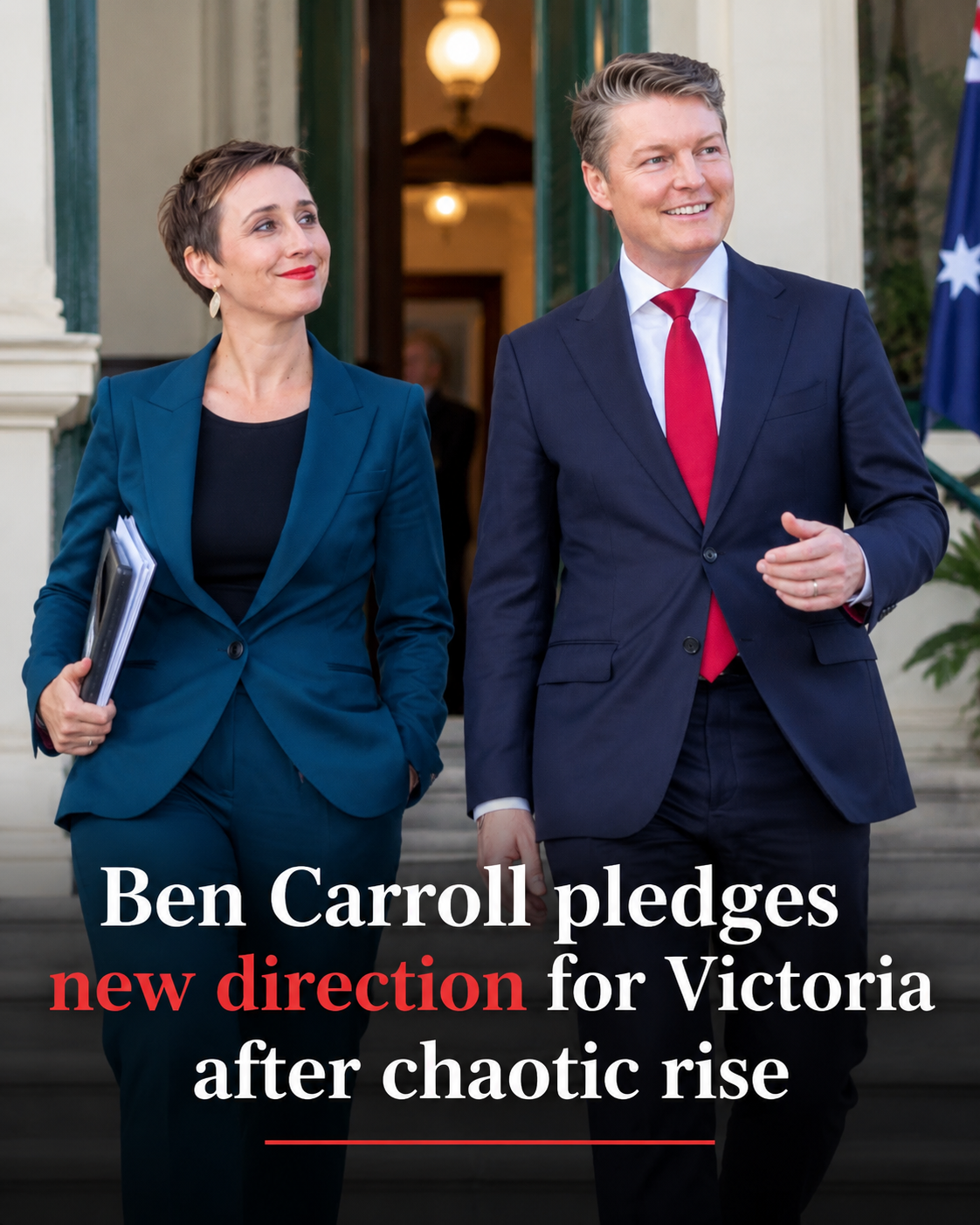
Victoria has entered a new political chapter after Ben Carroll was officially sworn in as the state’s 50th premier, promising a fresh approach to government as Labor seeks to recover from one of the most turbulent leadership crises in its modern history.
Mr Carroll took the oath of office at Government House in Melbourne, formally replacing Jacinta Allan after she stepped down following intense internal pressure from colleagues just four months before Victorians head to the polls for the November state election. The leadership transition marks Labor’s second change of premier in less than three years and comes at a pivotal moment for a government facing declining public support and increasing electoral competition.
During his first public remarks as premier, Carroll pledged to lead the state in “a new direction”, identifying integrity, community safety and economic management as the three central priorities of his administration.
“I will do things differently,” Carroll said, signalling that while Labor remains in government, his leadership would not simply continue the approach of previous administrations. He stressed that Victorians wanted practical action rather than political conflict and promised a government that would be more accountable, transparent and focused on delivering results.
The swearing-in ceremony concluded a dramatic 48-hour period of political upheaval that exposed deep divisions within the Victorian Labor Party.
Jacinta Allan had initially indicated she intended to contest any leadership challenge, but ultimately chose to resign before a caucus vote after it became clear that support within the parliamentary party had shifted decisively towards Carroll. A brief attempt by Attorney-General Sonya Kilkenny to enter the leadership contest added to the uncertainty before she withdrew, allowing Carroll to be elected unopposed.
Gabrielle Williams was sworn in as Deputy Premier alongside Carroll, forming the new leadership team tasked with steering Labor through the remaining months before the election.
Carroll acknowledged that the government faced significant challenges but argued that leadership renewal was necessary to restore public confidence.
“Victorians expect integrity in government, they expect safer communities and they expect a stronger economy,” he said, outlining the framework that he believes will define his premiership.
Among Carroll’s first major policy announcements was a commitment to establish a royal commission into alleged corruption and criminal influence within parts of Victoria’s construction sector. He also pledged to strengthen the powers of the state’s anti-corruption watchdog and create additional mechanisms to investigate serious misconduct involving public projects.
The proposed reforms represent one of the clearest attempts yet by the new premier to distinguish his administration from those of Daniel Andrews and Jacinta Allan, both of whom faced criticism from opponents over governance and integrity issues during their time in office.
Economic management is also expected to dominate Carroll’s first months in office.
Victoria continues to carry one of the largest debt burdens of any Australian state following years of major infrastructure investment and pandemic-related spending. Carroll has acknowledged those fiscal pressures while insisting that infrastructure projects capable of supporting long-term economic growth will continue to play an important role.
However, he has also promised a greater emphasis on financial discipline and stronger engagement with the business community. Reports indicate the government will review spending priorities and examine whether some large-scale projects require adjustment to improve value for taxpayers.
Community safety forms the third pillar of Carroll’s agenda.
The premier said Victorians wanted stronger action against organised crime and greater confidence in policing and public institutions. His government has already flagged additional legislative measures targeting corruption, organised criminal networks and workplace misconduct within sectors that have attracted significant public scrutiny.
Observers say these early announcements are designed to demonstrate decisive leadership and reassure voters that Labor recognises the need for change before the November election.
The leadership transition follows months of deteriorating polling for Labor.
After more than a decade in office, the government has faced mounting criticism over cost-of-living pressures, housing affordability, infrastructure cost overruns and concerns surrounding government integrity. Recent opinion polls have suggested Labor risks losing its parliamentary majority, while support for the Liberal Party, One Nation and independent candidates has increased across a number of key electorates.
Former federal Labor leader Bill Shorten has argued that the leadership change was necessary if the party hoped to avoid a devastating electoral defeat. According to reports, Shorten warned colleagues that failing to reset before the election could result in an “extinction-level” electoral wipeout similar to Labor’s heavy defeat in Victoria during the early 1990s.
Political analysts believe Carroll’s greatest challenge will be convincing voters that he represents genuine change rather than simply a new face leading the same government.
ABC political analyst Richard Willingham noted that Carroll has less than four months to persuade Victorians that their daily lives would improve under his leadership. By immediately placing integrity and accountability at the centre of his agenda, Carroll has attempted to establish a clear point of difference from his predecessors.
The opposition has responded cautiously to the change in leadership, arguing that replacing the premier does not erase years of policy decisions made by the Labor government.
Meanwhile, the broader political landscape continues to shift. Former Liberal MP Moira Deeming has formally quit the Liberal Party after a prolonged dispute with party leadership, becoming an independent member of parliament. Her departure adds another layer of uncertainty to Victorian politics as parties prepare for what is expected to be one of the state’s most competitive elections in decades.
Carroll’s political career spans more than a decade in the Victorian Parliament. First elected in 2012 to represent the seat of Niddrie, the former lawyer has held several ministerial portfolios, including public transport, industry, employment and education, before becoming deputy premier in 2023. Supporters describe him as a pragmatic administrator with strong relationships across Labor’s factions, qualities that helped secure unanimous backing from caucus once Allan resigned.
Throughout his first day as premier, Carroll repeatedly stressed that his government would not be defined by internal party disputes but by its ability to deliver practical outcomes.
He acknowledged that many Victorians had become frustrated with politics and argued that rebuilding trust would require actions rather than slogans.
“Change starts today,” he said, presenting his premiership as an opportunity to reset Labor’s relationship with voters ahead of the November election.
Whether that message resonates with the electorate remains uncertain.
Victorians will head to the polls on 28 November, with all 88 seats in the Legislative Assembly and 40 seats in the Legislative Council up for election. Labor enters the campaign seeking a fourth consecutive term after more than twelve years in government, while the Liberal-National Coalition hopes to capitalise on voter dissatisfaction. Minor parties, including One Nation and the Greens, are also expected to play an increasingly influential role in several marginal electorates.
For Carroll, the months ahead will provide the first real test of his promise to deliver “a new direction”. His government must not only manage Victoria’s economic and fiscal challenges but also persuade voters that Labor has genuinely turned a page after weeks of political turmoil.
With the election rapidly approaching, every major policy announcement, parliamentary decision and leadership choice is likely to be viewed through the lens of whether the new premier can translate his promises of integrity, safer communities and stronger economic management into renewed public confidence.






