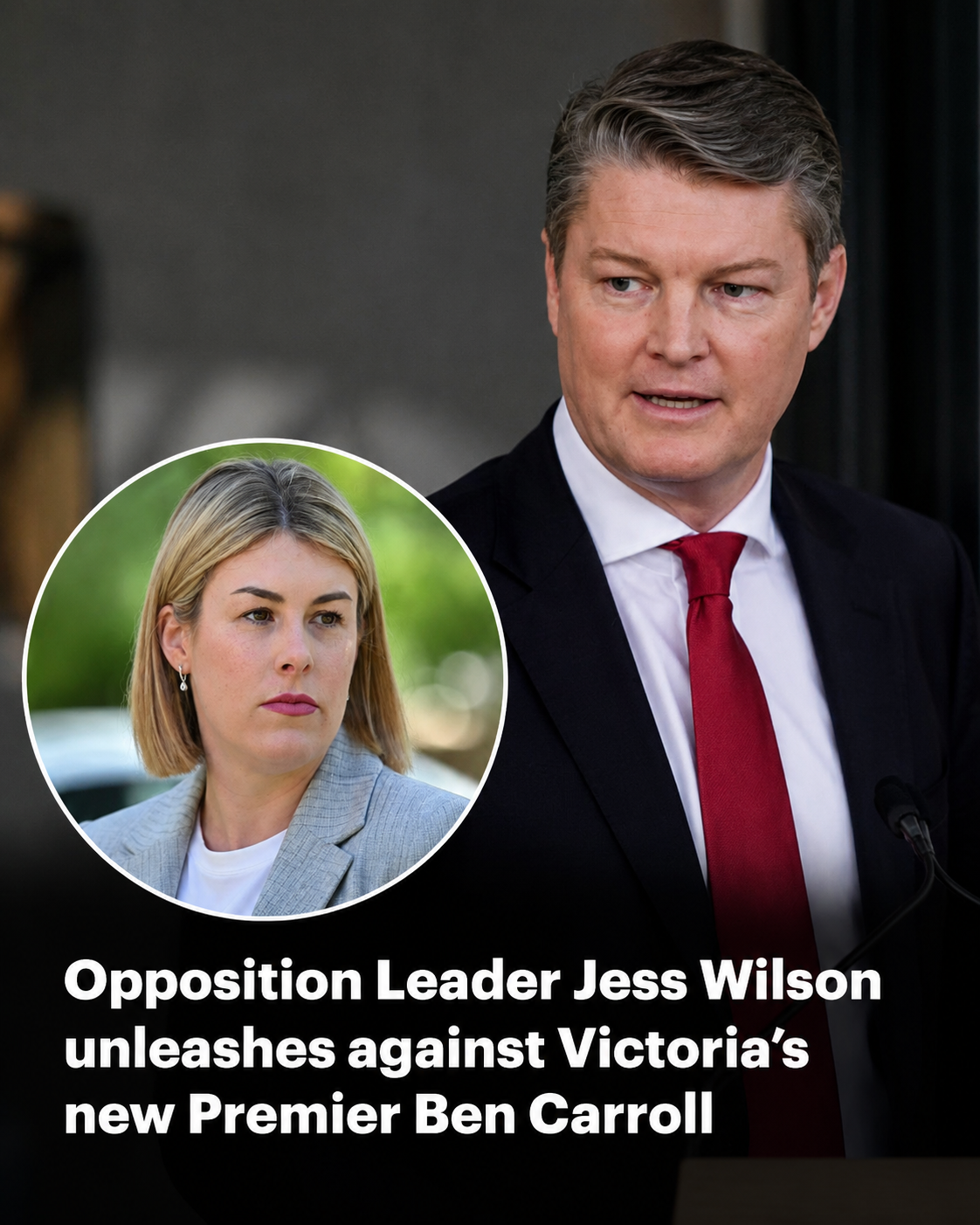
Ben Carroll has officially become Victoria’s 50th premier after winning the Victorian Labor leadership following Jacinta Allan’s resignation, but his first day in office has already been overshadowed by fierce political attacks questioning whether he can genuinely deliver the “new direction” he has promised voters.
The leadership transition ended weeks of mounting pressure on Jacinta Allan, who stepped aside after losing the confidence of a majority of Labor’s parliamentary caucus despite insisting she still believed she could lead the party to victory at November’s state election.
Appearing visibly emotional as she announced her resignation, Allan said she chose not to prolong an internal contest because “the stakes at this election are too high”, arguing that party unity had become more important than her own political future.
Although Carroll had emerged as the overwhelming favourite to replace Allan, the transition proved considerably more chaotic than many inside Labor had expected.
Attorney-General Sonya Kilkenny unexpectedly entered the leadership race shortly before the caucus meeting, triggering confusion and heated exchanges behind closed doors as MPs debated the party’s future.
Witnesses later reported raised voices during the meeting before Kilkenny ultimately withdrew her nomination, allowing Carroll to be elected Labor leader without a contested ballot.
In an unusual procedural step, Transport Infrastructure Minister Gabrielle Williams briefly became interim leader while the formal transfer of leadership was completed before later being elected deputy leader.
Carroll, 51, now inherits a government facing one of its most difficult electoral challenges in more than a decade.
After nearly twelve years in office, Victorian Labor enters the November election confronting declining opinion polls, growing concern over state debt, infrastructure cost overruns, housing affordability, crime and allegations of corruption linked to major construction projects.
Political analysts have suggested Labor’s leadership change reflects an acknowledgement that many MPs believed a fresh face was necessary if the party hoped to retain government.
Seeking to reassure voters that meaningful change was underway, Carroll used his first press conference as premier to distance himself from previous administrations.
“I’m not Daniel Andrews. I’m not Jacinta Allan,” he declared, promising a stronger emphasis on integrity, economic management and accountability.
Among his first announcements was the establishment of a royal commission into Victoria’s construction sector, accompanied by plans for a specialist prosecutor and expanded powers for the state’s anti-corruption commission.
Carroll described the reforms as evidence that “integrity will not be optional” under his leadership.
However, opposition parties moved quickly to challenge that message.
Victorian Liberal leader Jess Wilson argued Carroll’s sudden decision to seek the leadership contradicted repeated public statements in which he had pledged loyalty to Jacinta Allan only weeks earlier.
Wilson referred to comments Carroll had previously made to his young daughter, saying he would not challenge Allan, before later reversing that position after internal support for the premier collapsed.
“How can Victorians possibly believe he can act with integrity when he can’t be honest about his own daughter?” Wilson said during Question Time.
She also asked whether Carroll would apologise for what she described as misleading both his family and Victorian voters.
Carroll rejected the criticism, insisting circumstances had fundamentally changed once colleagues informed him that Allan no longer commanded majority support inside the parliamentary Labor Party.
He said he had not been actively plotting against Allan and only agreed to stand after being approached by fellow MPs who believed the government required new leadership before the election.
The new premier maintained that his responsibility ultimately lay with ensuring stable government rather than remaining personally loyal to a leader who no longer enjoyed caucus support.
The exchange immediately illustrated the political challenge Carroll now faces.
While Labor hopes the leadership change will allow it to reset the political narrative before November, the opposition argues Carroll cannot present himself as an outsider after serving as deputy premier throughout Allan’s administration and holding senior ministerial portfolios under both Allan and Daniel Andrews.
Critics contend he shares responsibility for the very decisions from which he is now attempting to distance himself.
Public criticism has not been confined to Parliament.
Media personality Rebecca Judd publicly described Carroll as “complicit” in Victoria’s recent decline, arguing that replacing one Labor premier with another did not amount to genuine political renewal.
She characterised the leadership change as “same s**t, different face”, reflecting broader scepticism among some critics that Labor’s internal reshuffle alone will alter the government’s direction.
Supporters of Carroll, however, argue he represents a different leadership style.
Unlike several of Labor’s most prominent figures, Carroll has generally avoided major personal controversies during his parliamentary career and has earned a reputation inside caucus as a pragmatic negotiator capable of working across factional lines.
His extensive ministerial experience spans education, public transport, industry, employment, medical research and WorkSafe, giving him one of the broadest administrative backgrounds within the Victorian cabinet.
Nevertheless, his political timetable is unforgiving.
With only a few months remaining before Victorians return to the polls, Carroll has limited opportunity to convince voters that Labor has genuinely changed course after more than a decade in government.
His administration must simultaneously rebuild public confidence while responding to continuing concerns over government spending, infrastructure delivery, public safety and integrity.
The royal commission into the construction sector has therefore assumed particular political importance.
Some governance experts believe the inquiry could strengthen Labor’s electoral prospects by demonstrating a willingness to confront allegations of corruption that critics say were not adequately addressed under previous governments.
Others argue voters may question why Carroll did not advocate similar action while serving as deputy premier.
For Jacinta Allan, the leadership change concludes nearly three years as premier following Daniel Andrews’ resignation in 2023.
Although she maintained until the end that she believed she could still win both a caucus ballot and the November election, Allan ultimately concluded that avoiding a prolonged internal struggle offered Labor its best chance of remaining in government.
Her resignation closed one chapter of Victorian politics but immediately opened another, placing Carroll at the centre of one of the state’s most closely watched election campaigns in decades.
The coming months are likely to determine whether Labor’s dramatic leadership change succeeds in resetting public opinion or merely reinforces opposition claims that replacing the premier cannot erase the government’s record over the past twelve years.
For Carroll, every policy announcement, parliamentary appearance and public statement will now be scrutinised through the lens of the promise he made on his first day in office—that Victoria is entering a new era built on integrity, accountability and renewal.
Whether voters accept that promise remains one of the defining questions heading into November’s election.






