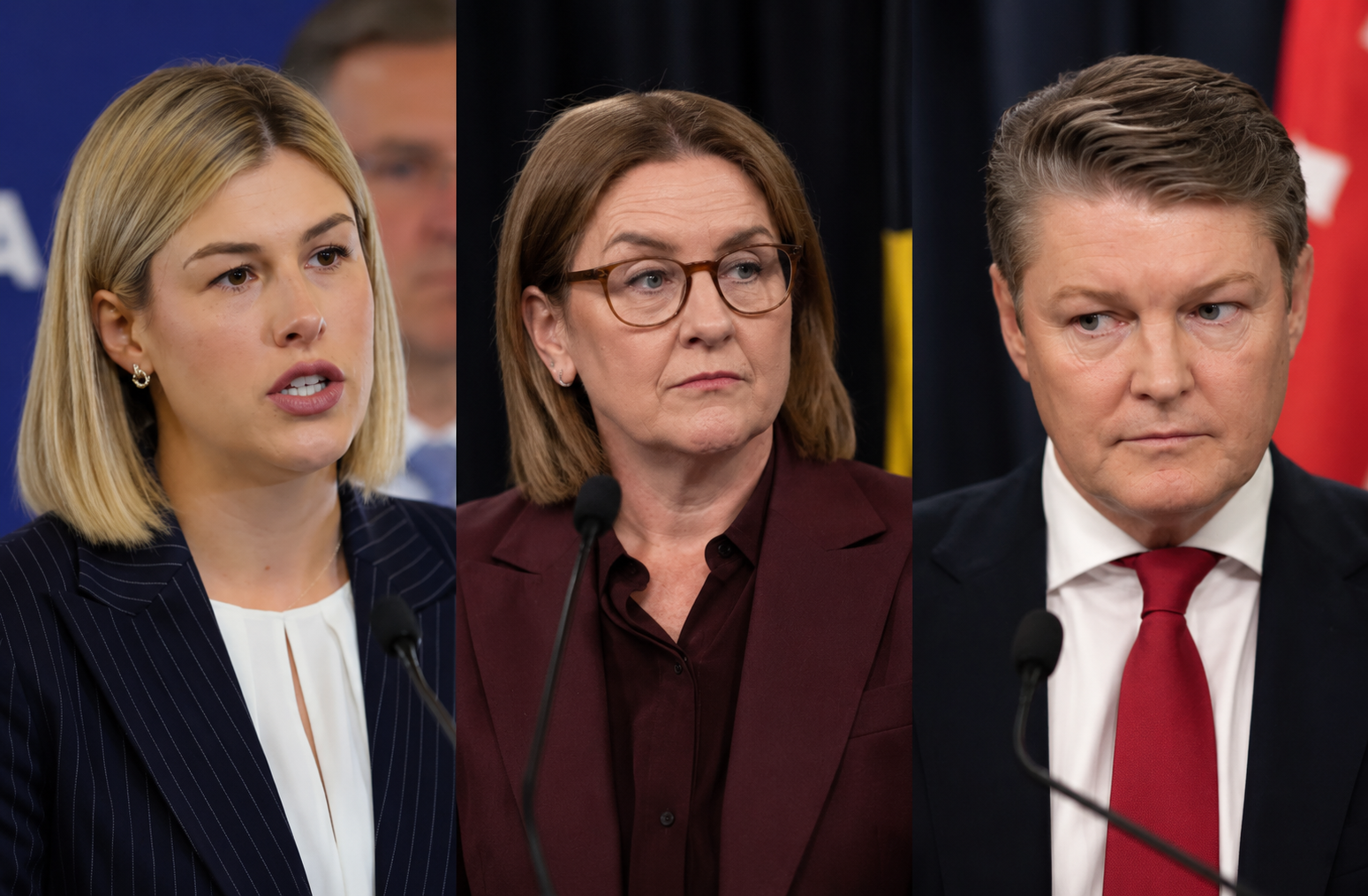
Victoria’s newly sworn-in Premier Ben Carroll has faced his first major parliamentary test only hours after taking office, with Opposition Leader Jess Wilson launching a direct attack on his integrity during his inaugural Question Time.
The confrontation came less than 24 hours after Carroll replaced Jacinta Allan as Victoria’s 50th premier, capping one of the most dramatic leadership transitions in recent Victorian political history.
Rather than focusing immediately on policy, the opposition used its first opportunity in Parliament to question Carroll’s credibility, arguing that his actions leading up to the leadership spill contradicted public declarations of loyalty he had made only weeks earlier.
Wilson centred her attack on remarks Carroll made during the leadership speculation surrounding Jacinta Allan, when he publicly declared he remained firmly behind the then premier.
Quoting Carroll’s earlier comments, Wilson reminded Parliament that he had previously said he was “proud” that his young daughter knew he supported Jacinta Allan.
She then contrasted those remarks with Carroll’s subsequent decision to seek the Labor leadership after Allan lost majority support within the parliamentary party.
“How can Victorians possibly believe this Premier can act with integrity when governing Victoria, when he can’t even be honest with his own daughter?” Wilson asked Parliament during Question Time.
The exchange immediately demonstrated that the Liberal opposition intends to make questions of trust and leadership central themes of the election campaign, which is only months away.
Rather than allowing Labor to present the leadership change as a political reset, the opposition sought to portray Carroll’s rise as evidence of internal disunity and broken promises.
Wilson argued that voters would inevitably question whether commitments made by the new premier could be trusted if he had reversed his own public position regarding Allan’s leadership.
She also challenged Carroll to apologise, claiming his previous assurances had proven inconsistent with the actions that ultimately delivered him the premiership.
Carroll rejected the accusation, insisting that circumstances inside the Labor caucus had fundamentally changed in the days before the leadership transition.
He argued that his earlier public support for Allan had reflected the situation at that time, but that he later accepted the leadership only after it became clear she no longer commanded the confidence of the parliamentary party.
According to Carroll, his decision was driven by responsibility rather than personal ambition.
He maintained that once colleagues advised him the government could no longer function effectively under the existing leadership, he believed it was necessary to step forward in order to provide stability before the November election.
The new premier has consistently denied suggestions that he spent months organising a leadership challenge behind the scenes.
Instead, he has described the events as a rapid response to changing political circumstances after growing numbers of Labor MPs concluded that Allan could no longer lead the party into the election.
That account broadly reflects the sequence of events that unfolded during Labor’s dramatic caucus meeting, where Allan eventually resigned before a formal leadership ballot and Attorney-General Sonya Kilkenny briefly launched an unsuccessful leadership challenge before withdrawing.
The confrontation in Parliament occurred against the backdrop of Labor’s attempt to reposition itself before Victorians vote later this year.
Immediately after becoming premier, Carroll pledged what he described as “a new direction” for the state, emphasising integrity, accountability and economic management.
One of his first major announcements was a commitment to establish a royal commission into alleged corruption within Victoria’s construction sector, alongside proposals to strengthen anti-corruption oversight and create a specialist prosecutor.
Carroll argued those measures demonstrated that his government intended to restore public confidence following months of controversy surrounding major infrastructure projects.
The opposition, however, argues that replacing the premier does not erase Labor’s broader record after more than a decade in government.
Liberal MPs contend Carroll cannot realistically distance himself from previous administrations because he served as a senior minister under both Daniel Andrews and Jacinta Allan before becoming deputy premier.
From their perspective, the leadership change represents continuity rather than genuine renewal.
Labor rejects that characterisation, insisting Carroll’s leadership marks a meaningful shift in priorities and governing style while retaining the party’s commitment to major public investment in health, education and transport.
The sharp exchange also illustrates how personal leadership narratives are expected to play a significant role in the coming election campaign.
With relatively little time before Victorians head to the polls, both major parties are attempting to define Carroll before he has the opportunity to establish his own public identity.
For Labor, he represents a fresh start capable of rebuilding confidence after Jacinta Allan’s resignation.
For the opposition, he is portrayed as another senior figure from the same government attempting to distance himself from decisions in which he previously participated.
Political analysts note that leadership transitions shortly before an election often create opportunities as well as risks.
A new leader can attract renewed public attention and reset political messaging, but opponents typically seek to highlight inconsistencies between previous statements and subsequent actions.
Wilson’s questioning reflects that strategy by focusing less on government policy than on Carroll’s personal credibility and leadership judgment.
Despite the political theatre, Parliament is expected to spend the coming weeks debating substantial policy issues including Victoria’s financial position, infrastructure spending, housing affordability, crime, healthcare and integrity reforms.
Carroll has indicated those issues—not the circumstances of his elevation to the premiership—will define his government.
He has repeatedly argued that Victorians are more interested in practical outcomes than internal party politics and has pledged to spend the remaining months before the election focused on governing rather than defending the events surrounding Labor’s leadership change.
Whether voters accept that argument remains uncertain.
For now, Carroll’s first appearance in Parliament as premier has demonstrated that the opposition intends to test not only his policies but also the personal narrative underpinning his rise to the state’s highest political office.
With only a handful of parliamentary sitting days remaining before the election campaign intensifies, every appearance by the new premier is likely to attract close scrutiny as both sides compete to shape public perceptions of Victoria’s newest leader.






