Victoria has a new premier after one of the most dramatic leadership changes in recent state political history, with Ben Carroll sworn in as the state’s 50th Premier following Jacinta Allan’s resignation just moments before she was due to face a potentially bruising leadership challenge.
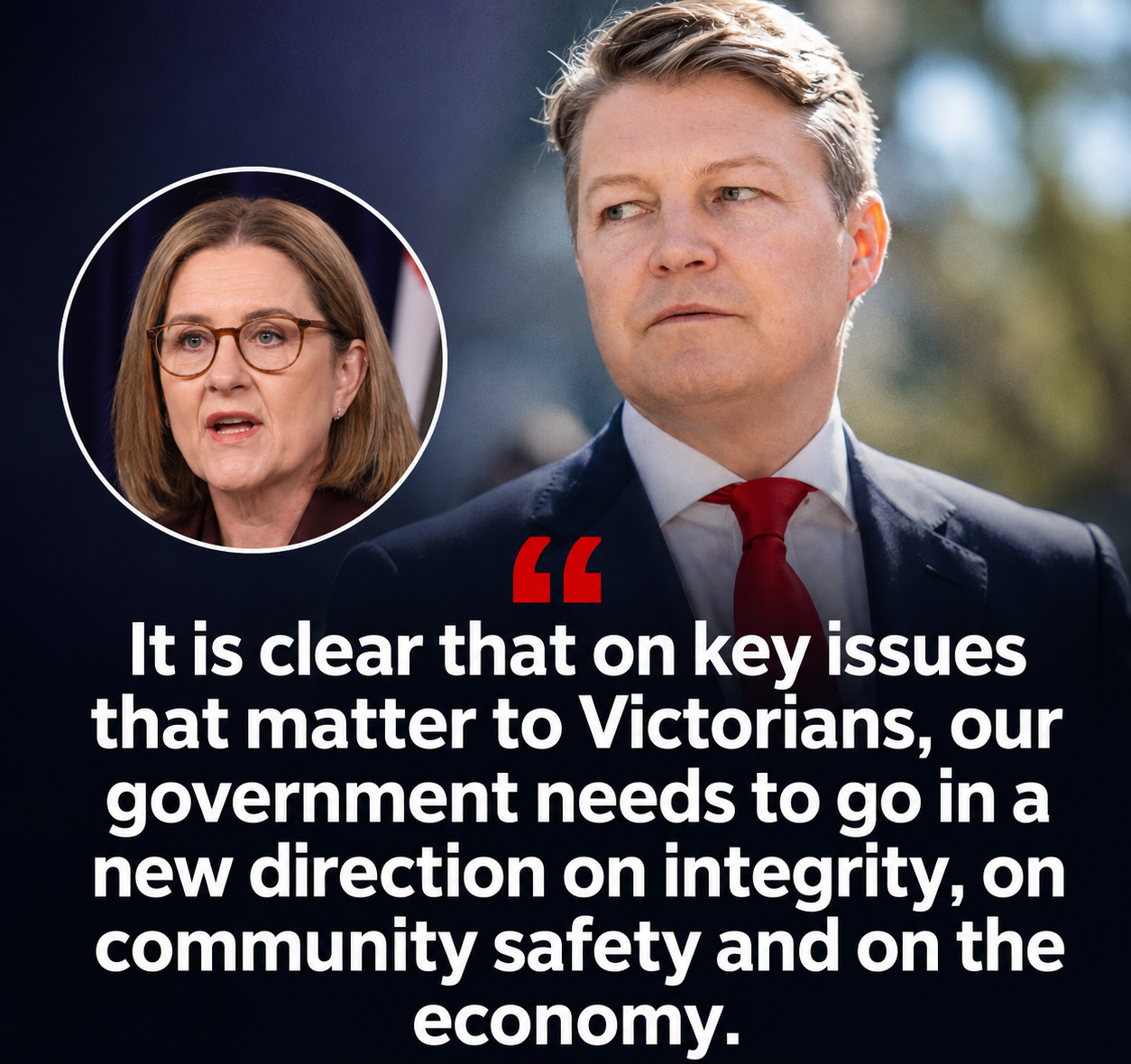
The extraordinary transition comes only four months before Victorians are due to vote in the state election, placing Labor under intense pressure as it attempts to reset its government after nearly 12 years in office.
Carroll, who had served as Deputy Premier under Allan, was sworn in before lunchtime on Tuesday after the outgoing premier announced she would step aside rather than force Victorian Labor through a divisive caucus battle. Her resignation ended days of intense speculation over her political future and avoided what was expected to become one of the most bitter internal leadership contests the party had faced in years.
In his first appearance as Premier, Carroll sought to immediately distinguish himself from both of his predecessors.
“Let me make one thing very clear – I am not Daniel Andrews, I am not Jacinta Allan,” he told reporters.
“I will do things differently because different times require a new approach.”
The message was unmistakable. Rather than attempting to defend Labor’s recent record, Carroll presented himself as the beginning of a new chapter for the Victorian government, acknowledging that public confidence had weakened and promising a different style of leadership.
He repeatedly emphasised integrity, accountability and restoring trust in government as the defining themes of his premiership.
“Integrity under my government will not be optional,” Carroll declared.
“We need to restore trust.”
He added that Victorians expected stronger standards from their elected representatives and pledged to lead what he described as a united Labor team into the November election.
One of the first difficult questions Carroll faced concerned a promise he had made only six weeks earlier, when he publicly indicated he would not challenge Allan’s leadership.
Asked repeatedly why he had changed course, Carroll gave the same explanation several times during his first press conference.
“The circumstances changed,” he said.
According to Carroll, events moved rapidly after a delegation of Labor MPs approached him on Monday morning and urged him to stand for the leadership. He said the same group had already informed Allan that a majority of caucus members wanted new leadership before the next election.
“Yesterday morning I was approached by a delegation who asked me to stand for leader,” Carroll said.
“This delegation had already visited the premier and informed her they wanted change.”
Faced with the prospect of a damaging internal contest, Allan ultimately chose to resign before the scheduled caucus ballot.
While insisting she believed she could have survived the challenge, the outgoing premier said a prolonged leadership fight would consume valuable time only months before Victorians head to the polls.
She argued that preserving party unity was ultimately more important than fighting to remain premier.
Allan also offered her full support to Carroll, saying she hoped Labor could now focus entirely on governing and preparing for the election rather than internal divisions.
The caucus meeting itself proved chaotic despite Allan’s decision to step aside.
Attorney-General Sonya Kilkenny briefly entered the leadership contest before withdrawing, allowing Carroll to emerge as leader without a prolonged ballot. Gabrielle Williams was subsequently elected Deputy Leader, completing Labor’s new leadership team.
Carroll’s elevation represents the culmination of a political career spanning more than a decade.
First elected to Parliament in a 2012 by-election representing the electorate of Niddrie, he has held a number of senior ministerial portfolios, including Public Transport, Roads, Industry, Employment and Education. He became Deputy Premier in 2023 following Daniel Andrews’ resignation and Jacinta Allan’s elevation to the state’s top job.
Although Carroll inherits government only months before an election, he has already outlined several immediate priorities.
Within hours of taking office he announced a royal commission into alleged corruption within Victoria’s construction sector, one of the issues that has significantly damaged public confidence in the government over recent years.
He also pledged stronger powers for the state’s anti-corruption watchdog and the appointment of a special prosecutor to work alongside the royal commission.
The announcements were widely interpreted as an effort to demonstrate a decisive break from previous approaches to integrity and accountability.
Victoria’s construction industry has remained under intense political scrutiny following allegations of criminal infiltration, misconduct and governance failures linked to major infrastructure projects. The issue has become one of the defining political debates facing Labor ahead of the election, with opposition parties arguing the government failed to act quickly enough.
By making integrity his first priority, Carroll appears to be signalling that restoring public confidence will be central to Labor’s campaign strategy.
The leadership change also reflects broader political challenges confronting Labor in Victoria.
The party has governed the state continuously since 2014 under first Daniel Andrews and then Jacinta Allan. While that period included major infrastructure investment and significant reforms, it has also coincided with growing concern about state debt, cost-of-living pressures, crime, major project cost blowouts and declining voter confidence.
Recent opinion polling has suggested Labor faces one of its toughest elections in years, with the Liberal Party hoping to return to government and some surveys indicating a potential role for One Nation in a future centre-right parliamentary majority.
Allan herself acknowledged that possibility during her resignation announcement, warning against the prospect of a Liberal–One Nation partnership after the election.
Her resignation therefore represents not only the end of her premiership, which began in September 2023 following Daniel Andrews’ departure, but also Labor’s attempt to reset its electoral prospects before November.
For Carroll, the immediate challenge will be convincing voters that a change of leader represents genuine renewal rather than simply a reshuffle within a government that has already spent more than a decade in office.
His repeated insistence that he is “not Daniel Andrews” and “not Jacinta Allan” reflects an understanding that many voters are looking for a different style of leadership, even if Labor remains in power.
Whether that message resonates will become clear over the coming months as Victorians prepare to elect their next state government.
With only a short campaign runway remaining, Carroll has little time to establish his own political identity while simultaneously defending Labor’s record and persuading voters his administration represents meaningful change rather than continuity.
Regardless of the election outcome, Tuesday’s dramatic events have already reshaped Victorian politics, ending Jacinta Allan’s premiership and placing Ben Carroll at the centre of one of the state’s most consequential election campaigns in more than a decade.






