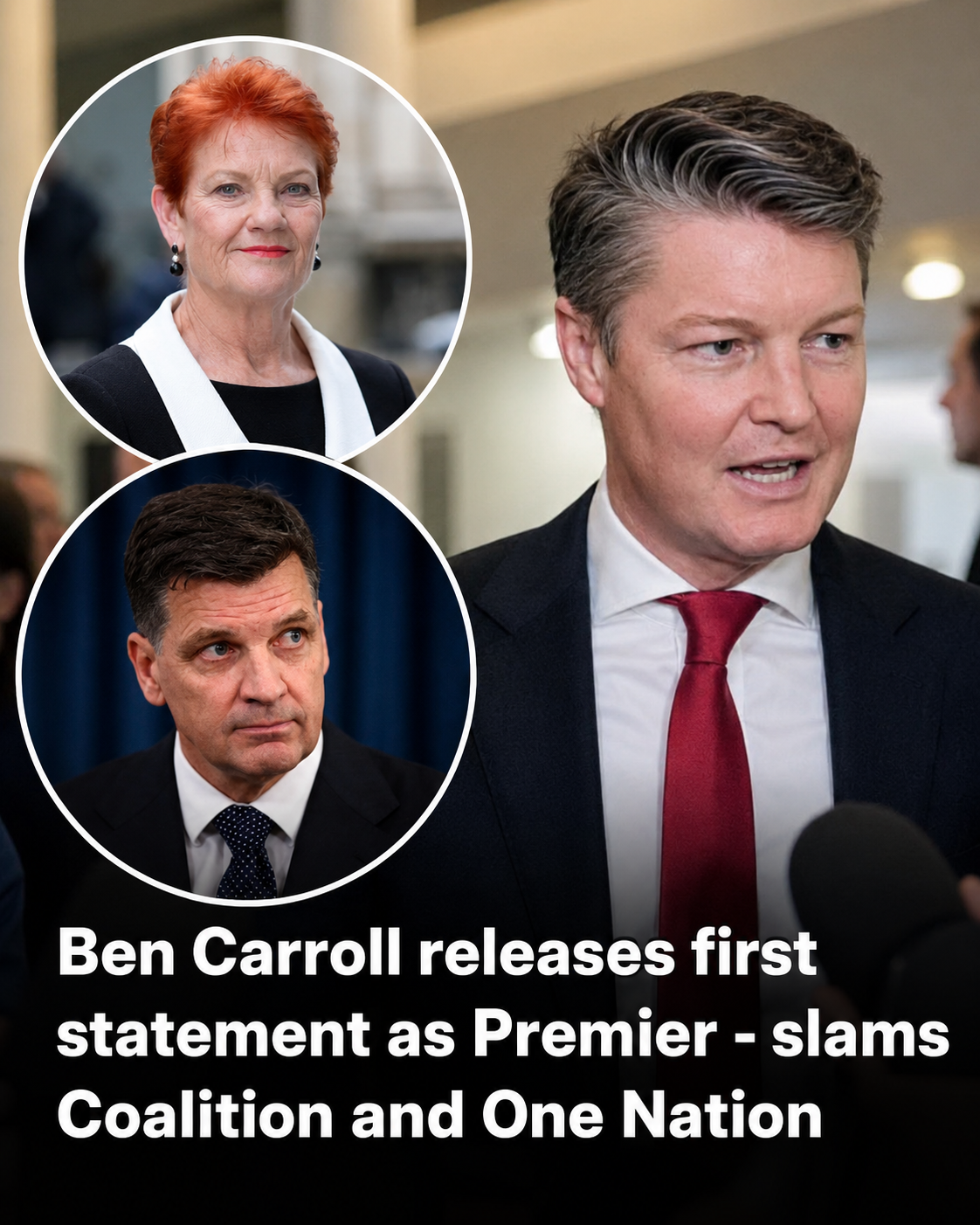
Victoria has entered a new political era after Ben Carroll was elected leader of the Victorian Labor Party and sworn in as the state’s 50th premier, bringing an end to weeks of uncertainty over Jacinta Allan’s leadership just months before one of the most consequential state elections in recent history.
The leadership transition followed an extraordinary day of political drama inside Labor’s parliamentary caucus, where Allan abandoned a final attempt to remain premier despite insisting she still believed she could lead the party to victory at the November election.
Instead, she chose to resign before a formal leadership ballot, arguing that prolonging an internal contest would only distract the government and damage Labor’s electoral prospects.
“The stakes at this election are too high,” Allan said as she announced her resignation, becoming visibly emotional while reflecting on her decision to step aside after nearly three years as premier and more than two decades in the Victorian Parliament.
Her resignation concluded weeks of intense speculation over whether Labor would replace its leader following a sustained decline in opinion polling and growing concern among MPs that the government was heading towards a heavy defeat after more than twelve years in office.
Only a day earlier, Allan had rejected calls to resign from a cross-factional group of senior ministers and MPs who informed her that she no longer commanded majority support within the parliamentary Labor Party.
Despite those warnings, Allan initially remained determined to contest the leadership if challenged, insisting she retained confidence in her ability to win both the internal vote and the upcoming state election.
By Tuesday morning, however, she concluded that forcing colleagues into a divisive ballot would further weaken Labor’s position and ultimately decided to stand aside.
Even after Allan’s resignation, Labor’s leadership transition did not unfold smoothly.
Deputy Premier Ben Carroll had widely been expected to assume the leadership unopposed after emerging as the consensus candidate across Labor’s major factions.
Instead, Attorney-General Sonya Kilkenny unexpectedly nominated herself for the leadership, triggering confusion and delaying what many MPs had expected would be a straightforward transition.
According to reports from inside the caucus meeting, heated exchanges broke out as members debated the surprise challenge, with raised voices heard behind closed doors while party officials attempted to restore order.
After a brief but tense period of uncertainty, Kilkenny withdrew her nomination, clearing the way for Carroll to be elected unanimously as Labor leader and premier.
One of the more unusual moments of the day occurred during the formal leadership process.
Transport Infrastructure Minister Gabrielle Williams was elected interim leader of the Victorian Labor Party for only a matter of minutes while constitutional and procedural requirements surrounding the leadership transfer were completed.
Once Carroll formally became leader, Williams was then elected deputy leader, completing Labor’s new leadership team ahead of the November election.
For Carroll, the promotion represents both the greatest opportunity and the greatest challenge of his political career.
The 51-year-old has spent more than a decade in Victorian politics after first entering Parliament in 2012 as the member for Niddrie. Over the years he has held portfolios including public transport, industry, employment, education, WorkSafe and medical research before serving as deputy premier under Allan.
Throughout that period he developed a reputation inside Labor as an effective negotiator capable of working across factional divisions, a quality that ultimately helped secure overwhelming caucus support once Allan stepped aside.
Yet becoming premier may prove easier than winning the election that now confronts him.
Labor enters the campaign under considerable electoral pressure.
After governing Victoria continuously since 2014, the party has faced increasing public concern over state debt, cost-of-living pressures, housing affordability, infrastructure cost overruns and questions surrounding government integrity.
Recent polling has suggested Labor risks losing its parliamentary majority, with support shifting towards the Liberal-National Coalition, the Greens, One Nation and independent candidates in several key electorates.
Recognising those concerns, Carroll used his first public appearance as premier to promise what he described as “a new direction” for Victoria.
He pledged to focus his government on restoring integrity, improving community safety and strengthening economic management while seeking to distinguish his administration from both the Andrews and Allan governments.
“I’m not Daniel Andrews. I’m not Jacinta Allan,” Carroll declared, signalling his intention to establish a distinct leadership style despite serving in both previous administrations.
His first major policy announcement reflected that strategy.
Within hours of taking office, Carroll announced plans for a royal commission into alleged corruption within Victoria’s construction sector, alongside proposals for a specialist prosecutor and expanded powers for the state’s anti-corruption watchdog.
The measures were presented as evidence that the new premier intended to place integrity at the centre of his administration from its first day in office.
Political analysts believe Carroll’s immediate challenge extends beyond announcing new policies.
He must persuade voters that Labor has genuinely changed direction despite remaining the same party that has governed Victoria for more than a decade.
That task is complicated by his own role as deputy premier throughout much of the Allan government.
Opposition figures have already argued that replacing the premier does not erase years of controversial decisions on major infrastructure spending, fiscal management and public sector governance.
Coalition leaders contend Carroll cannot credibly distance himself from policies he helped oversee while serving as Allan’s deputy.
For Allan, the resignation marks the conclusion of a political career that included almost 27 years representing Bendigo East and becoming Victoria’s second female premier.
Supporters credit her with advancing regional development, overseeing major transport and infrastructure projects and maintaining continuity following Daniel Andrews’ unexpected departure in 2023.
Critics, however, argue her premiership became increasingly defined by declining public confidence, rising state debt and Labor’s deteriorating electoral position.
Even in announcing her resignation, Allan maintained she believed she could still have won a caucus ballot and potentially the state election, but said preserving party unity ultimately took precedence over her personal ambitions.
The broader significance of the leadership change extends well beyond Labor itself.
Victoria’s election, scheduled for November, is widely regarded as one of the state’s most unpredictable contests in decades.
Labor is seeking an unprecedented fourth consecutive term, while the Liberal-National Coalition hopes to capitalise on voter dissatisfaction.
Minor parties and independents are also expected to play increasingly influential roles in a number of closely contested electorates, raising the possibility of a more fragmented parliament than Victoria has experienced in recent years.
For Carroll, the timing leaves little room for error.
Unlike leaders who inherit government early in an electoral cycle, he has only a few months to establish his public profile, demonstrate that his promises of renewal are credible and convince voters that Labor deserves another term despite the pressures that forced the leadership change.
Whether his message resonates may determine not only Labor’s electoral fortunes but also the political legacy of the government that has shaped Victoria for more than twelve years.
As Parliament prepares for the final sitting period before the election campaign formally begins, attention will now shift from Labor’s internal divisions to Carroll’s ability to convert a dramatic leadership transition into electoral recovery.
The events that delivered him to the premiership may have ended one chapter of Victorian politics, but they have also begun a race against time—one in which the new premier must convince voters that a change of leader represents a genuine change of government.






