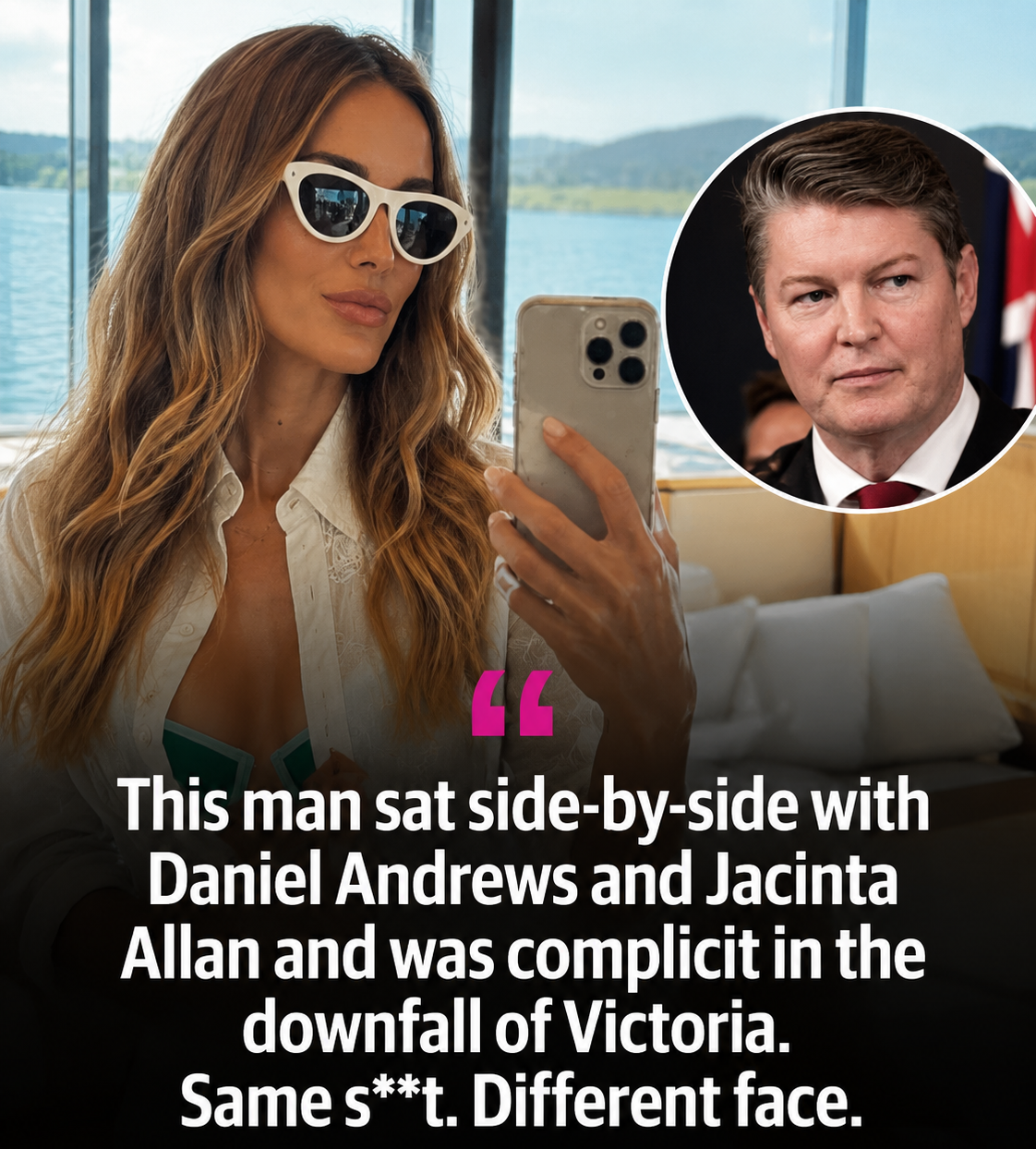
Media personality and entrepreneur Bec Judd has delivered a scathing public criticism of newly appointed Victorian Premier Ben Carroll, arguing that changing Labor’s leader does not represent genuine political renewal after more than a decade of Labor government.
The outspoken influencer took to Instagram shortly after Carroll was elected Victorian Labor leader and sworn in as the state’s 50th premier, using her social media platform to question whether Victorians should expect any meaningful change following Jacinta Allan’s resignation.
Sharing a news report announcing Carroll’s appointment, Judd wrote: “Never forget that this man sat side-by-side with Daniel Andrews and Jacinta Allan and was complicit in the downfall of Victoria.”
She followed the post with another blunt assessment: “Same s**t. Different face.”
The remarks quickly attracted widespread attention online and added another high-profile voice to the growing political debate surrounding Labor’s leadership transition.
Judd’s comments came only hours after Jacinta Allan announced her resignation following weeks of mounting pressure from within the Victorian Labor caucus.
Although Allan insisted she believed she could still have won November’s state election, she ultimately stepped aside after acknowledging that a prolonged leadership contest would consume valuable time and resources only months before voters head to the polls.
Carroll was subsequently elected Labor leader after a chaotic caucus meeting that briefly descended into uncertainty when Attorney-General Sonya Kilkenny unexpectedly entered the leadership race before later withdrawing her nomination.
For Judd, however, the leadership change does little to alter Labor’s broader record.
Her criticism reflects the argument advanced by many of the government’s opponents—that Carroll cannot credibly present himself as an agent of change because he spent years serving as a senior cabinet minister under both former premiers Daniel Andrews and Jacinta Allan.
Before becoming premier, Carroll held a succession of senior portfolios including public transport, education, industry, employment and medical research before serving as deputy premier.
Supporters argue that experience gives him the administrative background necessary to lead the state.
Critics counter that it also ties him directly to the decisions made by previous Labor governments.
Judd has become one of Victoria’s most prominent celebrity critics of the state government over recent years.
Her public commentary has frequently focused on crime, public safety and the direction of Melbourne under Labor.
In 2024 she described Melbourne as “woke, broke and violent” while expressing concern about violent crime, saying residents increasingly felt unsafe in suburbs once regarded as among the state’s most secure.
She has also previously criticised what she viewed as insufficient government action in response to home invasions and youth crime affecting Melbourne’s bayside communities.
Her latest comments therefore continue a pattern of public criticism rather than representing an isolated reaction to Carroll’s appointment.
Although Judd does not hold elected office, her large social media following has made her one of Australia’s most influential lifestyle personalities, and her political observations frequently attract widespread media coverage.
The political significance of her latest remarks lies less in celebrity commentary itself than in the way they mirror arguments now being advanced by Victoria’s Liberal-National opposition.
Opposition Leader Jess Wilson has likewise argued that replacing Jacinta Allan with Ben Carroll does not amount to genuine renewal because Carroll participated in the same cabinet decisions that shaped the Andrews and Allan governments.
Wilson has repeatedly contended that Labor has lost the public’s confidence after more than twelve years in office and that changing leaders cannot erase that record.
Carroll rejects that characterisation.
In his first public appearances as premier, he has insisted Victorians should judge him on the decisions his own government makes rather than assuming continuity with previous administrations.
“I’m not Daniel Andrews. I’m not Jacinta Allan,” Carroll said after taking office, promising a stronger emphasis on integrity, accountability and economic management.
He also announced plans for a royal commission into Victoria’s construction sector together with broader integrity reforms, presenting them as evidence that his premiership would mark a genuine change in direction.
Labor supporters argue the government required a fresh leader precisely because political circumstances had changed.
They contend Carroll’s extensive ministerial experience positions him to address challenges including cost-of-living pressures, housing affordability, infrastructure delivery and public confidence while maintaining policy continuity in key areas such as health and education.
Opponents remain unconvinced.
They argue that because Carroll served as deputy premier and senior cabinet minister throughout many of the controversies that affected the Andrews and Allan governments, he cannot realistically distance himself from decisions that contributed to Labor’s declining electoral position.
The exchange illustrates how personal leadership narratives are likely to dominate Victoria’s political debate over coming months.
With the state election rapidly approaching, both major parties are competing to define Carroll before he has time to establish his own identity with voters.
Labor hopes the leadership change will be viewed as an opportunity for renewal and a fresh start.
The Coalition, meanwhile, is seeking to frame Carroll as simply another representative of the same government under a different leader.
Political analysts note that leadership transitions shortly before elections often become contests over perception as much as policy.
New leaders generally attempt to highlight differences in style, priorities and governing approach, while opponents emphasise continuity and shared responsibility for past decisions.
Carroll’s administration is therefore likely to face sustained scrutiny over whether it can convincingly demonstrate meaningful change after more than a decade of Labor government.
Judd’s social media comments have amplified that debate beyond Parliament and into the broader public conversation.
While her criticism represents a personal political opinion rather than an objective assessment, it reflects concerns expressed by some sections of the Victorian community about crime, government spending, infrastructure delivery and public confidence.
Equally, Labor supporters argue that many of those issues are complex, long-term challenges and that Carroll deserves to be judged on the performance of his own premiership rather than solely on his association with previous leaders.
As Victoria moves closer to November’s election, the contest is increasingly becoming one of competing narratives.
For Carroll, the central challenge will be convincing voters that replacing the premier represents genuine renewal.
For critics such as Bec Judd and the opposition, the message is very different—that changing the person at the top does not change the government’s overall record.
Which interpretation ultimately resonates with Victorian voters will become clearer when the state heads to the polls later this year.






