A dispute between Senator Ralph Babet and Foreign Minister Penny Wong over fuel linked to Russian crude has reopened a difficult question for Australia’s energy supply chain: how can a country oppose Russian oil while purchasing refined products that may have passed through refineries in other countries?
Babet has challenged Wong over the treatment of fuel products that originate from Russian crude, including raising questions about whether similar concerns apply to other major buyers. In an earlier Senate exchange, Wong said his support for Vladimir Putin’s regime was a disgrace. That was her accusation about his political position, not an independently established fact that he supports the Russian government.
The chronology matters. Wong’s severe rebuke came in a documented earlier parliamentary exchange. A later challenge by Babet does not prove she made a fresh reply using the same words. The two statements belong to separate interventions, not a single new confrontation. Their substance raises a technical question about refined fuel and the traceability of crude oil.
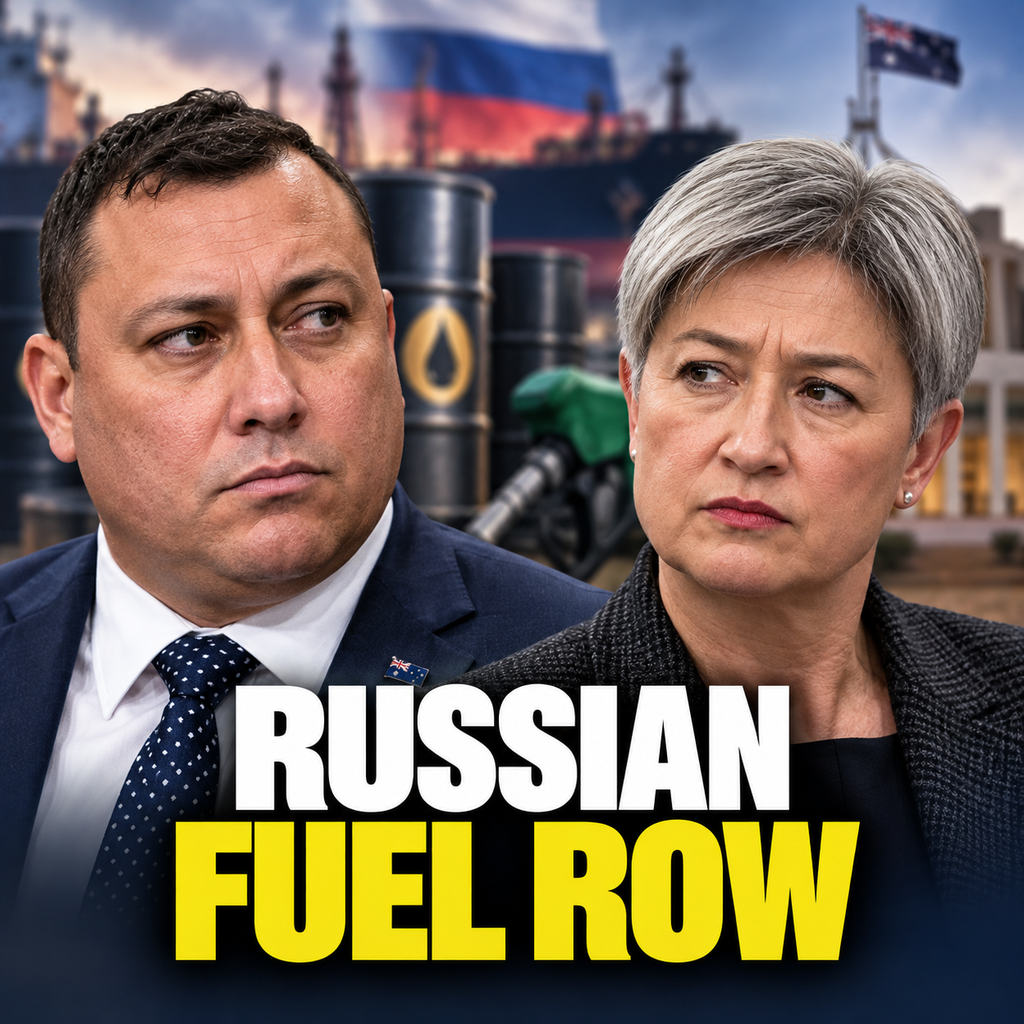
During the recorded Senate questioning, Babet asked whether Australia had imported refined fuel from countries processing Russian crude. Wong pointed to restrictions on Russian imports but acknowledged the difficulty of tracing the original source of crude after it has been substantially transformed by refining elsewhere. She described efforts to encourage supply-chain disclosure and assurance by importers.
That is a real regulatory problem, not merely political wordplay. Crude oil can be transported from a producing country to a refinery, processed into petrol, diesel or aviation fuel, and then sold through international supply chains. Documentation for the refined product may identify a country of refining or shipment without giving consumers a straightforward answer about every barrel that contributed to the finished fuel.
Direct sanctions against imports from Russia and the treatment of refined products made elsewhere are not necessarily identical. The legal treatment depends on the exact rules, origin, transaction and applicable sanctions. A politician’s assertion that Australia indirectly benefits Russia cannot by itself establish that a particular importer violated Australian law.
Wong’s response drew a moral distinction between maintaining pressure on Russia over its invasion of Ukraine and relying on opaque global fuel supply. She argued that Australia’s sanctions seek to avoid financing the Russian war effort, while acknowledging that supply-chain tracing can be technically difficult. Babet argued that Australia must consider whether restricting access to fuel is compatible with the national interest.
Both positions engage with real trade-offs, but neither relieves decision-makers of the obligation to specify what a policy would actually ban, how compliance would be verified and what alternative supply would be available. A blanket promise to secure cheaper fuel, or a claim that every imported litre can be traced without uncertainty, needs evidence.
For households, the related issue is petrol and diesel prices. The amount displayed at a service station reflects several components: wholesale product costs, freight and distribution, taxes and margins at different stages of the supply chain. Global oil and refined-product markets influence Australian prices, but the movement of the pump price is not a simple mirror of the price of crude oil on a single day.
Exchange rates also matter because internationally traded fuel is commonly priced in US dollars. A weaker Australian dollar can increase local costs even when an international benchmark is broadly steady. Domestic competition and regional transport costs then influence the differences drivers see between capital-city suburbs and smaller communities.
The distinction between fuel affordability and availability can be particularly sharp outside major cities. Regional motorists may have fewer nearby stations and longer distances between essential services. Farmers, road freight operators and businesses relying on diesel face additional exposure because fuel is an input into production and distribution, rather than only a household driving expense.
Those costs can travel further through the economy. A transport operator paying more for diesel may try to pass on part of the expense through freight charges. A farm paying more to operate equipment may face pressure on margins. It does not follow that every food price increase can be traced to fuel alone; labour, weather, insurance and other costs also affect prices.
The Senate debate itself acknowledged the effect on Australians travelling for medical care. A separate question raised the problems faced by a regional patient who needs repeated journeys for dialysis. Wong pointed to measures aimed at fuel supply and excise relief. The example illustrates why policy discussions about foreign sanctions and international markets ultimately connect with everyday access to essential services.
For a household assessing transport costs, it is more useful to compare the complete cost of travel than to focus only on a dramatic political exchange. Vehicle efficiency, the distances driven, local competition, available public transport and the timing of purchases can all affect the budget. None of these considerations substitutes for a national energy-security policy, but they explain the direct consequences of price volatility.
Australia’s reliance on global refining and distribution networks also makes energy security a question of stockholdings, shipping, infrastructure and the capacity to respond to disruptions. Buying more from one region may reduce exposure to one risk while creating another. Any proposal must be judged against the actual capacity of suppliers and the legal obligations of Australian importers.
Babet’s later questions deserve a factual answer about supply chains. Wong’s earlier condemnation should be understood as part of an already documented dispute, not evidence of a fresh allegation. The most important unresolved policy issue is how Australia can increase transparency about fuel origin while maintaining lawful and reliable supply.
Fuel prices also need to be understood across different kinds of users. A driver of a small passenger car typically considers pump prices alongside kilometres travelled and maintenance. A transport fleet may negotiate fuel supply contracts and monitor how diesel expenses affect freight quotes. A farmer operating eligible machinery may have access to fuel tax credits under tax rules that do not apply to ordinary private motoring. Those distinctions make it impossible to describe one typical national fuel bill without specifying the buyer and use.
Fuel tax credits are especially easy to misunderstand. Businesses may be eligible for credits for fuel used in certain machinery, equipment, heavy vehicles or business activities, subject to detailed rules. The amount and whether a road user charge applies depend on the activity and fuel type. It is not a general refund of all fuel tax for anyone who drives to work. Readers considering a business claim should check the Australian Taxation Office’s published conditions rather than infer eligibility from statements about excise policy.
For many drivers, the cost of running a vehicle extends beyond petrol and diesel. Insurance premiums, registration, servicing, tyres, loan interest and depreciation can account for a substantial share of annual spending. A temporary easing in fuel prices may provide relief while leaving those fixed and semi-fixed costs untouched. Conversely, a fuel spike can be especially painful for households that cannot readily reduce essential driving.
The pricing chain also explains why public statements about wholesale fuel do not immediately map onto local retail prices. Petrol stations may purchase supply under different arrangements and face distinct transport and storage costs. Competition within a particular suburb or regional town can be uneven. The relevant question is not simply whether an international crude benchmark moved but how that movement passes through refining, shipping, distribution and retail decisions.
Australia’s fuel security involves physical logistics as well as law. Stockholding obligations, port capacity, regional depots and access to international shipping can determine how a supply interruption affects consumers. A country may have theoretical access to international sellers yet face practical delays moving fuel to remote communities. That is why government discussions about energy security tend to combine stock releases, supply procurement and distribution measures rather than rely on one step alone.
Sanctions compliance and fuel-market transparency also affect businesses. Importers may be asked to provide information about counterparties and supply chains. Compliance can require record keeping and due diligence, but the ability to trace inputs through several refineries may vary. Firms retain their legal compliance responsibilities even when the precise origins of every input in a refined product may not be visible to ordinary consumers.
The international question Babet raised is therefore relevant to Australian household budgets without proving his broader political argument. Greater transparency about where refined products were processed could inform policy discussions, while different arrangements for lawful imports might affect price or availability. Yet an exact price effect cannot be predicted from the Senate exchange alone; it would require modelling supply volumes, substitutes, currency and transport costs.
Wong’s objections and Babet’s challenge should be judged against those realities. Strong sanctions can pursue foreign-policy goals, while governments also have duties to manage supply risks at home. Those competing obligations create trade-offs that cannot be resolved by promising Australia can avoid every ethical complication or guarantee cheap fuel at every service station.
The wider public debate will be better served by clear sanctions rules, better information about refined-fuel sourcing and realistic analysis of household and business costs. Those are measurable concerns. Claims about another senator’s political sympathies remain allegations made in political argument.






