Australia’s peak hydrogen industry body has quietly removed the word “hydrogen” from its name, adopting a new identity that reflects the rapidly changing direction of the country’s clean energy transition.
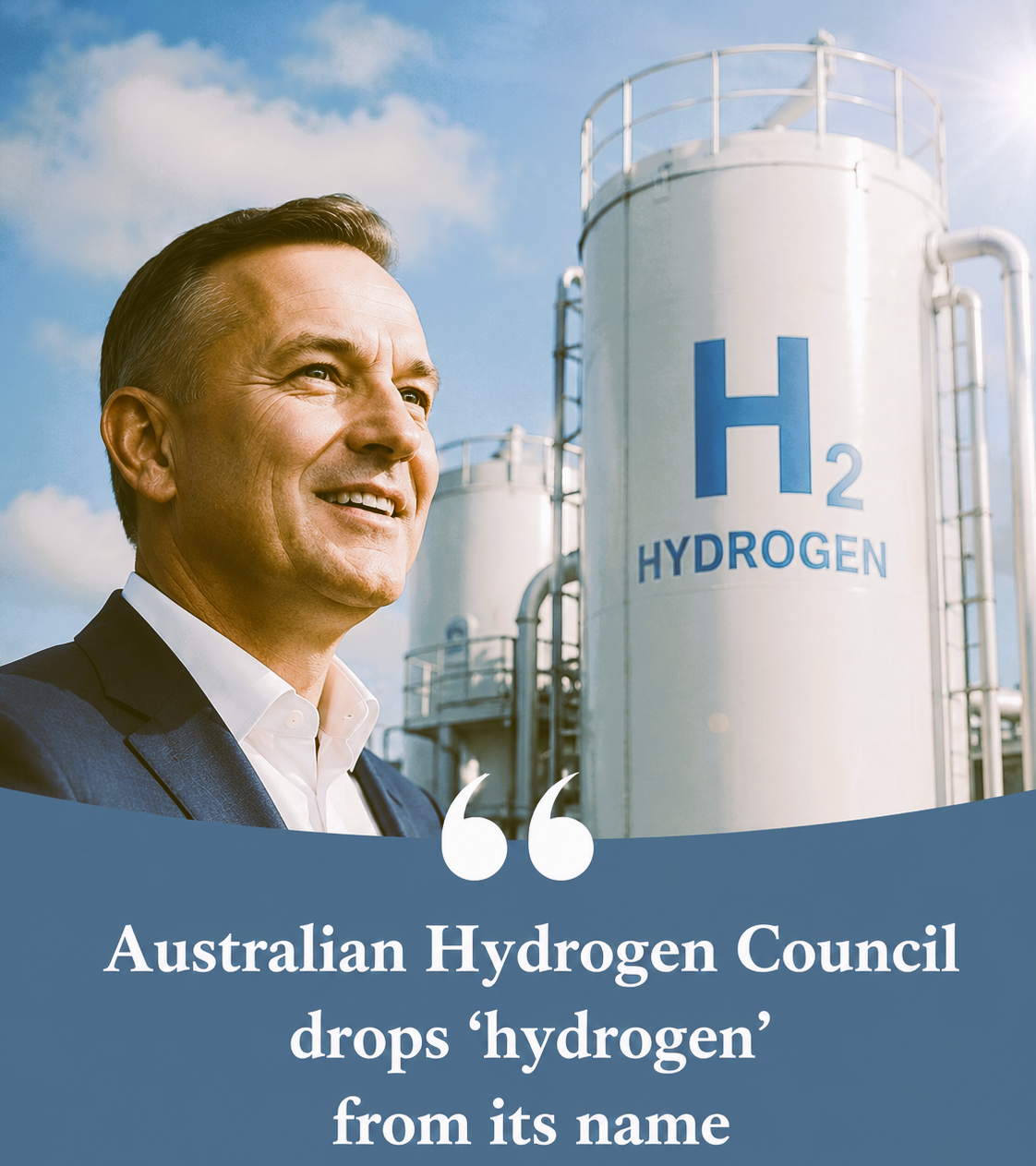
The Australian Hydrogen Council has officially rebranded as the Australian Industrial Decarbonisation Council, a move that comes after several years of slowing investment, cancelled projects and mounting questions over the commercial viability of large-scale green hydrogen production in Australia.
Although the organisation says the new name reflects a broader mission to support industrial decarbonisation rather than a retreat from hydrogen, the timing has attracted considerable attention across the energy sector.
For critics of Australia’s hydrogen strategy, the rebranding is being interpreted as symbolic of an industry that has struggled to match the ambitious expectations set only a few years ago.
In explaining the change, the organisation said Australia’s hydrogen opportunity had initially been viewed as a broad global export industry.
However, as the market evolved, attention increasingly shifted toward domestic industrial applications that could help decarbonise heavy industry, build local capability and support future export opportunities.
Rather than abandoning hydrogen, the council argues it is recognising that industrial emissions reduction now extends well beyond a single technology.
The decision nevertheless arrives during a difficult period for Australia’s hydrogen sector.
Over the past two years, numerous flagship projects have been delayed, scaled back or cancelled as developers confronted rising construction costs, higher interest rates, slower-than-expected customer demand and continuing uncertainty over commercial returns.
Many companies that once announced billion-dollar hydrogen ambitions have since revised their investment strategies.
Among the highest-profile examples has been Fortescue.
Founder Andrew Forrest was one of the world’s strongest advocates for green hydrogen and previously set a target of producing 15 million tonnes annually.
That ambition has since been substantially revised, with several international projects paused or postponed as the company reassessed commercial realities.
The Albanese Government has continued to back hydrogen as an important part of Australia’s long-term energy transition.
Energy and Climate Change Minister Chris Bowen launched the updated National Hydrogen Strategy in 2024, outlining an ambition to develop Australia into a major producer of renewable hydrogen while supporting new export industries and helping heavy manufacturing reduce emissions.
The strategy included a national production target of 500,000 tonnes of renewable hydrogen annually by 2030.
However, recent Senate estimates hearings highlighted the scale of the challenge still facing the industry.
Officials revealed that Australia’s domestic renewable hydrogen production during 2024 totalled only about 1,100 tonnes—approximately 0.2 per cent of the government’s long-term production target.
The gap between ambition and reality has prompted increasing debate over whether government support should continue focusing heavily on hydrogen or be spread more broadly across a range of industrial decarbonisation technologies.
Labor maintains that emerging industries often require long investment horizons before achieving commercial scale.
Government ministers argue Australia possesses abundant renewable energy resources, significant export opportunities and existing industrial expertise that could ultimately provide long-term competitive advantages.
Supporters of hydrogen also point out that the technology remains widely regarded as one of the few realistic pathways for reducing emissions in sectors where direct electrification is difficult.
These include steel production, ammonia manufacturing, chemicals, shipping and some forms of long-distance heavy transport.
Many international decarbonisation roadmaps continue to assign hydrogen an important role in achieving net-zero emissions over coming decades.
However, commercial reality has proved considerably more challenging than early forecasts suggested.
Producing green hydrogen requires large quantities of renewable electricity to power electrolysers that split water into hydrogen and oxygen.
Although renewable electricity costs have fallen significantly, electrolyser costs, infrastructure requirements, storage, transport and customer demand continue to present major economic hurdles.
In many applications, hydrogen remains substantially more expensive than conventional fossil fuel alternatives without significant government subsidies.
Australia has nevertheless committed considerable public funding to support hydrogen development.
Recent federal and state government initiatives include production tax incentives, infrastructure grants and direct project funding intended to accelerate commercial deployment.
One prominent example is the jointly funded renewable hydrogen hub in Newcastle, which received hundreds of millions of dollars in government support as part of broader industrial decarbonisation efforts.
Critics argue those investments have yet to demonstrate value for taxpayers.
Some policy analysts have questioned whether the carbon emissions reductions achieved by subsidised projects justify their overall cost, particularly while commercial demand remains relatively limited.
Others contend early government investment is essential because major energy transitions have historically required decades of sustained public and private capital before becoming economically competitive.
The council’s rebranding also reflects broader changes occurring throughout the energy sector.
Several major companies have adopted names emphasising broader energy or decarbonisation themes rather than traditional fuel categories as their businesses diversify.
Within Australia, Woodside Petroleum became Woodside Energy, while the Australian Petroleum Production and Exploration Association previously rebranded as Australian Energy Producers to better reflect changing industry priorities.
Membership trends also illustrate the industry’s evolution.
Reports indicate the organisation has lost dozens of corporate members since 2023, including several major multinational companies and financial institutions.
While membership changes occur for many reasons, observers say they reflect more cautious expectations surrounding hydrogen’s commercial development than those seen during the industry’s rapid expansion several years ago.
Importantly, the rebranding does not mean hydrogen development in Australia has ceased.
Numerous demonstration projects continue across sectors including heavy industry, mining, transport and export infrastructure.
Research institutions, state governments and private companies remain actively involved in advancing hydrogen technologies, particularly where they may complement renewable electricity rather than compete directly with it.
Internationally, many governments continue investing in hydrogen despite slower-than-expected commercial deployment.
Countries including Japan, South Korea, Germany and members of the European Union continue supporting hydrogen supply chains as part of broader decarbonisation strategies, although timelines have generally become more cautious than initially anticipated.
Energy analysts increasingly suggest that expectations surrounding hydrogen are becoming more realistic.
Rather than serving as a universal replacement for fossil fuels, hydrogen is now widely viewed as a specialised solution likely to play a significant role in selected industrial applications where few practical alternatives exist.
That more targeted approach aligns closely with the Australian Industrial Decarbonisation Council’s new identity, which places industrial emissions reduction ahead of any single technology.
Whether the rebranding ultimately represents a strategic evolution or a recognition that earlier expectations proved overly optimistic will remain a matter of debate.
What is clear is that Australia’s clean energy transition is entering a more pragmatic phase, one in which commercial viability, industrial demand and long-term economics are becoming just as important as technological ambition.
For the hydrogen industry, the challenge now is demonstrating that the technology can move beyond pilot projects and government support to become a commercially sustainable part of Australia’s low-emissions future.






