Prime Minister Anthony Albanese has used his keynote address to the Australian Labor Party’s 50th National Conference to outline a new phase of the government’s reform agenda, combining major workplace and education announcements with a pointed political message rejecting what he described as a vision of a monocultural Australia.
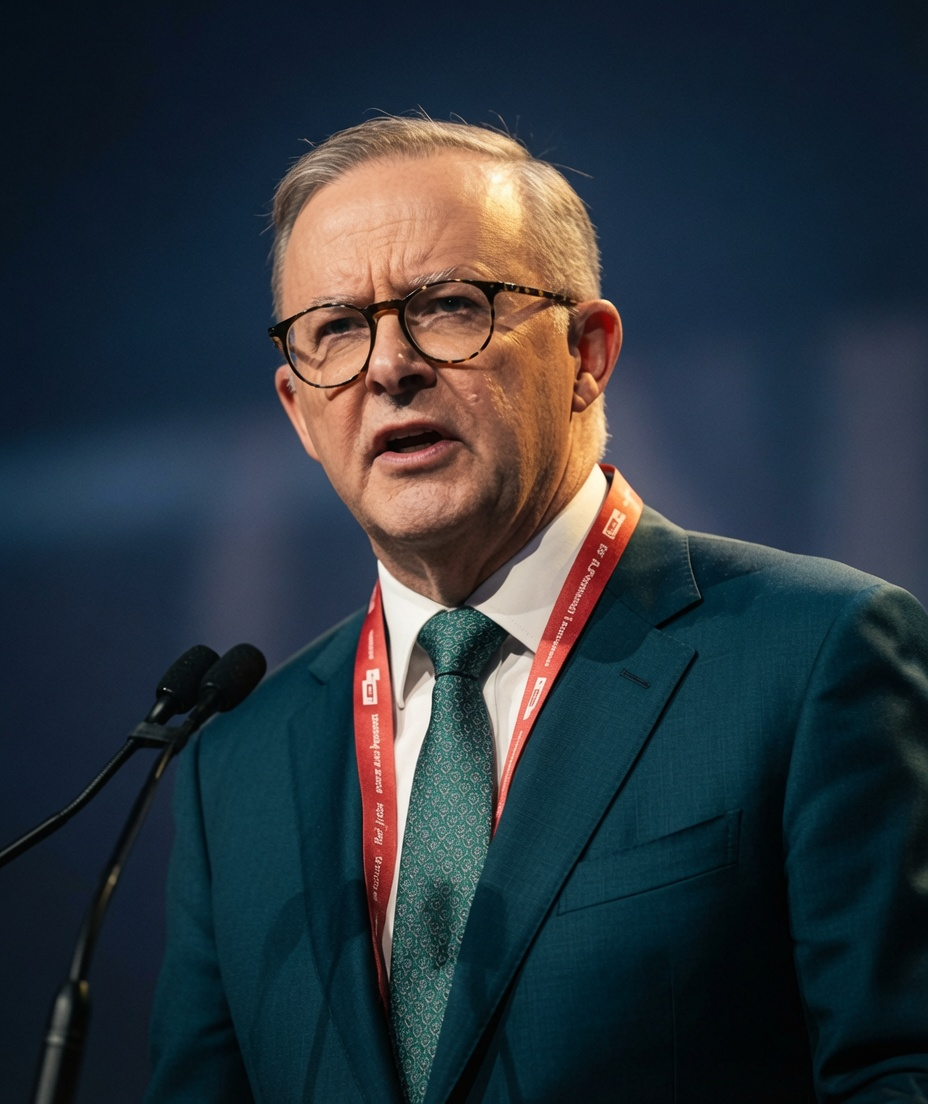
Speaking to hundreds of delegates gathered in Adelaide for Labor’s triennial policy-setting conference, Albanese announced plans to establish a dedicated Fair Work Court, expand financial support for health students undertaking mandatory placements and reinforce the government’s commitment to multiculturalism, workplace protections and practical economic reform.
The address closed the opening day of the conference with a strong political contrast between Labor and its opponents ahead of the next federal election.
Without directly naming Pauline Hanson for much of his speech, the Prime Minister criticised what he characterised as divisive politics and rejected the idea that Australia’s future should be defined by a single cultural identity.
“Our strength comes from our diversity,” Albanese told delegates, pointing to the multicultural composition of Labor’s parliamentary caucus and arguing it better reflected modern Australia than the vision promoted by parties advocating a more restrictive approach to immigration and national identity.
The comments came after several days of renewed national debate surrounding One Nation, migration policy and Australia’s cultural identity during the Labor conference.
Labor figures have increasingly identified One Nation as a significant political challenger following stronger polling throughout 2026, prompting senior ministers to sharpen their attacks on the minor party while emphasising Labor’s commitment to an inclusive Australia.
One of the centrepieces of Albanese’s speech was the announcement of a new Fair Work Court.
The proposed specialist court would be designed to hear employment and industrial relations disputes more quickly and at lower cost than the current system, with expert judges dedicated to workplace matters.
The government said the reform aims to simplify legal processes for workers and employers while providing faster access to justice in cases involving wage underpayments, unfair workplace practices and industrial disputes. The proposal will now proceed to consultation with business groups, unions and legal experts before legislation is introduced. >
Unions have long argued that Australia’s existing employment dispute system is overly complex because workplace cases are currently spread across multiple courts.
The Australian Council of Trade Unions welcomed the proposal, describing it as an important step towards improving enforcement of workplace rights and making legal remedies more accessible for employees affected by wage theft or unfair treatment.
Albanese also announced a significant expansion of Labor’s Paid Prac program.
Under the plan, students completing mandatory placements in ten additional frontline allied health professions—including physiotherapy, occupational therapy, speech pathology and paramedicine—will become eligible for financial assistance while undertaking compulsory practical training from 1 July 2027.
The government argues the measure will help reduce financial barriers that discourage students from entering essential healthcare professions facing ongoing workforce shortages.
The Paid Prac scheme was originally introduced to support students in nursing, midwifery, teaching and social work.
By extending eligibility to a broader range of health disciplines, Labor says thousands more students will receive weekly financial support during placements that often require them to suspend paid employment for extended periods.
The expansion forms part of the government’s broader strategy to strengthen Australia’s future healthcare workforce while helping students manage rising living costs.
Another measure announced during the conference was a change to superannuation rules affecting younger workers.
The government pledged to remove the existing requirement that employees under the age of 18 work at least 30 hours each week before qualifying for compulsory employer superannuation contributions.
If implemented, the reform would extend superannuation coverage to all eligible young workers regardless of hours worked, providing what Labor described as an important boost to long-term retirement savings.
Throughout the speech, Albanese repeatedly returned to the theme of practical government.
He acknowledged that many Australians continued to experience financial pressure despite improvements in headline economic indicators, arguing that Labor’s role was to deliver policies addressing everyday concerns rather than pursuing symbolic political conflict.
The Prime Minister said Australians wanted governments focused on lowering costs, strengthening Medicare, improving housing affordability and creating secure employment opportunities.
His remarks also reflected Labor’s emerging electoral strategy.
Rather than focusing exclusively on the Liberal Party, Albanese portrayed the Coalition, the Nationals and One Nation as increasingly aligned on key issues, arguing they represented a fragmented conservative alternative lacking coherent policy solutions.
He suggested Labor remained the only party capable of providing stable government while continuing to invest in public services and workplace protections.
The speech was delivered during Labor’s 50th National Conference, the party’s highest decision-making forum.
Held every three years, the conference brings together delegates from state and territory branches, affiliated trade unions and the federal parliamentary caucus to debate policy, amend the party platform and establish strategic priorities for the coming electoral cycle.
Although much attention focused on Albanese’s announcements, delegates were also scheduled to debate a wide range of policy issues over the course of the conference.
These include industrial relations, taxation, artificial intelligence, energy policy, gambling reform, immigration and international affairs, with some proposals expected to generate vigorous discussion despite Labor’s strong parliamentary majority.
Outside the conference, Labor also faced pressure from advocacy groups and sections of the party membership over issues including the war in Gaza, climate policy and proposed taxation changes affecting the resources sector.
While these debates continue, the government’s leadership has emphasised maintaining unity and presenting a coherent policy platform ahead of the next election.
Political observers noted that Albanese’s address combined policy announcements with a campaign-style message intended to frame Labor’s next electoral contest.
Rather than concentrating solely on economic management, the Prime Minister sought to contrast Labor’s emphasis on multiculturalism, workplace rights and practical reforms with what he described as more divisive approaches advocated elsewhere in Australian politics.
His closing remarks celebrating the diversity of Labor’s parliamentary team reinforced that broader theme, presenting multicultural Australia as both a defining national strength and a central element of the government’s political identity.
Whether the newly announced initiatives ultimately become law will depend on the legislative process and consultation with affected industries and stakeholders.
However, the announcements provide an early indication of the policy priorities Labor intends to take into the next phase of government: strengthening workplace protections, investing in future health professionals, expanding retirement savings for young workers and positioning itself as the party of an inclusive and culturally diverse Australia.






