Prime Minister Anthony Albanese has defended the federal government’s decision to begin winding back Australia’s temporary fuel excise relief, insisting the measure was always designed as short-term assistance rather than a permanent reduction in fuel taxes.
The government’s fuel tax relief was introduced earlier this year after conflict in the Middle East sent global oil prices sharply higher, pushing petrol and diesel costs to levels that placed significant pressure on Australian households and businesses. Rather than permanently reducing the fuel excise, Labor implemented a temporary package intended to cushion motorists while international energy markets experienced exceptional volatility.
Speaking as the final stage of that assistance begins to expire, Albanese said the policy had always been framed as emergency relief.
“It was always intended to be temporary,” the Prime Minister said, explaining that the government was now following the timetable announced when the package was introduced.
The temporary measure initially halved the fuel excise from 1 April before transitioning to a smaller discount during July. From early August, the concession is being removed completely, restoring the normal rate of excise on petrol and diesel.
The decision means motorists will gradually begin paying more at the pump as service stations replenish existing fuel stocks with fuel purchased under the restored tax rate. Industry analysts have noted that prices are unlikely to rise uniformly overnight because retailers hold different inventory levels and replenish supplies at different times.
Although the government is proceeding with the scheduled phase-out, Albanese indicated the situation remains under review.
He acknowledged that global oil markets continue to be heavily influenced by instability in the Middle East and said the government could reconsider additional assistance if circumstances deteriorate significantly.
“If the conflict continues and conditions change substantially, obviously we would assess the situation at the time,” Albanese said, while stressing that no decision had been made to extend the relief beyond its existing timetable.
The temporary excise reduction formed one element of a broader package announced after geopolitical tensions disrupted international energy supplies. The conflict placed renewed pressure on crude oil markets, with concerns over shipping through the Strait of Hormuz contributing to higher global prices and increased fuel costs across Australia.
To help limit the immediate impact on households, the Albanese government introduced a temporary reduction in the fuel excise alongside concessions for heavy vehicle operators and other transport measures aimed at maintaining supply chains. The government described the package as emergency cost-of-living support rather than a permanent tax reform.
As the emergency support winds back, Albanese argues that Australia’s long-term response to cost-of-living pressures should rely less on temporary tax relief and more on structural economic measures.
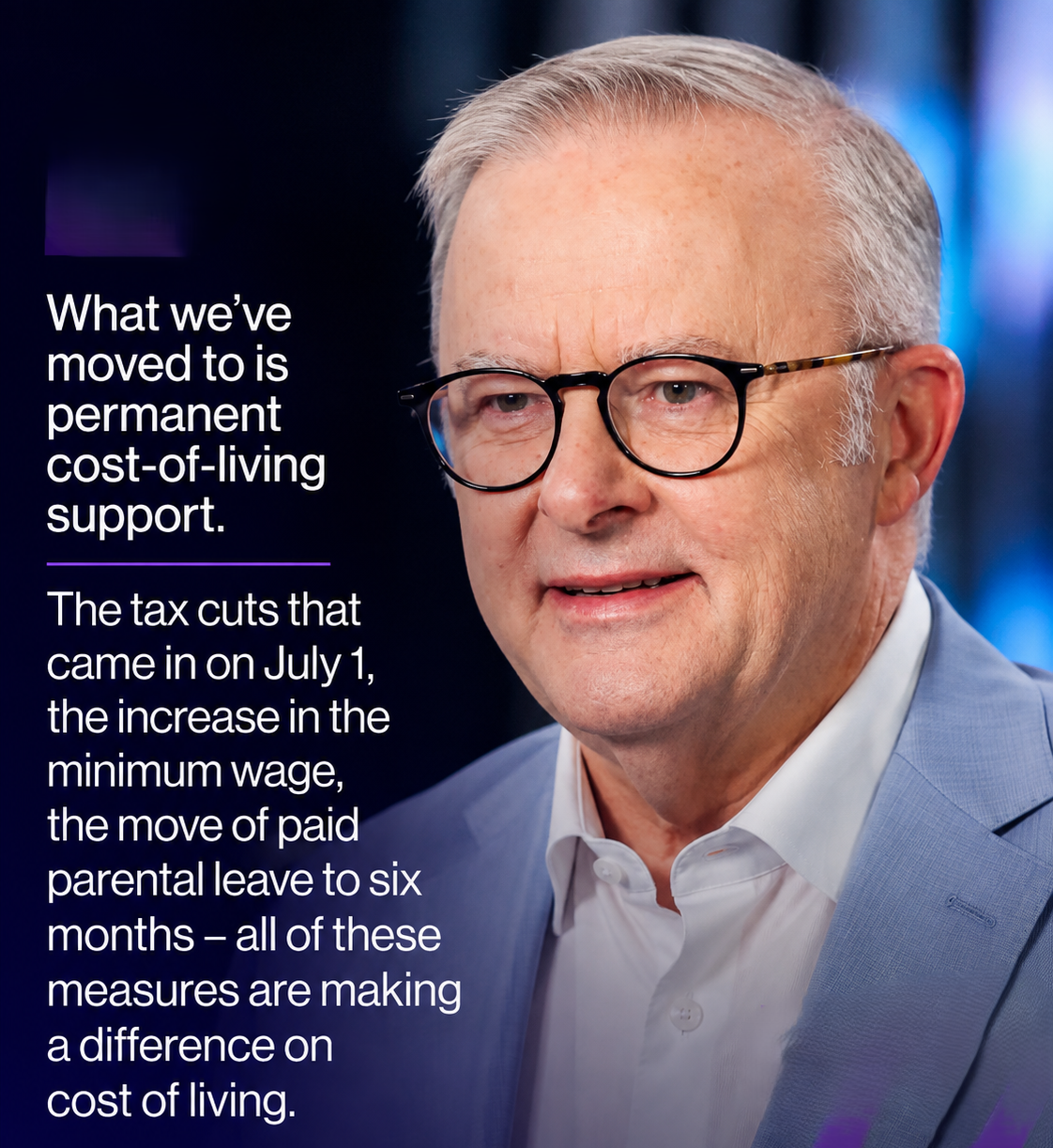
The Prime Minister pointed to the government’s income tax cuts, increases to the national minimum wage and expansion of paid parental leave as examples of policies designed to provide continuing financial assistance rather than short-term relief.
According to Albanese, these measures strengthen household finances across a wider section of the community while avoiding the ongoing budget cost associated with permanent fuel tax reductions.
“We’ve always said temporary support should transition to longer-term reforms that improve people’s financial position,” he said in outlining the government’s broader economic strategy.
Treasurer Jim Chalmers has similarly argued that while fuel tax relief played an important role during the peak of the international energy shock, maintaining the discount indefinitely would place substantial pressure on the federal budget while becoming less effective as global fuel markets stabilised.
Not everyone agrees with that assessment.
Opposition figures have argued that many Australians continue to struggle with elevated living costs despite easing inflation, warning that ending the excise relief risks placing additional pressure on families already dealing with higher mortgage repayments, insurance premiums and grocery bills.
Some business groups have also expressed concern about the impact on freight costs, particularly in regional Australia where long travel distances make fuel prices a significant operating expense.
Transport operators are expected to experience the combined effect of the restored fuel excise and the return of the Heavy Vehicle Road User Charge concession, which was introduced as part of the same emergency package.
Despite these concerns, Energy Minister Chris Bowen has urged motorists not to panic, noting that Australia currently maintains stable fuel supplies despite ongoing geopolitical uncertainty.
Government ministers have also warned fuel retailers against exploiting the change by introducing unjustified price increases, with the Australian Competition and Consumer Commission expected to continue monitoring pricing behaviour across the market.
The debate has once again highlighted Australia’s vulnerability to international energy disruptions.
Australia imports the majority of its refined fuel, leaving domestic prices highly exposed to developments in overseas oil markets. The recent Middle East conflict has reinforced long-standing concerns about fuel security and prompted renewed discussion about expanding domestic refining capacity.
Last week, the Albanese government announced support for a feasibility study into what could become Australia’s first new oil refinery in more than six decades, arguing the project would strengthen national fuel security and reduce dependence on overseas supply chains.
Economists note that temporary fuel tax reductions can provide rapid relief when prices spike suddenly, but they are generally regarded as expensive measures because they reduce government revenue while benefiting all motorists regardless of income.
For that reason, governments often prefer targeted assistance or permanent income measures once the immediate crisis begins to ease.
Whether the current phase-out proves politically sustainable will largely depend on future developments in global oil markets. If tensions in the Middle East escalate again and crude oil prices climb sharply, pressure could quickly return on Canberra to provide additional support for motorists.
For now, however, the Albanese government is standing by its original plan.
While acknowledging that global uncertainty remains, ministers continue to insist the fuel excise relief achieved its purpose by helping Australians through an extraordinary period of international instability. They argue that the country’s long-term economic resilience will be better supported through broader tax reforms, wage growth and expanded family assistance rather than an ongoing subsidy at the petrol pump.






