Prime Minister Anthony Albanese has come under widespread criticism after comments he made during a light-hearted podcast appearance sparked debate about political judgment, public standards and whether Australia’s national leaders should participate in viral internet trends.
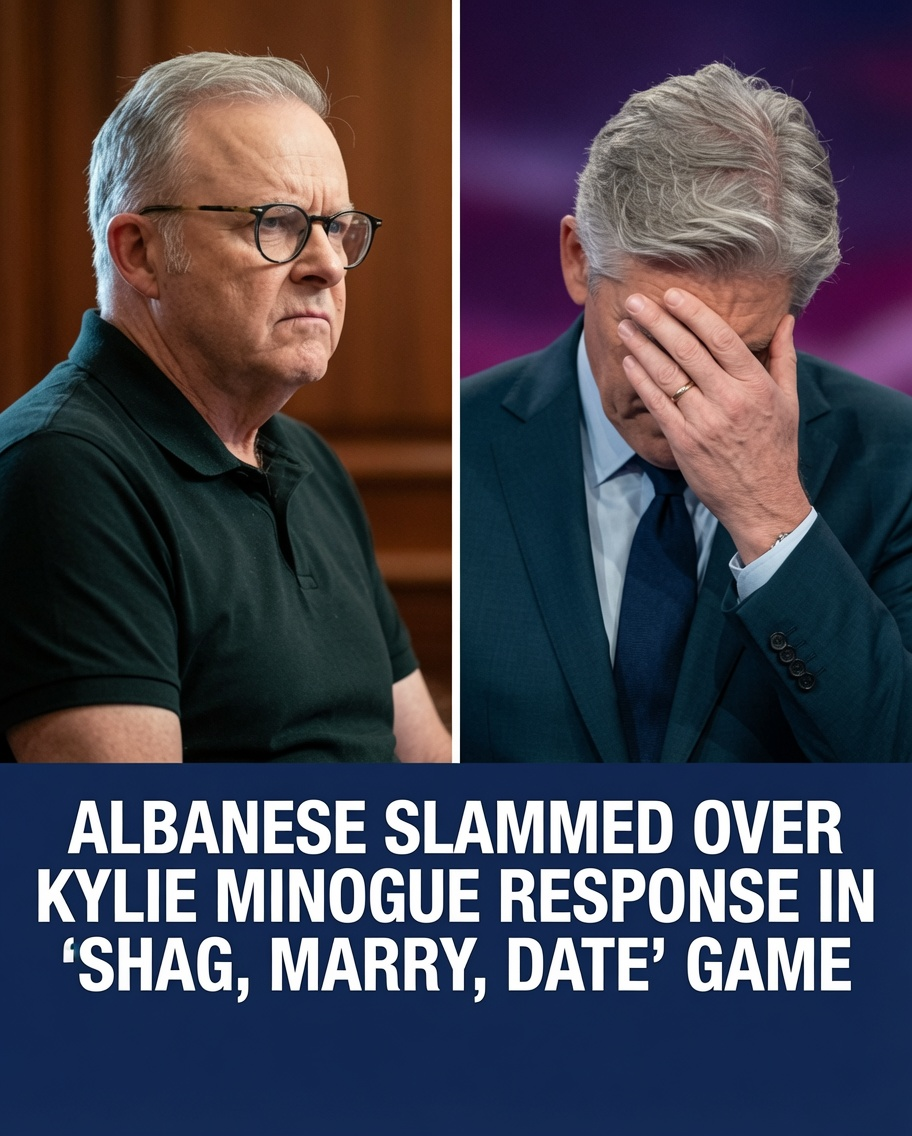
The controversy began after Albanese appeared on comedian Nikki Osborne’s Bush Deep podcast, where he took part in an informal conversation covering politics, sport, popular culture and his personal life.
During the interview, Osborne asked the Prime Minister to play the familiar “shag, marry, date” game involving three well-known Australian entertainers: Kylie Minogue, Nicole Kidman and Rhonda Burchmore.
Albanese initially hesitated, noting that he had “only just got married” and had been married for about six months.
However, after further prompting, he replied: “Kylie, clearly.”
When Osborne jokingly asked whether that meant he would “marry Kylie and shag her and date her”, Albanese responded: “All of the above.”
The exchange quickly spread across social media and news outlets, generating criticism from political opponents, commentators and some advocacy groups who argued the remarks were inconsistent with the dignity expected of a serving prime minister.
Among those expressing concern was 7NEWS Political Editor Mark Riley.
Speaking on Sunrise, Riley said politicians should engage with podcasts and newer media platforms but avoid doing so in ways that could diminish the authority of their office.
“They do podcasts to be like the cool kids. Well, Prime Minister, you’re not; you’re a 63-year-old national leader; you’ve got to act like one,” Riley said.
He suggested Albanese could simply have declined to answer the question rather than participating in the game.
Riley also argued that Australians were more concerned with everyday challenges such as housing costs, mortgages, employment and raising families than with seeing political leaders take part in social media-style entertainment.
The criticism reflects a broader debate about how politicians should communicate in the digital age.
In recent years, Australian political leaders from across the political spectrum have increasingly appeared on podcasts, YouTube channels and social media programs to reach younger audiences who consume less traditional news.
Supporters argue these appearances make politicians appear more authentic and accessible.
Critics contend that informal settings can encourage lapses in judgment that distract from policy discussion and undermine public confidence in political leadership.
The backlash intensified over the weekend, with women’s advocates and several opposition politicians describing the comments as inappropriate.
Some argued the remarks sat uneasily alongside the government’s stated commitment to promoting respect for women and gender equality.
Others defended the Prime Minister, noting the exchange occurred during a comedy podcast and should be viewed within that informal context rather than as a formal political statement.
Facing mounting criticism, Albanese issued a public statement on Monday apologising for his remarks.
“I apologise unequivocally for the comments,” the Prime Minister said.
The apology was reported by multiple Australian media organisations and confirmed by the Prime Minister’s office.
Deputy Prime Minister Richard Marles defended the government’s broader record, saying Labor had consistently promoted gender equality through its policies and the composition of its ministry.
Several senior ministers declined to expand on the controversy, instead emphasising the government’s focus on economic management and other policy priorities.
The incident has also prompted discussion about the opportunities and risks of podcast appearances for political leaders.
Podcast interviews typically allow politicians to speak at greater length and in a more relaxed environment than traditional press conferences or television interviews.
That format can help leaders reach audiences who rarely follow conventional political coverage.
At the same time, the conversational style often encourages humour, spontaneity and personal disclosure, increasing the likelihood that off-the-cuff remarks become headline news.
Political analysts have noted that modern campaigns increasingly depend on reaching voters through a wide range of media channels rather than relying solely on traditional interviews.
However, the Albanese controversy illustrates how quickly a single exchange can overshadow the broader purpose of an appearance.
The debate also unfolded during a period of heightened political competition.
Labor is seeking to maintain support amid rising competition from minor parties, including One Nation, while also attempting to engage younger Australians through non-traditional media platforms.
Observers say that strategy carries both potential benefits and political risks.
Informal appearances may broaden a leader’s appeal, but they can also expose them to criticism if comments are perceived as inconsistent with public expectations of the office they hold.
For Albanese, the controversy proved short-lived but highly visible.
While supporters described the exchange as an unsuccessful attempt at humour, critics argued it demonstrated poor judgment for a sitting prime minister.
The subsequent apology effectively closed the immediate political issue, but the episode has become another example of the challenges facing contemporary political leaders as they balance authenticity, accessibility and the expectations attached to high public office.
As podcasts and social media continue to reshape political communication, the incident is likely to remain a reference point in discussions about where the boundaries lie between relatable public engagement and preserving the authority of national leadership.






