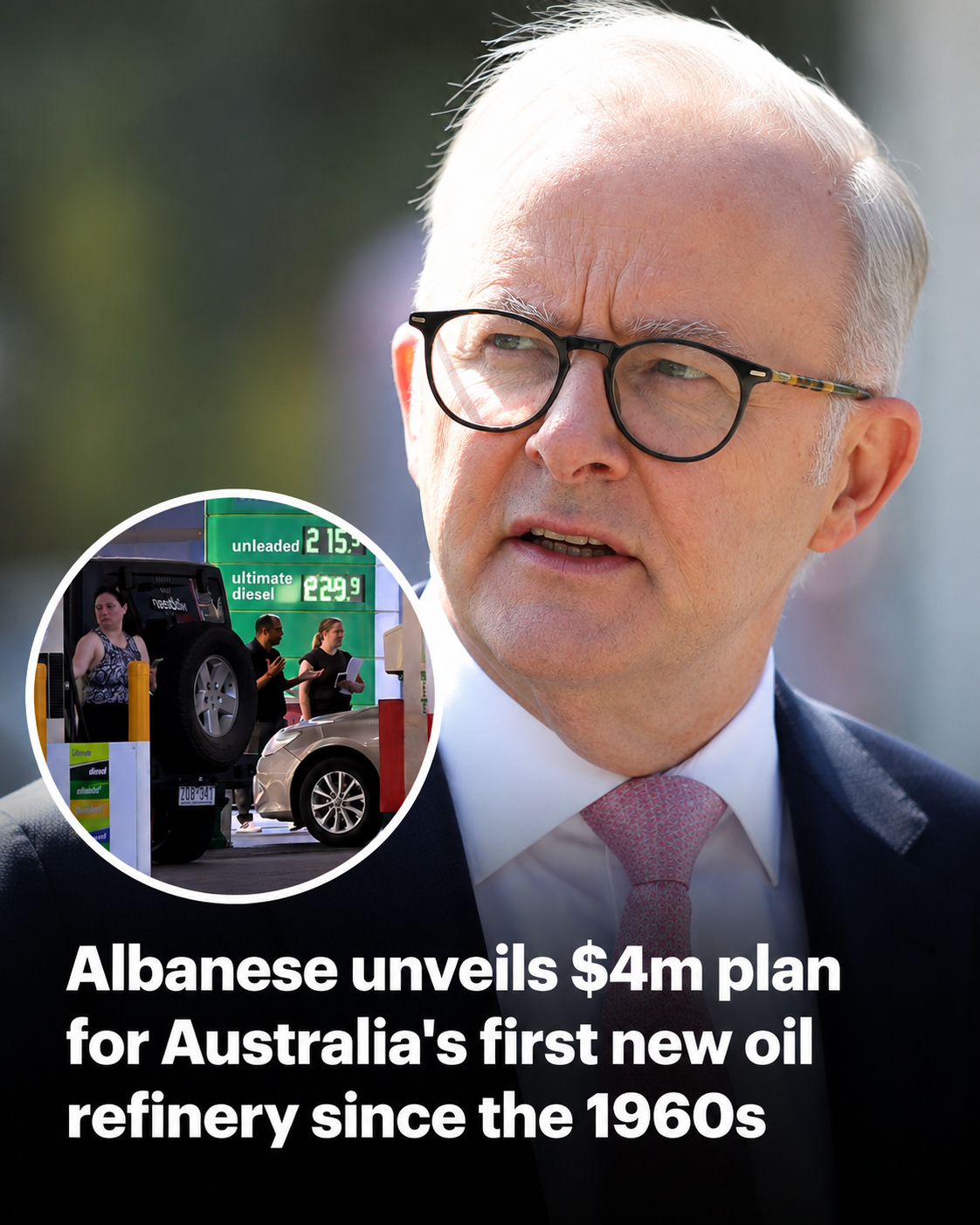
Prime Minister Anthony Albanese has announced a joint federal and Western Australian initiative to investigate building Australia’s first new large-scale oil refinery since the 1960s, describing the proposal as a major step towards strengthening the nation’s fuel security at a time of growing geopolitical uncertainty.
The Commonwealth and Western Australian governments will jointly contribute $4 million towards a pre-feasibility study examining the construction of a large-scale refinery proposed by Perth-based industrial company Perdaman. If the project ultimately proceeds, it would become only Australia’s third operating oil refinery, joining existing facilities in Geelong and Brisbane.
The announcement was made during a visit to Karratha by Mr Albanese and Western Australian Premier Roger Cook, who said the project could strengthen Australia’s sovereign fuel capability while creating thousands of construction and long-term operational jobs.
Although Karratha hosted the announcement, the refinery’s final location has not yet been determined. The pre-feasibility study will assess a number of potential sites across Western Australia, with locations including Geraldton, Bunbury, Perth and Collie among those expected to be examined before a final recommendation is made.
“Building an oil refinery here on the west coast would obviously build our resilience as a nation,” Mr Albanese said.
He argued that increasing Australia’s domestic refining capacity would reduce vulnerability to international disruptions while supporting manufacturing, regional employment and long-term industrial capability.
The proposal forms part of Labor’s broader strategy to strengthen Australia’s energy security following repeated global supply disruptions linked to geopolitical instability, including conflict in the Middle East and recent volatility in international oil markets.
Australia’s refining industry has contracted dramatically over the past two decades.
At the beginning of the century the country operated eight major oil refineries, but a series of closures driven by global competition and lower-cost Asian mega-refineries reduced that number to just two. BP’s Kwinana refinery south of Perth ceased refining operations in 2021 before being converted into an import terminal, leaving Western Australia without an operating refinery despite its importance to Australia’s mining and export economy.
The shrinking refining sector has significantly increased Australia’s reliance on imported fuel.
Today the country imports the overwhelming majority of its refined petroleum products, including petrol, diesel and aviation fuel, from refineries across Singapore, South Korea, Japan, Malaysia and Taiwan.
While Australia still produces some crude oil domestically, production has declined substantially over recent decades and no longer comes close to meeting national demand.
Resources Minister Madeleine King acknowledged that even if the proposed refinery is built, Australia would continue relying largely on imported crude oil because current domestic production remains insufficient.
She argued, however, that refining imported crude inside Australia would still provide a significant strategic advantage.
“The difference with crude oil is that it can be stored for much longer than refined fuel,” she said, explaining that larger strategic crude reserves could help Australia maintain fuel supplies during future international crises.
That distinction has become central to the government’s case for the project.
Unlike petrol and diesel, crude oil can remain in storage for extended periods before being processed. Supporters argue this would allow Australia to maintain larger emergency reserves while refining fuel domestically when international supply chains become disrupted.
The proposal has been driven partly by growing concern over Australia’s energy resilience.
The federal government’s latest fuel security assessments warn that geopolitical conflicts, shipping disruptions and tightening global inventories have increased the likelihood of future supply shocks. Earlier this year, a major fire at the Geelong refinery also highlighted Australia’s dependence on a very small number of domestic refining facilities.
Perdaman, the company behind the proposal, is already developing a multi-billion-dollar fertiliser manufacturing complex near Karratha.
The company argues a large-scale refinery would complement Western Australia’s expanding industrial base while supporting mining, agriculture, heavy transport and defence industries throughout northern Australia.
If approved following feasibility work, the refinery would represent one of the largest industrial developments ever undertaken in Western Australia.
Despite the government’s optimism, energy analysts caution that the refinery would not eliminate Australia’s exposure to global oil markets.
Because the facility would still depend primarily on imported crude oil, international conflicts capable of disrupting crude supplies would continue affecting Australia.
Analysts instead describe the project as improving resilience rather than achieving full energy independence.
Energy analyst Saul Kavonic said Australia also needs secure long-term crude supplies if additional refining capacity is to achieve its intended purpose.
He suggested potential future domestic oil production from offshore Western Australian basins could eventually help supply the refinery, although commercially viable discoveries have yet to be confirmed.
Financial considerations also remain significant.
While governments have committed only $4 million for the initial study, experts estimate constructing a modern refinery capable of materially increasing Australia’s refining capacity could cost around $15 billion.
Some analysts believe substantial government support or revenue guarantees may ultimately be required if the project proceeds because refining margins remain highly competitive internationally.
Environmental groups have questioned whether investing in new oil refining infrastructure aligns with Australia’s long-term climate objectives.
The Conservation Council of Western Australia argued the proposal remains heavily dependent on imported fossil fuels and suggested greater investment should instead be directed towards renewable energy technologies and electrification.
Government ministers reject suggestions that the refinery contradicts Australia’s emissions targets, arguing that improving fuel security and progressing the energy transition can occur simultaneously.
The political response has also reflected broader debates over Australia’s energy strategy.
Nationals leader Matt Canavan welcomed renewed attention to domestic refining but argued the proposal demonstrated shortcomings in Labor’s broader energy policy, claiming stronger support for Australia’s oil and gas sector was required. Other opposition figures indicated conditional support while seeking further details regarding the project’s commercial viability and long-term costs.
For Western Australia, the refinery proposal carries particular strategic importance.
The state is Australia’s largest producer of iron ore, liquefied natural gas and numerous critical minerals, while also hosting some of the country’s busiest export ports.
Government leaders argue that improving fuel security on the west coast would better support industries that underpin both the state and national economies.
WA Energy Minister Amber-Jade Sanderson said Western Australia’s geographic isolation made a third refinery particularly valuable because fuel currently travels thousands of kilometres from existing refining capacity on Australia’s east coast or arrives via international shipping routes.
The proposal also forms part of a broader federal fuel security strategy worth more than $10 billion, including strategic fuel reserves, support for domestic shipping capability and measures designed to strengthen Australia’s ability to withstand future international supply disruptions.
The newly announced study will examine technical requirements, commercial viability, environmental considerations, infrastructure needs and potential locations before governments decide whether to proceed with detailed planning.
No final investment decision has yet been made, and ministers emphasise that construction will depend on the study demonstrating both economic and strategic merit.
Even so, the announcement represents the most significant proposal to expand Australia’s oil refining capacity in more than sixty years.
If eventually approved and constructed, the refinery would not eliminate Australia’s dependence on imported oil. However, supporters argue it would substantially improve the nation’s ability to convert crude oil into usable fuel domestically during periods of international disruption, strengthening energy resilience while supporting thousands of jobs and expanding Australia’s industrial capability for decades to come.






