A Christian protester stood outside the Queensland Health Minister’s electorate office wearing a shirt carrying two words.
“Abolish Abortion.”
A police officer told him the message “could be considered offensive to members of the public”.
What happened next has triggered an uncomfortable argument about policing, protest and the increasingly blurred line between conduct that is unlawful and an opinion that simply makes somebody angry.
Footage released this week by Christian group Ambassadors for Christ shows police confronting protesters outside the Clayfield electorate office of Queensland Health and Ambulance Services Minister Tim Nicholls.
The demonstration itself took place on 29 May.
The video was not publicly shared by the group until this week.
One demonstrator, identified as Jarryn, held a large sign declaring: “We are ambassadors of Jesus Christ.”
Another wore the “Abolish Abortion” shirt.
The footage shows a female police officer discussing whether the group’s behaviour could amount to public nuisance.
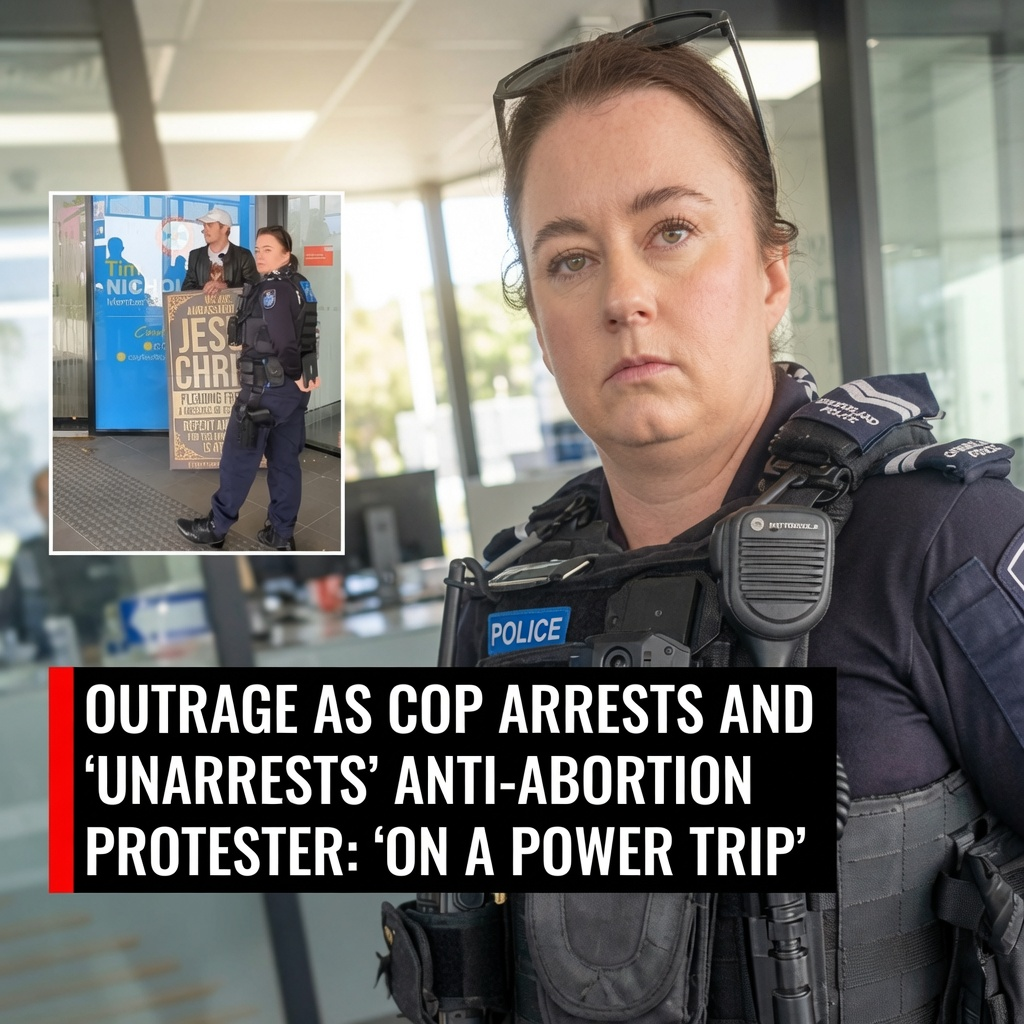
At one point, Jarryn is told he is under arrest.
He is searched.
Then the situation changes.
The officer subsequently tells him he is no longer under arrest.
Online critics have described the sequence as an arrest followed by an “unarrest”.
That is not the language Queensland legislation uses.
The Police Powers and Responsibilities Act expressly contains provisions dealing with discontinuing an arrest.
But the legal terminology does not make the footage any less striking.
A peaceful political protest outside a minister’s office escalated to an arrest.
Then the arrest ended.
And the remark that an anti-abortion T-shirt “could be considered offensive” has become the centre of a much larger debate.
The footage matters because the protesters do not appear to be outside an abortion clinic
Queensland has specific laws protecting access to termination services.
Safe access zones extend 150 metres around premises where terminations are provided.
Within those zones, certain conduct relating to abortion is prohibited where it could be seen or heard by people entering or leaving the premises and is reasonably likely to cause distress or anxiety.
The purpose is to protect patients and staff accessing reproductive health services.
That legal context is important whenever an anti-abortion protester is confronted by police.
But the Ambassadors for Christ footage was filmed outside Tim Nicholls’ electorate office in Clayfield.
Queensland Parliament lists the electorate office at Shop 1, 729 Sandgate Road.
The public material presently available does not establish that the protesters were demonstrating inside a statutory abortion safe access zone.
Instead, the police discussion captured in the footage centres on public nuisance.
That distinction is crucial.
Australians may strongly support laws preventing patients from being harassed or intimidated while entering a reproductive health clinic.
That does not automatically answer what police should do when a person wears an anti-abortion shirt outside the office of the minister politically responsible for the health portfolio.
A minister’s electorate office is an obvious location for political protest.
Politicians make decisions.
Citizens disagree with those decisions.
Citizens sometimes stand outside political offices holding signs that politicians and members of the public find offensive.
That is not a defect in democratic life.
It is part of democratic life.
Queensland’s public nuisance law is broader than many Australians may realise
Under Queensland’s Summary Offences Act, a person commits public nuisance if they behave in a disorderly, offensive, threatening or violent way and that behaviour interferes, or is likely to interfere, with the peaceful passage through or enjoyment of a public place by a member of the public.
The legislation also covers conduct that interferes, or is likely to interfere, with the peaceful enjoyment of a public place by a member of the public.
The offence can carry a maximum penalty of 10 penalty units or six months’ imprisonment in ordinary circumstances, with different maximum provisions applying around licensed premises.
The word attracting attention in the Clayfield footage is “offensive”.
It is an inherently difficult concept.
Political speech is frequently offensive.
“Abolish abortion” is offensive to many Australians who believe access to termination is a fundamental element of reproductive healthcare.
“Abortion is healthcare” is deeply offensive to many Christians who believe abortion ends a human life.
An anti-war protest can offend military families.
A pro-Israel rally can offend Palestinian activists.
A pro-Palestinian rally can deeply distress Jewish Australians.
A republican sign can offend monarchists.
A protest against Christianity can offend Christians.
If the legal test were simply whether a member of the public considered a political message offensive, the practical space for protest would become extraordinarily narrow.
That is why context, conduct and the actual statutory elements matter.
The question is not merely whether somebody dislikes the words on a shirt.
The question is whether the behaviour meets the legal test for an offence.
That is the unresolved issue sitting at the centre of this footage.
The officer repeatedly focused on offence and public complaints
According to the footage and the account published with it, police had attended after concerns were raised about the protesters.
The officer discusses members of the public potentially being offended by the anti-abortion message.
The protesters respond by insisting they are peaceful.
They identify themselves as Christians.
They argue that they are expressing their beliefs.
At points, the conversation becomes circular.
The officer speaks about public nuisance.
The protesters ask what they have done.
The message on the shirt is discussed.
The group challenges whether offence is sufficient.
Then Jarryn is arrested.
The sequence is precisely the kind of interaction that now explodes across social media because the camera allows viewers to examine every word.
Supporters of the protesters see a police officer attempting to invent an offence because she dislikes Christian anti-abortion speech.
Critics of the group may see activists deliberately testing police boundaries while filming the confrontation for online content.
Both interpretations are politically convenient.
The law requires something more disciplined.
Was there disorderly conduct?
Was there offensive conduct within the meaning of the public nuisance provision?
Was the conduct interfering, or likely to interfere, with public use or enjoyment of the place?
What information had police received before arriving?
What did officers personally observe?
Why was the arrest initiated?
Why was it discontinued?
Those questions deserve an official explanation.
At the time of publication, no detailed public Queensland Police statement located by this publication had answered them.
Being arrested and then released does not automatically prove police acted unlawfully
The word “unarrested” is perfect social media language.
It sounds ridiculous.
It implies a police officer suddenly realised she had made a spectacular mistake and attempted to reverse time.
Queensland law is less theatrical.
The Police Powers and Responsibilities Act contains a part specifically titled “Discontinuing arrest”.
The legislation recognises circumstances in which an arrest may be discontinued.
That is important because police decisions are sometimes made in rapidly changing situations.
New information can emerge.
An officer’s assessment can change.
The factual basis for continuing detention may disappear.
A legal system should not require police to keep somebody under arrest merely because the words “you are under arrest” have already been spoken.
Ending an arrest can be the correct decision.
But that does not eliminate scrutiny of the initial decision.
If a person’s liberty is restricted, even briefly, the public is entitled to ask what offence the officer reasonably suspected had occurred.
The footage becomes particularly controversial because viewers hear the discussion about offence immediately before the escalation.
That creates an obvious impression.
The protest message was considered offensive.
The officer invoked public nuisance.
A protester was arrested.
The arrest was then discontinued.
Perhaps additional police context would materially change that picture.
If so, Queensland Police should provide it.
Without that explanation, the video is being interpreted through the words the public can hear for themselves.
Police should not be asked to decide which political opinions are acceptable
This is where the incident becomes bigger than abortion.
Australians can believe the Ambassadors for Christ protesters are completely wrong.
They can believe the “Abolish Abortion” message is cruel, simplistic or offensive.
They can support Queensland’s decriminalisation of abortion and the state’s safe access zone laws.
None of those beliefs require police to become referees of acceptable political opinion.
In fact, people who strongly disagree with the protesters should be among the most careful about that principle.
Police powers do not belong permanently to one political side.
A power used against a Christian anti-abortion protest today can be used against an environmental protest tomorrow.
A broad interpretation of “offensive” speech can affect pro-Palestinian activists.
It can affect women’s rights campaigners.
It can affect Indigenous protesters.
It can affect gay rights activists.
It can affect immigration protesters.
Every political movement eventually says something that somebody considers offensive.
Queensland has recent experience with precisely this tension.
Earlier this year, police enforcement of the state’s new laws targeting certain prohibited public expressions triggered civil liberties concerns after protesters were arrested over pro-Palestinian slogans.
Queensland Police defended its enforcement role, while critics accused officers of overreach.
The political identities are completely different.
The principle is not.
When governments expand speech-related offences or police rely on broadly worded public order provisions, officers on the street are placed in extraordinarily difficult positions.
They have to decide whether words have crossed a legal line.
They may be surrounded by angry people.
They may be filmed from multiple angles.
They may have incomplete information.
And their decision can become national content within hours.
The answer is not to pretend police have an easy job.
The answer is to insist that legal boundaries are clear enough that political offence alone does not become a substitute for unlawful conduct.
The location makes the protest politically relevant
Tim Nicholls is not a random member of the public whose home was targeted by activists.
He is Queensland’s Minister for Health and Ambulance Services.
He is also the state member for Clayfield.
The protest occurred outside his electorate office.
Abortion is a health policy issue.
The protesters oppose Queensland’s abortion laws and want political change.
Whatever one thinks of their position, there is an obvious connection between their political grievance and the office they selected.
This matters because protest rights do not mean activists can go anywhere and do anything.
There are laws against trespass.
There are laws against threats.
There are laws dealing with obstruction and public nuisance.
There are specific protections around abortion service premises.
But political offices have always attracted demonstrations because they are physical points of contact between elected representatives and the public.
A sign outside a minister’s office is different from following a patient into a clinic.
A slogan directed at a politician is different from intimidating a woman seeking medical care.
Those distinctions should remain clear.
If the Ambassadors for Christ protesters obstructed access, threatened people or engaged in conduct meeting the public nuisance test, police should explain the evidence.
If the issue was principally the political message on a T-shirt, Australians should be concerned.
The abortion debate is difficult precisely because both sides believe the stakes are enormous
Abortion is not a subject on which Australia is going to achieve emotional neutrality.
Supporters of abortion access see the issue through bodily autonomy, healthcare and the right of women to make decisions about pregnancy.
Anti-abortion Christians see an unborn child as a human life deserving protection.
Those are fundamentally conflicting moral positions.
One side hears “abolish abortion” and sees an attack on women’s freedom.
The other hears “abortion is healthcare” and believes society is normalising the destruction of innocent life.
There is no clever public relations phrase that dissolves the disagreement.
Democracy has to contain it.
That means parliaments make laws.
Courts interpret laws.
Citizens vote.
Campaigners argue.
Protesters carry signs.
Other citizens tell them they are wrong.
The purpose of public order law should be to prevent harmful conduct, not to manufacture consensus on the underlying moral question.
Queensland has already made a legislative decision on abortion.
Termination of pregnancy was decriminalised in 2018.
The law provides access to abortion within the state’s healthcare framework.
Safe access zones protect people attending premises where termination services are provided.
Anti-abortion activists remain free to campaign for those laws to be changed, subject to the ordinary limits of criminal and public order law.
That last part is essential.
Losing a political argument in Parliament does not make advocacy for the losing position illegal.
The officer has become the target of an online pile-on — and that carries its own risk
The footage has produced furious criticism of the female officer involved.
She has been described as “power-tripping”.
Commenters have accused her of ignorance of the law and political bias.
Some have demanded disciplinary consequences.
The frustration is understandable when viewers believe they are watching an arrest without a proper basis.
But there is another standard worth preserving.
One video should be examined carefully before an individual police officer is turned into a national hate figure.
The public does not presently have every piece of operational information available to police.
It is not clear from the reporting whether officers received additional allegations before arriving.
It is not clear what was communicated over police radio during the interaction.
It is not clear whether another officer or supervisor influenced the decision to discontinue the arrest.
Those details matter.
Police accountability should be rigorous.
It should also be factual.
The strongest criticism of the footage does not require personal abuse of the officer.
It requires Queensland Police to explain the legal reasoning.
What was the suspected offence?
Which conduct created that suspicion?
Why was Jarryn arrested?
Why was the arrest discontinued?
Was the wording on the anti-abortion shirt itself considered relevant to the public nuisance assessment?
Those are answerable questions.
The protesters were filming — because modern protest is also media production
Ambassadors for Christ did not merely attend Tim Nicholls’ office.
They recorded the interaction.
Then they published it.
That is how modern activism works.
The protest happens in two places.
First, on the footpath.
Then, on the internet.
A small demonstration involving a handful of people can reach an audience far larger than the number of pedestrians who ever saw the original signs.
Police know they are being filmed.
Protesters know a confrontation may generate attention.
Political publishers know an arrest clip will travel further than a quiet discussion.
This creates incentives on every side.
Activists may test boundaries.
Police may become frustrated by people who appear more interested in filming an encounter than resolving it.
Online audiences receive an edited piece of content and rapidly choose heroes and villains.
None of that makes the footage irrelevant.
Quite the opposite.
The camera creates a record that previous generations of protesters rarely possessed.
If an officer says a T-shirt “could be considered offensive”, viewers can hear the remark.
If a protester remains calm, viewers can see it.
If a protester becomes aggressive, the camera can show that too.
The existence of activist motives does not erase police conduct.
The existence of police pressure does not automatically make activists innocent of every possible offence.
The evidence should be assessed on what it shows.
Queensland needs to explain where the line actually is
The easiest response to this controversy is tribal.
If you oppose abortion, the police officer is a tyrant.
If you support abortion rights, the protesters are extremists looking for attention.
That argument will dominate social media.
It should not be enough for Queensland’s institutions.
The state has public nuisance laws.
It has police powers.
It has specific abortion safe access zone legislation.
It has a democratic tradition of political protest.
Those systems need boundaries ordinary people can understand.
Can a person stand outside a minister’s electorate office wearing a shirt saying “Abolish Abortion”?
Can police consider the offensiveness of that message when assessing public nuisance?
What additional behaviour turns a political demonstration into an offence?
When an arrest is discontinued shortly after it begins, what accountability or review follows?
The footage from Clayfield has made those questions public.
Queensland Police may have context that has not yet been released.
If it does, it should provide it.
Because based on the material Australians can currently see, the sequence is deeply uncomfortable.
A political message was described as potentially offensive.
A public nuisance offence was discussed.
A Christian protester was placed under arrest.
Then the arrest was discontinued.
People do not have to support Ambassadors for Christ.
They do not have to support banning abortion.
They do not have to like the shirt.
That is precisely the point.
The real test of political speech is rarely whether society protects words everybody finds pleasant.
The test comes when the words are unpopular, provocative and offensive to somebody standing nearby.
If the protesters in Clayfield broke the law, Queensland Police should clearly explain what they did.
If they did not, the fact that somebody disliked their message cannot be allowed to fill the gap.
“Abolish Abortion” is a political demand.
Australians can reject it.
They can argue against it.
They can vote against politicians who support it.
But before police put somebody under arrest outside a minister’s office, the standard has to be more serious than this:
Somebody might be offended.






